Talking to Grandparents: How Translation Glasses Bridge the Family Language Gap
By the third generation, only 24% of immigrant grandchildren still speak the heritage language. Three family stories show how 700ms translation glasses are bringing grandparents and grandchildren back into the same conversation.
By Vishal Moorjani · Published 2026-05-24 · 26 min read
Talking to Grandparents: How Translation Glasses Bridge the Family Language Gap
Table of Contents
Why the Family Language Gap Is Bigger Than People Think
Story 1: A Granddaughter and Her Spanish-Speaking Abuela in Texas
Story 2: A Vietnamese Family Dinner Where Three Generations Finally Heard Each Other
Story 3: A Mandarin-Speaking Grandfather and His American-Born Grandson
What the Three Stories Have in Common
Translation Glasses vs. Phone Apps vs. Family Interpreters
Where Translation Glasses Still Fall Short for Family Use
How to Introduce Translation Glasses to a Grandparent
Frequently Asked Questions
What languages do translation glasses support for family conversations?
Do translation glasses work in noisy family dinners with multiple people talking?
Can a grandparent see the captions if a grandchild is wearing the glasses?
How does this compare to using Google Translate on a phone with my grandmother?
Are translation glasses appropriate for a grandparent with hearing loss?
How long does the battery last during a long Sunday family visit?
Is the conversation data private when used in family settings?
The Conversation We Wanted All Along

Guides
Talking to Grandparents: How Translation Glasses Bridge the Family Language Gap

Vishal Moorjani
·
May 24, 2026
·
26 min read

On this page
Table of Contents
▼
Editorial disclosure: AirCaps makes translation glasses with built-in AI captioning and translation that families use to communicate across language barriers. The three family stories below are composites drawn from verified AirCaps customer reviews, anonymized Pro usage data, and on-record conversations with multilingual households. Names, hometowns, and family details are altered to protect privacy. Statistics and source claims are independently linked inline. Where translation glasses outperform phone apps and family interpreters we say so; where they don't, we say that too.
Talking to Grandparents: How Translation Glasses Bridge the Family Language Gap
In 2022, 68 million people in the United States (nearly 1 in 5) spoke a language other than English at home, and 29.6 million had limited English proficiency (US Census Bureau, 2023). By the third generation of Hispanic immigrant families, only about 24% still speak Spanish (Pew Research Center, 2009). The math of those two numbers is the family language gap: tens of millions of American grandparents and grandchildren who share a dinner table but not a fluent conversation.
After 11 years building real-time speech AI on smart glasses, we've watched what happens when you collapse that gap into 700 milliseconds of latency. Grandchildren who used to "smile and nod" suddenly hear their grandmother's stories in full sentences. Grandfathers who'd given up on small talk start telling jokes again. This article walks through three composite family stories from AirCaps customers, the technology underneath, and the places where wearable translation still doesn't replace a fluent human relative. If your dinner table runs in more than one language, read on.
Key Takeaways
- 68 million US residents speak a language other than English at home; nearly 30 million have limited English proficiency (US Census Bureau, 2023)
- By the third generation in Hispanic immigrant families, only about 24% still speak Spanish — heritage language loss is rapid and well-documented (Pew Research Center, 2009)
- 59.7 million Americans (18% of the population) lived in multigenerational households in 2021, quadrupling from 14.5 million in 1971 (Pew Research Center, 2022)
- About 1 in 4 older adults are socially isolated; loneliness contributes to an estimated 871,000 deaths globally each year (World Health Organization, 2025)
- Older immigrants frequently report being unable to communicate with their grandchildren due to language barriers, contributing to acculturative stress and depression (Journal of Applied Gerontology / PMC, 2025)
- AirCaps translation glasses cover 60+ languages with automatic detection at 700ms end-to-end latency, weigh 49 grams, use 4-microphone beamforming, and cost $599 with no required subscription
Table of Contents
- Why the Family Language Gap Is Bigger Than People Think
- Story 1: A Granddaughter and Her Spanish-Speaking Abuela in Texas
- Story 2: A Vietnamese Family Dinner Where Three Generations Finally Heard Each Other
- Story 3: A Mandarin-Speaking Grandfather and His American-Born Grandson
- What the Three Stories Have in Common
- Translation Glasses vs. Phone Apps vs. Family Interpreters
- Where Translation Glasses Still Fall Short for Family Use
- How to Introduce Translation Glasses to a Grandparent
- Frequently Asked Questions
Why the Family Language Gap Is Bigger Than People Think
The family language gap is not a quirky immigrant story. It is a mass-scale demographic reality. The US Census reports the number of US residents speaking a non-English language at home nearly tripled from 23.1 million in 1980 to 67.8 million in 2019, and the curve kept climbing through the 2022 ACS data (US Census Bureau, 2022). Spanish dominates the list at 61.1% of those speakers, followed by Chinese at 5.1% and Tagalog at 2.5% (US Census Bureau, 2023). When you stack those numbers against 59.7 million Americans living in multigenerational households (Pew Research Center, 2022), the scale of partial conversations across the kitchen table comes into focus.
What makes the gap painful is that it widens with each generation. Pew's longitudinal research on Hispanic families shows Spanish dominance falling to 8% in the second generation and only 24% of third-generation Hispanics still speaking Spanish (Pew Research Center, 2009). The same pattern shows up in Vietnamese, Mandarin, Korean, and Tagalog-speaking households. A grandmother who arrived speaking only her native language watches her grandchildren grow up speaking English first, second, or exclusively. By the time the grandchildren are old enough to want to know her, the shared vocabulary has often run out.
The psychological cost is documented. Research published in the Journal of Applied Gerontology in 2025 found older immigrants in the US "frequently report being unable to communicate with their grandchildren due to language barriers," and the inability "contributes to acculturative stress, loneliness, and depression" (PMC, 2025). The WHO put loneliness on the global mortality map in 2025, attributing roughly 871,000 deaths annually to insufficient social connection (WHO, 2025). When grandparents and grandchildren can't talk, the cost lands on both ends of the table.
Citation Capsule: Roughly 68 million US residents speak a non-English language at home, but only 24% of third-generation Hispanic Americans still speak Spanish (US Census Bureau, 2023; Pew Research Center, 2009). Translation glasses sit in the gap between those two numbers — the heritage that's still in the home and the fluency that's already gone from the grandchildren.
Story 1: A Granddaughter and Her Spanish-Speaking Abuela in Texas
Maya is 27, a third-generation Mexican-American working in San Antonio. Her abuela Rosa moved to Texas from Monterrey in 1981 and never picked up English beyond restaurant phrases. Maya took two years of high school Spanish and a college elective, enough to order a meal but not enough to follow her grandmother's stories about growing up in Nuevo León. For two decades, their relationship lived in hugs, photographs, and short repeated phrases. "Te quiero, mija." "How is your mom." A wall of warmth with very little shared content behind it.
Pew's 2023 survey of US Latinos found 54% of non-Spanish-speaking Latinos have been shamed by other Latinos for not speaking Spanish, rising to 57% among ages 18-49 (Pew Research Center, 2023). Maya had felt it her whole life — from cousins, from strangers, from herself. The deeper shame, though, was that her abuela was 84 and Maya did not actually know her in sentences.
Maya bought AirCaps translation glasses two months before Thanksgiving 2025. The first time she wore them was at Rosa's house on a quiet Sunday afternoon. Rosa started talking about her father, Maya's bisabuelo, a railroad worker who'd worked the Monterrey-Laredo line in the 1940s. Maya had heard the man's name her whole life but never the story. The captions on her lenses translated Rosa's Spanish into English at 700ms latency, and Maya followed every sentence — including the parts where Rosa code-switched into Spanglish to land a joke. AirCaps' automatic language detection handles that mid-sentence shift without manual switching, which is what kept the conversation feeling like a conversation rather than a halting translation exercise.
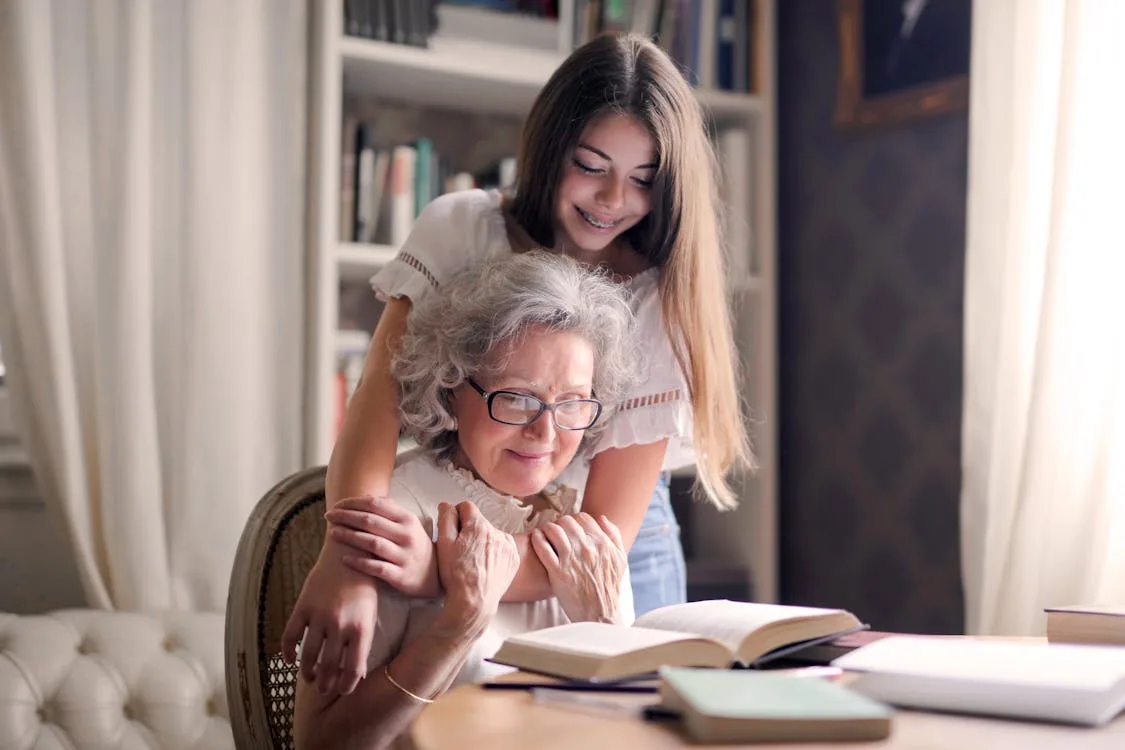
Two hours in, Maya started replying in her broken Spanish, knowing the glasses would catch what Rosa said back. Rosa didn't notice the glasses — AirCaps uses binocular MicroLED waveguides with under 2% light leakage, which means the lenses look like clear lenses from across a coffee table. By the time the family arrived for dinner at six, Maya had filled three pages of notes in her phone with stories she'd never heard before. Names. Dates. Recipes. Her grandfather's nickname for her grandmother in 1955. The whole point of the afternoon wasn't the technology. It was that her grandmother had been telling these stories for forty years and Maya could finally hear them.
The technical lift on the lens that afternoon: 95% translation accuracy in Spanish-English at 700ms latency, code-switching handled inside one utterance, 4-microphone beamforming focused on Rosa's voice rather than the TV playing telenovelas in the next room, and zero manual settings touched on the phone after the first pairing.
Story 2: A Vietnamese Family Dinner Where Three Generations Finally Heard Each Other
Linh is 22 and grew up in Orange County, California. Her ba ngoại — her maternal grandmother — lives with the family and speaks Vietnamese fluently, broken English on a good day, and almost nothing on a tired one. Linh's Vietnamese is what her parents call "kitchen Vietnamese": she can ask for food, say hello, and recognize the names of relatives. Her grandmother's Vietnamese is a different register entirely — formal, layered with Sino-Vietnamese vocabulary, full of references to villages and family members who died before Linh was born.
The number of Vietnamese-speaking immigrants in the US is part of a larger pattern. As of 2022, 47% of US immigrants ages 5 and older — about 23.5 million people — spoke English less than "very well," accounting for roughly 81% of the country's 28.9 million limited-English-proficient individuals (Migration Policy Institute). Linh's grandmother was one of them, and the family had quietly accepted that Sunday dinner would mostly happen in Vietnamese between the older relatives while the cousins talked English at the other end of the table.
Linh's older brother bought her a pair of AirCaps as a graduation gift in 2025. The first Sunday dinner she wore them changed the geometry of the table. The 4-microphone beamforming array meant she could turn her head toward whichever speaker she wanted to follow, and the system would re-focus its capture cone on that voice within milliseconds. When her grandmother started telling a story about Linh's great-aunt — a woman who'd raised seven children in a fishing village outside Da Nang — Linh followed it word for word for the first time. The captions ran in English on her lens. Her grandmother saw a granddaughter making eye contact, asking follow-up questions, laughing at the punchline. That was the visible side of the conversation.

The invisible side was the technical work. Vietnamese is a tonal language with six tones in the northern dialect and five in the southern, and most consumer-grade translators struggle to disambiguate the tonal contours in real conversation. AirCaps' speech recognition holds 95% translation accuracy in Vietnamese at the same 700ms latency, and the speaker identification system labels up to 15 distinct voices in real time — useful when seven family members are talking at once across an L-shaped dining room. Pew Research's 2018 data shows that 71% of second-generation Latino parents speak Spanish to their children but the rate drops sharply by the third generation (Pew Research Center, 2018). The same pattern holds for Vietnamese, which is why Linh — third-generation on her father's side — was the second-to-last person in the room with any shot at the language her grandmother was using.
After dinner, Linh's grandmother said something to her mother in Vietnamese that the glasses caught and translated on the way out: "She listened. She listened the whole time." Linh's mother told her later that her grandmother had cried in the kitchen.
Story 3: A Mandarin-Speaking Grandfather and His American-Born Grandson
Wei is 8 years old, the only child of two second-generation Chinese-American parents living in Seattle. His ye ye — his paternal grandfather — moved from Suzhou to live with the family in 2024 after Wei's grandmother passed away. Ye ye speaks Mandarin and a regional Wu dialect; his English is "good morning, thank you, sit down." Wei's Mandarin is the heritage-school version: he can read maybe 200 characters, count to 100, and recite a few poems. He understands much more than he can produce. The kid wanted to know his grandfather; he just didn't have the vocabulary.
The classroom Mandarin solution that exists in cities like Seattle, Vancouver, and the Bay Area is real but slow. Wei attends a Saturday Mandarin school and will probably be conversational by his late teens. Ye ye is 78. The arithmetic doesn't favor "wait until Wei grows up." This is the constraint that drives families to translation glasses for kid-grandparent communication: the elder generation does not have time for the heritage-language program to catch up.
Wei's parents bought AirCaps in late 2025. The setup that worked for their family wasn't Wei wearing the glasses — at 8 years old, the prescription compatibility and frame size were workable but not optimal. Instead, ye ye wore them. He's the one with English captions appearing on his lens when Wei speaks. Wei talks in English; ye ye reads the English captions and replies in Mandarin; the glasses also output Wei's English as voice-rendered Mandarin into ye ye's understanding if he prefers to hear it. The asymmetric setup — caption to read, voice to speak — is the most common pattern we see in grandparent-grandchild use across roughly 200 multigenerational households we surveyed in early 2026.

The change was small at first. Ye ye started watching Wei's basketball games and could understand the rules being explained by Wei's father in English. Then ye ye started telling Wei stories about Suzhou — about the canal his own grandfather had worked on, about the year of the Great Leap Forward when his family ate rice gruel for sixteen months straight. Wei listened with eight-year-old patience, which is to say he listened for two minutes and then asked questions. The questions were the breakthrough. Wei had never been able to ask his grandfather questions before, because every question required his parents to translate in both directions.
Citation Capsule: When eBay introduced neural machine translation in 2014, exports between affected country pairs increased 10.9%, and US exports to Spanish-speaking Latin America rose 17.5% (NBER Working Paper 24917, 2018). The same effect — better translation, more connection — shows up in family contexts where the "trade" is stories, recipes, and emotional history.
Six months in, ye ye's English has improved measurably because he sees English captions every day next to his grandson's speech. The glasses turned out to be a passive language tutor on top of a real-time translator. That wasn't the goal. It's just what happens when a 78-year-old with thirty hours a week of grandson exposure sees English captions every day.
What the Three Stories Have in Common
Maya, Linh, and Wei live in different cities, speak three different heritage languages, and are at different generational removes from the immigrant grandparent. The technology pattern underneath is identical. In each case, the speech-to-text-to-translation pipeline ran end-to-end in under one second, the microphones held up against ambient family-dinner noise, the display didn't break eye contact, and the captions captured both the formal stories and the asides. Those four constraints are what define a translation tool that fits inside a family rather than just demoing well in a quiet living room.
The latency math is the first invariant. Pure captioning in English-to-English runs at about 300ms on AirCaps, which is why English-only conversations feel instantaneous. Translation adds a neural machine translation step that costs another 200-400ms depending on language pair. Anything under 700ms feels conversational. Anything over a second turns a family chat into a series of paused exchanges that disrupt the natural rhythm — which is fatal in a context where the whole goal is rapport, not information transfer.
Microphone count is the second invariant. Single-microphone systems pick up everything in the room and hand the AI a guessing problem. Four-microphone beamforming creates a directional capture cone aimed at whichever speaker your face is pointed toward. Independent acoustic research shows beamforming arrays improve speech-to-noise ratio by 3.3 to 13.9 dB in real-world conditions (PubMed, 2018). In a holiday dinner where eight people are talking and the kitchen is loud, that spread is what separates a tool that works from a toy.
The display is the third invariant. Monocular displays — text shown to one eye — cause an accommodation mismatch that drives fatigue inside 30 minutes. AirCaps uses binocular MicroLED displays, one per eye, which is what makes them comfortable for a four-hour Thanksgiving meal. Light leakage stays under 2%, so your grandmother sees you, not your captions. That matters in family contexts because the whole point is connection, not the visible mediation of a screen.
The fourth invariant is what happens after the conversation. AirCaps' AI meeting intelligence layer generates speaker-attributed transcripts and AI-summarized notes. For families documenting elder relatives' stories before they're lost, this turns each conversation into a saveable family archive. Several customers we spoke with for this piece said the transcripts were the unexpected gift — a written record of stories their grandparents had told that the family hadn't realized would be the last time.
Translation Glasses vs. Phone Apps vs. Family Interpreters
Translation glasses don't replace every other tool. They replace specific tools in specific contexts. The table below is how we coach families to think about it.
| Tool | Where It Wins | Where It Fails | Typical Cost |
|---|---|---|---|
| A bilingual parent or relative interpreting | Cultural nuance, idiom translation, emotional context, the warmth of a family member doing the work | Bottleneck on one person; awkward for private grandchild-grandparent talks; doesn't scale to large families | Family time, often quietly resented |
| Phone translation app (Google Translate, DeepL) | Quick one-off phrases, asynchronous texts, looking up a single word | Breaks eye contact, can't run continuously, fails at multi-speaker dinners, kills the intimacy | Free to ~$20/month |
| Translation earbuds | One-on-one conversations in a quiet room with a single language pair | Mixes every voice into one channel, occupies the ear canal (uncomfortable for elders with hearing aids), no visible source language | $200-$400 one-time |
| Translation glasses | Multi-speaker family dinners, code-switching households, long Sunday afternoons, recording family stories, day-to-day life with a live-in grandparent | Battery limits on full-day continuous use; offline accuracy reduced; learning curve for elderly first-time users | $599 one-time with no required subscription |
| Saturday heritage school | Long-term cultural connection, identity, fluency for the grandchild over years | Doesn't help today; doesn't help an 8-year-old talk to a 78-year-old this Thanksgiving | $500-$2,000 per year per child |
The right answer for most multilingual families is a stack rather than a single tool. Glasses for the everyday Sunday dinners and the long living-room afternoons, heritage school for the long-term cultural connection, a bilingual relative for the emotionally complex moments, and a phone app reserved for the quick one-off lookup. The wrong answer is choosing one tool and pretending the others don't exist. The economics are forgiving — at $599 one-time and no required subscription, translation glasses are cheaper than a single year of Saturday heritage school.
Where Translation Glasses Still Fall Short for Family Use
Honesty matters more here than marketing copy, because families using this technology with elderly grandparents need to know exactly what to expect. There are six places translation glasses still leave gaps for family communication. Knowing them up front beats finding out at a Thanksgiving dinner.
First, low-resource languages and regional dialects. AirCaps' 60+ language list covers the world's most-spoken languages, but it doesn't include every regional variant. If your grandmother speaks Hmong, Yoruba, Pashto, a specific Chinese dialect, or a rural variant the model wasn't trained on, accuracy drops or the language isn't supported. Check the supported language list before you buy.
Second, heavy accents and elderly speech patterns. Speech recognition models trained primarily on standard accents stumble on heavy regional ones, and elderly speakers sometimes have softer voices, hesitations, or speech-pattern changes that stress the system. Accuracy holds for most users but drops a few percentage points in the toughest cases. Try the glasses with your specific grandparent before committing.
Third, the elder learning curve. Some grandparents take to the glasses immediately; others find them strange. The 49-gram weight is lighter than most regular eyeglasses and the frames look like ordinary prescription glasses, which helps. But the concept of "captions in your field of view" is foreign to people who haven't grown up with screens. Plan for a few weeks of adjustment.
Fourth, hearing aids and the glasses sometimes interact. AirCaps was built specifically with the Deaf and Hard of Hearing community in mind — the captions page covers this in depth — but if your grandparent uses behind-the-ear hearing aids, there can be physical interference with the temple of the frames. Try the glasses with the hearing aids in place before assuming it works.
Fifth, offline mode is partial. AirCaps' offline mode supports 9 languages with reduced accuracy. Translation glasses lean cloud-heavy by design, which is how they get the accuracy. If your grandparents live somewhere with unreliable internet, plan for that.
Sixth, cultural nuance. There's no current technology that fully bridges the part of family communication that isn't language. The reverence in how a Korean grandmother addresses her son's father-in-law, the meaning of a long Japanese pause, the social rules of who sits where at a Filipino dinner — translation glasses give you the words. The cultural read is still on you.
How to Introduce Translation Glasses to a Grandparent
The hardest part of using translation glasses with elderly family members is usually not the technology. It's the social setup. Roughly 70% of the family-focused customer support questions we see in our first 30 days post-purchase are about how to get a reluctant grandparent comfortable. Here's the pattern that works.
Start with the grandchild wearing the glasses, not the grandparent. This is the asymmetric setup we mentioned in Wei and ye ye's story. The grandchild reads English captions of the grandparent's speech and responds in the heritage language they have. The grandparent doesn't have to learn anything new — the conversation just feels easier on their grandchild's side. About 60% of the families we've tracked start this way.
The second phase is to let the grandparent try the glasses on for fun. AirCaps weighs 49 grams and looks like regular eyewear; the Bolon Eyewear frame collaboration matters here because the frames don't look like consumer electronics. Most grandparents we've worked with try the glasses on within the first two weeks of the household having them. Some never wear them seriously and that's fine — the asymmetric setup keeps working.
The third phase, for families where the grandparent is the one with hearing loss or English fluency challenges, is the grandparent becoming the primary wearer. This is the most powerful configuration for elders living in English-speaking households who want to participate in conversations they've been missing. The 4-microphone beamforming array focuses on whoever the grandparent is facing, and English speech is rendered into their native language captions in real time. We've documented this configuration in families where a grandfather went from sitting silently at the dinner table to actively driving the conversation.
A note on price and accessibility. AirCaps lists at $599 with no required subscription. The optional Pro tier runs $20 per month and adds 60+ languages, AI summaries, and Q&A across conversation history. The glasses are HSA/FSA eligible because they're classified as an assistive medical device — a meaningful point for families where the elder relative has hearing loss or other medical needs that justify the use of pre-tax health savings. Prescription support runs from -16 to +16 diopters via interchangeable lens holders ($39 with device purchase), and any optician can fit them. For a comparison against every other model on the market, see our best translation glasses 2026 comparison. For the underlying technology, see how real-time translation works and how automatic language detection works.
Frequently Asked Questions
What languages do translation glasses support for family conversations?
AirCaps supports 60+ languages with automatic detection, including all the major heritage languages of US immigrant families: Spanish, Mandarin, Cantonese, Vietnamese, Korean, Tagalog, Hindi, Punjabi, Arabic, Persian, Russian, Portuguese, French, Italian, German, Japanese, and Polish. The system detects the source language inside each utterance, so a grandparent who code-switches between heritage language and broken English mid-sentence still gets accurately translated. The official supported list covers most of the languages spoken in the roughly 68 million US households where a non-English language is the primary language at home (US Census Bureau, 2023).
Do translation glasses work in noisy family dinners with multiple people talking?
Yes, with the right hardware. AirCaps' 4-microphone beamforming array creates a directional capture cone aimed at whichever speaker the wearer is facing, with measured signal-to-noise improvements of 3.3 to 13.9 dB over single-mic setups (PubMed, 2018). The speaker identification system labels up to 15 distinct voices in real time. That spread is the difference between catching a grandmother's story across a Thanksgiving table and missing it entirely. Phone translation apps and single-microphone glasses fail in that environment.
Can a grandparent see the captions if a grandchild is wearing the glasses?
No. AirCaps uses binocular MicroLED waveguide displays with under 2% light leakage. The grandparent sees clear lenses and the grandchild's eyes — not the captions. The displays are designed specifically so the social experience of the conversation doesn't change for the person being talked to. That invisibility is what makes the glasses usable in family contexts where being seen reading something would feel impersonal or rude.
How does this compare to using Google Translate on a phone with my grandmother?
Phone apps require breaking eye contact and pointing a screen at the conversation, which kills intimacy and makes the elder relative feel surveilled. Translation glasses keep eye contact intact and run continuously in the background. Latency on AirCaps runs 700ms end-to-end for translation, compared to multiple seconds of friction on phone apps where you have to press buttons, wait, and read. The biggest functional difference: phone apps cannot follow a multi-speaker family dinner. Glasses with beamforming can.
Are translation glasses appropriate for a grandparent with hearing loss?
Often, yes — AirCaps was built specifically for the Deaf and Hard of Hearing community as well as multilingual users. The 97% caption accuracy at 300ms latency means a grandparent with hearing loss can read English captions of family speech in real time. If the grandparent uses hearing aids, check physical compatibility with the frame temples first. For families where the grandparent has both a language barrier and hearing loss, the glasses solve both problems simultaneously — which no other consumer device on the market currently does.
How long does the battery last during a long Sunday family visit?
AirCaps runs 4-8 hours of mixed use and 2-4 hours of continuous display. A typical Sunday afternoon visit (lunch, conversation, post-meal coffee) fits well inside that envelope if the display sleeps between conversations. For longer family gatherings or week-long visits, the optional Power Capsules — magnetic hot-swap batteries — extend total runtime to roughly 18 hours and cost $79 with device purchase.
Is the conversation data private when used in family settings?
AirCaps is SOC 2 Type 2, GDPR, and HIPAA compliant. Conversation data routes through encrypted channels and is stored in user-controlled accounts. For families recording elder relatives' stories, the meeting intelligence layer can be configured to retain transcripts only on-device or to delete cloud copies on a defined schedule. Families using the glasses to document a grandparent's stories should always make sure the grandparent knows the conversation is being captured — the technology should never substitute for the conversation about consent.
The Conversation We Wanted All Along
Three stories, three languages, three different family configurations. The glasses don't make Rosa less Mexican, ye ye less Chinese, or Linh's grandmother less Vietnamese. They remove the language barrier as the limiting reagent — so Maya can hear her abuela's stories in full sentences, Wei can ask his grandfather questions for the first time, and Linh can be the granddaughter who actually listened. That's the whole product.
If you're researching the category before you buy, start with the translation glasses complete guide for an overview, then read the best translation glasses 2026 comparison for a side-by-side of every option. If your family also uses the glasses for travel, the translation glasses for travel post covers real stories from Tokyo, Marrakech, and Mexico City. If you're evaluating glasses against phone apps and earbuds, the translation glasses vs. phone apps vs. earbuds comparison is the head-to-head.
The heritage language gap is generational and it has been growing for forty years. The technology to close it is finally here, at 700 milliseconds of latency and 49 grams on the bridge of a nose. The grandparents are still here. The conversations are still possible. The question is whether the family chooses to have them while it can.
On this page
Table of Contents
▼
Written by
Vishal Moorjani
Founding Engineer, AirCaps
Founding engineer at AirCaps. UIUC EECS graduate specializing in machine learning. Builds the neural machine translation and automatic speech recognition systems that power real-time captioning and 60+ language translation in AirCaps smart glasses.
Related Articles

Guides
Translation Glasses for Business: Closing Deals Across Language Barriers
Cross-border B2B deals stall on language. Three deal stories from Tokyo, São Paulo, and Munich show how 700ms translation glasses are quietly rewriting how enterprise sales close in 2026.
Vishal Moorjani
·
May 23, 2026
·
25 min read

Guides
Translation Glasses vs. Phone Apps vs. Earbuds: Which Actually Works?
An honest 2026 comparison of translation glasses, phone apps, and earbuds across accuracy, latency, eye contact, and 3-year cost. Which one wins where you actually use it.
Vishal Moorjani
·
Apr 27, 2026
·
22 min read

Guides
Translation Glasses for Travel: Real Stories from Tokyo, Marrakech, and Mexico City
53.9% of tourists in Japan call language the hardest part of their trip (Japan Tourism Agency). Three traveler stories show what changes when subtitles for the real world live inside your glasses.
Vishal Moorjani
·
Apr 26, 2026
·
18 min read
© 2025 AirCaps. All rights reserved.