The Complete Guide to Hearing Loss Technology in 2026
Hearing aids, caption glasses, and apps compared for the 1.5B people with hearing loss. Accuracy, cost, and real-world performance data for 2026.
By Nirbhay Narang · Published 2026-03-27 · 22 min read
The Complete Guide to Hearing Loss Technology in 2026
Table of Contents
How Big Is the Hearing Loss Problem?
How Have Hearing Aids Changed in 2026?
AI-Powered Noise Processing
Over-the-Counter Availability
Where Hearing Aids Excel
Where Hearing Aids Struggle
What About Cochlear Implants?
How Do Caption Glasses Work for Hearing Loss?
The Core Technology
Why They Matter for Hearing Loss
Who Benefits Most?
Key Specs to Compare
Can Smartphone Apps Replace Dedicated Devices?
Where Apps Work Well
Where Apps Fall Short
The Practical Divide
Which Technology Fits Which Situation?
What Should You Evaluate in 2026?
Accuracy in Real-World Noise
Latency
Battery Life and Charging
Comfort and Aesthetics
Total Cost of Ownership
What Does the Future Look Like?
Convergence of Hearing Aids and Smart Glasses
AI That Keeps Getting Better
Mainstream Acceptance
Frequently Asked Questions
What is the best technology for hearing loss in 2026?
Can I use caption glasses with my hearing aids?
How much do hearing loss solutions cost in 2026?
Are smartphone captioning apps good enough for hearing loss?
Will insurance cover caption glasses or other hearing technology?
Where to Go from Here
Continue Reading

Guides
The Complete Guide to Hearing Loss Technology in 2026

Nirbhay Narang
·
March 27, 2026
·
22 min read
On this page
Table of Contents
▼
Editorial disclosure: AirCaps manufactures caption glasses. This guide covers the full market including our own product. All claims are independently sourced.
The Complete Guide to Hearing Loss Technology in 2026
Roughly 1.5 billion people worldwide live with some degree of hearing loss, and the World Health Organization projects that number will reach 2.5 billion by 2050 (WHO, 2024). In the United States alone, more than 50 million adults report hearing difficulty, making it the third most common chronic physical condition — more prevalent than diabetes or cancer (HLAA, 2025).
Yet 61% of people who need hearing aids don't use them (Healthy Hearing, 2025). That's a staggering gap between need and adoption, and it points to a fundamental truth: for millions of people, traditional solutions aren't enough. The technology landscape in 2026 looks very different from even five years ago. AI-powered hearing aids, over-the-counter devices, caption glasses, smartphone apps, and cochlear implants each solve a different piece of the puzzle. This guide breaks down every major category so you can find what actually works for your situation.
Key Takeaways
- 1.5 billion people have hearing loss globally, projected to reach 2.5 billion by 2050 (WHO, 2024)
- Hearing aids excel in quiet settings but struggle in noise; caption glasses fill that gap with 85-97% speech-to-text accuracy
- OTC hearing aids (available since 2022) have dropped prices for mild-to-moderate loss to $200-$800
- Caption glasses with four-microphone beamforming maintain accuracy in restaurants at 80 dBA
- The best approach for most people combines amplification and text-based solutions
Table of Contents
- How Big Is the Hearing Loss Problem?
- How Have Hearing Aids Changed in 2026?
- What About Cochlear Implants?
- How Do Caption Glasses Work for Hearing Loss?
- Can Smartphone Apps Replace Dedicated Devices?
- Which Technology Fits Which Situation?
- What Should You Evaluate in 2026?
- What Does the Future Look Like?
- Frequently Asked Questions
How Big Is the Hearing Loss Problem?
Hearing loss affects roughly 20% of the global population, with the WHO estimating that unaddressed hearing loss costs the global economy nearly $1 trillion annually in lost productivity, healthcare costs, and educational underachievement (WHO, 2024). In the United States, prevalence rises sharply with age: 1 in 3 adults aged 65-74 and nearly half of those over 75 experience significant hearing difficulty (NIDCD, 2025).
But hearing loss isn't just an aging issue. Noise exposure, medication side effects, genetic conditions, and diseases like Meniere's disease and COVID-19 can all cause it at any age. The WHO warns that over 1 billion young people aged 12-35 are at risk of hearing loss due to recreational noise exposure — concerts, earbuds, and clubs (WHO, 2024).
What makes the numbers so striking isn't just the scale. It's the treatment gap. Only 39% of Americans who need hearing aids use them. Why? Cost is one factor. Stigma is another. But the most underappreciated reason is that traditional hearing aids don't solve the problem in the situations that matter most — noisy restaurants, group conversations, lectures, family dinners. People try them, get frustrated, and stop wearing them.
That frustration is what's driving a wave of alternative technologies. The hearing loss technology market is no longer just "hearing aids or nothing." It's a growing ecosystem of solutions, each serving different needs. Understanding what's available is the first step toward finding what actually works.
Hearing Loss: The Scale of the Problem
━━━━━━━━━━━━━━━━━━━━━━━━━━━━━━━━━━━━
Global hearing loss ████████████████████████████████ 1.5B people
Projected by 2050 ████████████████████████████████████████████ 2.5B
U.S. adults affected ████████████ 50M+
Using hearing aids ████ 39%
WITHOUT treatment ████████████████ 61%
Source: WHO (2024), Healthy Hearing (2025)
How Have Hearing Aids Changed in 2026?
Modern hearing aids bear almost no resemblance to the clunky, whistling devices of decades past. As of 2026, only two consumer hearing aid models — Phonak Sphere Infinio and ReSound Vivia — use real-time AI to separate speech from background noise, though the broader industry is moving rapidly in this direction (Soundly, 2026). And since the FDA opened the over-the-counter hearing aid market in 2022, prices for mild-to-moderate devices have dropped significantly.
Here's what today's hearing aids can do that they couldn't five years ago.
AI-Powered Noise Processing
The biggest leap in hearing aid technology is AI scene classification. Premium models analyze the acoustic environment hundreds of times per second and adjust amplification settings automatically. Walking from a quiet office into a crowded lobby? The hearing aid detects the change and shifts its processing strategy without you touching anything.
Some models now use deep neural networks trained on millions of sound samples to separate speech from noise in real time. It's a meaningful improvement over older directional microphone approaches, though it still has limits in very noisy environments with multiple competing speakers.
Over-the-Counter Availability
The FDA's 2022 ruling allowing OTC hearing aids for mild-to-moderate loss changed the market dramatically. Devices from companies like Jabra, Sony, and Lexie now cost $200-$800, compared to $2,000-$7,000 for traditional prescription pairs (NIDCD, 2025). You can walk into a Best Buy or order online without an audiologist visit.
The trade-off: OTC devices don't include the professional fitting and programming that prescription aids provide. For mild loss, that's often fine. For moderate or complex loss patterns, professional calibration makes a real difference.

Where Hearing Aids Excel
Hearing aids are the right tool for amplifying environmental sounds — doorbells, approaching cars, birdsong, music. They're discreet, don't require a phone, and work all day on a single charge. For mild to moderate hearing loss in relatively quiet environments, they're hard to beat. Modern Bluetooth-enabled hearing aids also stream phone calls and media directly to the ear, which is convenient.
Where Hearing Aids Struggle
Group conversations. Noisy restaurants. Lecture halls. Any environment with competing sound sources. Even premium hearing aids with advanced noise reduction struggle when multiple people talk at once — because they're fundamentally trying to amplify the right sounds while suppressing the wrong ones. Restaurant noise averages 78 dBA, with bars hitting 81 dBA (NIDCD, 2025). At those levels, amplification alone often isn't enough.
This isn't a knock on hearing aids. It's a recognition that amplification has physical limits when the signal-to-noise ratio gets too low. And it's precisely why alternative solutions — especially text-based ones — have gained so much traction.
What About Cochlear Implants?
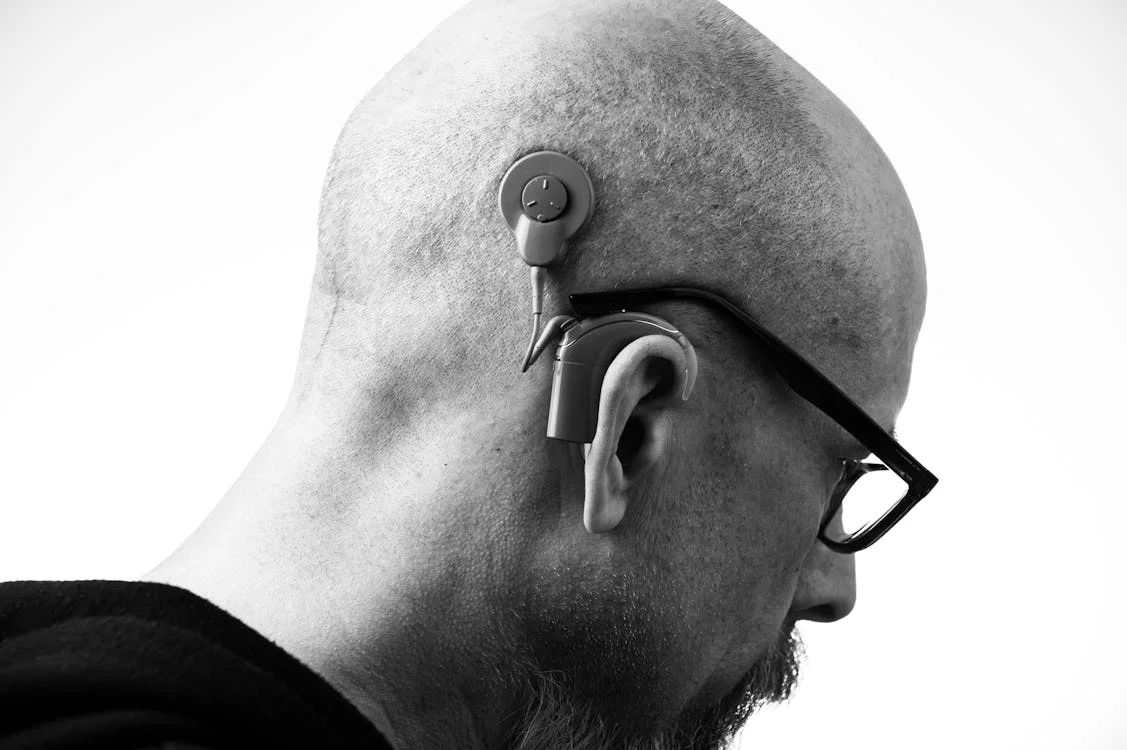
Cochlear implants bypass damaged hair cells entirely, stimulating the auditory nerve directly with electrical signals. For people with severe to profound sensorineural hearing loss who get little benefit from hearing aids, cochlear implants can restore meaningful sound perception. The FDA reports over 118,000 cochlear implant devices registered in the United States as of recent data, with both adults and children receiving them (FDA, 2024).
They're genuinely transformative for the right candidates. But they're not a universal solution. Here's why.
Cochlear implants require surgery under general anesthesia. The external processor sits behind the ear, and the internal component is surgically placed under the skin and into the cochlea. Recovery takes weeks, and learning to interpret the electrical signals as speech requires months of auditory rehabilitation. Children who receive implants early often achieve near-normal speech perception. Adults with late-onset deafness typically have good outcomes too. But adults who have been deaf since birth may get limited benefit.
The cost is significant — $30,000 to $50,000 per ear before insurance, though most insurance plans and Medicare cover them for qualifying candidates. Not everyone qualifies medically, and some people with hearing loss simply prefer non-surgical options.
We've heard from people who use cochlear implants alongside caption glasses. The implant handles environmental awareness and familiar voices, while the caption glasses fill in during noisy group settings where even cochlear implants struggle. One customer's otolaryngologist told the family they could "stop talking about a cochlear implant" after seeing how effectively caption glasses addressed the communication gap. That's not to say implants aren't valuable — they are, for the right person — but the landscape of options is broader than it used to be.
How Do Caption Glasses Work for Hearing Loss?
Caption glasses convert speech into real-time text displayed directly in your line of sight. The best models achieve 97% accuracy with under 300ms latency, even in noisy environments, using four-microphone beamforming arrays that isolate the speaker you're facing (HearingTracker, 2025). Think of them as closed captions for the real world — except the subtitles float in your glasses, invisible to everyone else.
This is the fastest-growing category in hearing loss technology, and for good reason. Let's break down why.
The Core Technology
Caption glasses use built-in microphones to capture speech, stream the audio via Bluetooth to a companion smartphone app, and run AI speech recognition to convert sound to text. The text then appears on a tiny transparent display inside the lens. The entire pipeline — from spoken word to text on the display — takes 300 to 1,000 milliseconds depending on the device.
What separates good caption glasses from mediocre ones is the microphone system. Glasses with four microphones can use beamforming, a technique that creates a directional "cone" of audio capture pointed at the speaker you're facing. Research shows beamforming improves speech-to-noise ratio by 3.3 to 13.9 decibels (PubMed, 2018; PMC, 2022). In practical terms, that's the difference between understanding 60% of words and understanding 95%+.

Why They Matter for Hearing Loss
Caption glasses solve the exact problem hearing aids can't: they work in noise. Instead of trying to amplify the right sound, they sidestep the amplification problem entirely by converting speech to text. Background noise at 80 dBA? Doesn't matter — you're reading, not listening through the chaos.
They also solve a social problem that phone-based solutions can't. Looking down at a phone to read captions pulls you out of the conversation. You lose eye contact, miss facial expressions, and signal to everyone at the table that you're checked out. Caption glasses keep your eyes up and engaged. It's a seemingly small difference with enormous social implications.
Who Benefits Most?
From years of building this technology and listening to thousands of users, a clear pattern emerges. The people who benefit most include those with moderate to severe hearing loss who have hearing aids but still struggle in groups. Families where a grandparent or parent can't follow dinner table conversations. Deaf professionals in workplace settings. Students in lecture halls. And, perhaps surprisingly, people with conditions like Meniere's disease, cancer treatment-related hearing loss, and COVID-related hearing damage — conditions where traditional hearing aids may not be the right fit.
The emotional impact is consistently stronger than people expect. They anticipate a useful gadget. What they get is participation. A 92-year-old customer told us the glasses "opened up my social world again." A mother who had been withdrawing from family conversations for years was moved to tears. These reactions aren't outliers — they're the norm when someone goes from missing 40% of a conversation to catching 97% of it.
Key Specs to Compare
Here's what to evaluate when comparing captioning glasses. We'll use AirCaps ($599) as a reference point since it's the product we build, but these specs apply to evaluating any model:
- Accuracy: 85-97% depending on model. Below 90% means too much guessing. AirCaps: 97% with cloud, 90%+ offline.
- Latency: 300ms to 1,000ms+. Under 500ms feels conversational. Over 1,000ms feels laggy. AirCaps: 300ms.
- Microphones: 1-2 mics for quiet rooms, 4 mics with beamforming for real-world noise. AirCaps: 4 mics with beamforming.
- Display: Monocular (one eye) causes strain. Binocular (both eyes) is more comfortable for all-day wear. AirCaps: binocular MicroLED waveguide.
- Weight: Under 50 grams is the target. Most regular glasses weigh 25-40 grams. AirCaps: 49 grams.
- Battery: 2-8 hours depending on usage. Some models offer hot-swap batteries extending to 18 hours. AirCaps: 4-8 hours, with optional Power Capsules for 18 hours.
- Prescription support: Can any optician fit lenses, or must you order through the vendor? AirCaps: any optician, -16 to +16 diopters.
- Subscription: Some work free forever. Others lock features behind $15-30/month. AirCaps: free tier with unlimited captions in 9 languages; Pro at $20/month for 60+ languages and meeting features.
Can Smartphone Apps Replace Dedicated Devices?
Smartphone captioning apps have made real-time transcription accessible to anyone with a phone, at zero cost. Google Live Transcribe (Android) and Apple Live Captions (iOS 16+) both offer real-time speech-to-text using your phone's built-in microphone. They're excellent entry points, and for some situations, they're all you need.
But they have significant limitations that dedicated devices address. Here's an honest comparison.
Where Apps Work Well
For quiet, one-on-one conversations — a doctor's office, a coffee shop at off-peak hours, a living room — phone apps work surprisingly well. Google Live Transcribe in particular has strong accuracy in controlled environments. Apple's Live Captions integrate system-wide, captioning phone calls, FaceTime, and media playback. Both are free, require no extra hardware, and can be set up in seconds.
If you're exploring whether text-based captioning helps you at all, starting with a free app is a smart first step.
Where Apps Fall Short
The limitations become obvious in the situations where captioning matters most. In a noisy restaurant, a single phone microphone sitting on the table captures everything — the person talking to you, the table behind you, the kitchen clatter, the music. Accuracy drops sharply. One study found that common noise environments above 75 dBA significantly degrade smartphone speech recognition accuracy (PMC, 2022).
Then there's the social cost. To use a phone app, you have to place the phone on the table and look down at it. You lose eye contact. You miss facial expressions. Everyone at the table notices you're reading your phone instead of engaging with them. For people who already feel isolated by hearing loss, adding visible technology that signals "I can't follow this conversation" compounds the problem rather than solving it.
Battery drain is another practical issue. Running continuous speech recognition on a smartphone consumes significant power. A full dinner out could drain 30-40% of your phone battery.
The Practical Divide
Here's a useful way to think about it: apps are good for predictable, quiet, short-duration captioning. Dedicated caption glasses are better for unpredictable, noisy, extended-duration situations. If you mostly need help at doctor's appointments, the free app might be enough. If you struggle at restaurants, family gatherings, work meetings, and social events, you'll likely outgrow the app quickly.
Which Technology Fits Which Situation?
No single device handles every hearing situation well. The best outcomes come from matching the right technology to the right environment. According to the HLAA, hearing loss is associated with a 3x increased risk of falling, a 5x increased risk of dementia, and significantly higher rates of social isolation and depression (HLAA, 2025). Getting the technology match right matters for far more than convenience.
Here's a practical breakdown.
| Situation | Best Solution | Why |
|---|---|---|
| Quiet one-on-one conversations | Hearing aids or free captioning apps | Low noise, amplification works well, apps are accurate in quiet |
| Noisy restaurants and social events | Caption glasses with beamforming mics | Amplification fails in noise; directional mics + text bypass the problem |
| Group conversations at home | Hearing aids + caption glasses together | Hearing aids for ambient sound, glasses for catching missed words |
| Work meetings and conferences | Caption glasses with meeting intelligence | Real-time captions plus automatic notes and speaker identification |
| Phone calls and media streaming | Bluetooth hearing aids or Apple Live Captions | Direct audio stream to ear; Live Captions work system-wide on iPhone |
| Lectures and classrooms | Caption glasses | Hands-free, eyes-up captioning without looking at a laptop or phone |
| International travel | Caption glasses with real-time translation | 60+ languages with automatic detection, no manual switching |
| Live events and theaters | Caption glasses | Uncaptioned venues become accessible without special accommodations |
The most effective users we've observed don't pick one technology — they layer them. Hearing aids handle the everyday ambient awareness: hearing a doorbell, catching a quiet comment from a spouse in the next room, enjoying music. Caption glasses come out for the challenging situations: the restaurant with friends, the work conference, the family reunion. Phone apps serve as a backup when neither dedicated device is available. Would it be simpler if one device did everything? Sure. But we're not there yet, and pretending otherwise leads to frustration.
What Should You Evaluate in 2026?
The hearing loss technology market has expanded from a handful of hearing aid brands to a diverse ecosystem that includes OTC aids, caption glasses, phone apps, and hybrid devices. Prices range from free (apps) to $50,000+ (cochlear implants), and spec sheets are getting harder to compare (HearingTracker, 2025). Here are the five factors that actually predict whether you'll use a device or leave it in a drawer.
Accuracy in Real-World Noise
This is the single most important metric, and it's the one manufacturers are most likely to fudge. A hearing aid that works great in a quiet audiologist's office may fail at a restaurant. A captioning device that claims 97% accuracy may have been tested only in a silent room. Always ask for noise-specific performance data. If a manufacturer can't or won't share it, that's your answer.
Latency
For hearing aids, latency is measured in microseconds — effectively instantaneous. For captioning devices, the relevant range is 300ms to 1,000ms+. Anything under 500ms feels natural in conversation. Above 700ms, you start noticing the lag. Above 1,000ms, the delay is disruptive enough that some people stop using the device.
Battery Life and Charging
A device that dies mid-dinner or mid-meeting isn't practical. For hearing aids, modern rechargeable models last 16-24 hours on a single charge. For caption glasses, battery life ranges from 2-8 hours of active captioning. Check whether external battery options exist — some caption glasses support hot-swappable batteries or charging cases that extend use to 12-18 hours.
Comfort and Aesthetics
You'll wear this device on your body for hours every day. Every gram matters for glasses. Every millimeter matters for hearing aids. And appearance matters too — stigma around hearing devices is real, even if it shouldn't be. The best 2026 devices are nearly indistinguishable from regular glasses or earbuds.
Total Cost of Ownership
Don't just look at the sticker price. A $500 captioning device with a mandatory $25/month subscription costs $1,100 over two years. AirCaps at $599 includes a free tier with unlimited captions and a 30-day Pro trial, so you can evaluate the full experience before committing to the $20/month subscription. Similarly, OTC hearing aids at $300 may be cheaper upfront but lack the professional fitting that makes $2,000 prescription aids more effective for moderate loss. Factor in batteries, accessories, professional services, and subscriptions when comparing.
Many hearing devices are HSA/FSA eligible. The IRS includes hearing aids and assistive hearing devices under eligible medical expenses in Publication 502 (IRS, 2025). If you have HSA or FSA funds, using pre-tax dollars can effectively reduce costs by 25-40% depending on your tax bracket.
What Does the Future Look Like?
The smart glasses market is projected to grow from $2.46 billion in 2025 to $14.38 billion by 2033, a 24.2% compound annual growth rate (Grand View Research, 2025). Samsung, Google, and Apple are all preparing smart glasses launches in 2026. That mainstream momentum will reshape the hearing loss technology landscape in three important ways.

Convergence of Hearing Aids and Smart Glasses
The hearing aid industry and the smart glasses industry are on a collision course. EssilorLuxottica — the company behind Ray-Ban and Oakley — received FDA clearance for Nuance Audio hearing aid glasses in 2025 (Ophthalmology Times, 2025). Forum discussions on HearingTracker show strong consumer demand for a single wearable that amplifies sound and displays captions. The technical challenges are real — battery life, heat, weight — but the market demand is undeniable.
Within 3-5 years, we'll likely see glasses that combine hearing aid amplification, real-time captioning, translation, and AI meeting tools in a single device under 50 grams. The question isn't whether this convergence will happen, but which company gets there first with a product that's actually comfortable to wear all day.
AI That Keeps Getting Better
The speech recognition models powering caption glasses and hearing aids improve every few months. Expect accuracy to push past 98% and latency to drop below 200ms within the next year. On-device processing is improving too — offline captioning that once hit 85% accuracy is now approaching 90%+, with fewer language limitations.
More interesting is the progress in contextual understanding. Current AI models transcribe what's said. Next-generation models will understand context — filling in mumbled words based on conversational context, identifying speakers more reliably, and even flagging when you've missed something important.
Mainstream Acceptance
When Apple ships smart glasses, "wearing tech on your face" will stop being unusual. The ripple effect for hearing loss technology is significant: less stigma around visible devices, lower component costs from mass manufacturing, better frame designs from fashion-forward companies, and broader insurance coverage as the economic case for hearing care becomes clearer.
The WHO estimates that every $1 invested in hearing care returns nearly $16 over 10 years (WHO, 2024). As smart glasses normalize and costs decrease, healthcare systems will face increasing pressure to cover captioning devices alongside traditional hearing aids.
Frequently Asked Questions
What is the best technology for hearing loss in 2026?
There's no single best technology — it depends on your hearing loss type, severity, and the situations where you struggle most. For mild loss in quiet settings, OTC hearing aids ($200-$800) work well. For noisy environments and group conversations, caption glasses with beamforming microphones (achieving 92-97% accuracy) outperform amplification alone (HearingTracker, 2025). Most audiologists recommend combining technologies.
Can I use caption glasses with my hearing aids?
Yes, and many users find the combination more effective than either device alone. Hearing aids amplify environmental sounds while caption glasses provide text backup for speech in challenging situations. The two technologies complement each other — they don't interfere. Group conversations and noisy restaurants are where the combination shines most.
How much do hearing loss solutions cost in 2026?
Costs span a wide range. Free smartphone captioning apps are available to everyone. OTC hearing aids run $200-$800. Caption glasses range from $300-$900 for consumer models. Prescription hearing aids cost $2,000-$7,000 per pair. Cochlear implants run $30,000-$50,000 per ear before insurance. Many devices are HSA/FSA eligible, reducing effective cost by 25-40% depending on your tax bracket (IRS, 2025).
Are smartphone captioning apps good enough for hearing loss?
For quiet, one-on-one conversations, free apps like Google Live Transcribe and Apple Live Captions work surprisingly well. But they struggle in noisy environments because they rely on a single phone microphone with no directional focus. They also require looking down at a screen, which breaks eye contact and social engagement. For occasional use in controlled settings, apps are a good starting point. For daily use across varied environments, dedicated devices perform significantly better.
Will insurance cover caption glasses or other hearing technology?
Coverage varies by plan and carrier. Traditional hearing aids are covered by many insurance plans, and Medicare covers cochlear implants. Caption glasses may qualify as durable medical equipment with a prescription or Letter of Medical Necessity from an audiologist. HSA and FSA funds are generally eligible for assistive hearing devices under IRS Publication 502. Contact your insurance provider for your specific plan details, as coverage for newer technologies is expanding.
Where to Go from Here
The hearing loss technology landscape in 2026 is broader and more capable than it's ever been. That's the good news. The challenge is that no single device solves every situation, and the marketing from each category tends to oversell what it can do while downplaying its limitations.
Here's the practical takeaway: start by identifying where you struggle most. If it's quiet conversations, try a free captioning app or OTC hearing aid first. If it's noisy environments, group settings, or workplaces, caption glasses with multi-microphone beamforming address the exact scenarios where amplification falls short. If it's everything, consider a layered approach — hearing aids for ambient awareness, caption glasses for challenging situations, phone apps as backup.
For the 1.5 billion people worldwide living with hearing loss, 2026 offers more real options than any year before. The gap between hearing and not hearing is narrowing — not through any single breakthrough, but through a growing ecosystem of technologies that work together.
Continue Reading
On this page
Table of Contents
▼
Written by
Nirbhay Narang
Co-founder & CTO, AirCaps
Co-founder of AirCaps. Cornell-trained engineer with 11+ years building audio AI and smart glasses hardware. Y Combinator alum. Leads the engineering behind AirCaps' 4-microphone beamforming array and real-time speech recognition pipeline.
Related Articles

Guides
Caption Glasses vs. Hearing Aids: What's the Difference?
Hearing aids amplify sound; caption glasses show real-time text. Learn how they differ, where each excels, and whether you might benefit from both.
AirCaps Team
·
Sep 17, 2026
·
9 min read
Guides
Captioning Glasses vs. Hearing Aids: A Complete Comparison
Captioning glasses and hearing aids solve hearing loss differently. Compare accuracy in noise, restaurant performance, cost, insurance coverage, and which solution works best for your situation.

Madhav Lavakare
·
Apr 1, 2026
·
17 min read

Guides
Can't Hear in Restaurants? How Captioning Glasses Solve the #1 Hearing Loss Complaint
Restaurant noise makes hearing aids fail. Learn why captioning glasses with 4-mic beamforming maintain 97% accuracy at 78+ dBA — and how they solve the most common hearing loss frustration.
Madhav Lavakare
·
Apr 4, 2026
·
16 min read
© 2025 AirCaps. All rights reserved.