Captioning Glasses vs. Hearing Aids: A Complete Comparison
Captioning glasses and hearing aids solve hearing loss differently. Compare accuracy in noise, restaurant performance, cost, insurance coverage, and which solution works best for your situation.
By Madhav Lavakare · Published 2026-04-01 · 17 min read
Captioning Glasses vs. Hearing Aids: Which Is Right for You?
Table of Contents
How Do Hearing Aids and Captioning Glasses Work Differently?
How Hearing Aids Work
How Captioning Glasses Work
The Full Comparison Table
Which Works Better in Noisy Restaurants?
How Do They Compare on Accuracy?
What Does Each One Cost?
Can You Use Both Together?
Which Is Better for Group Conversations?
What About Translation and Other Languages?
Which Is Right for Your Type of Hearing Loss?
What About Comfort and Appearance?
Beyond Hearing: What Else Can Each Device Do?
Frequently Asked Questions
Do captioning glasses replace hearing aids?
Are captioning glasses covered by insurance?
How long do captioning glasses batteries last compared to hearing aids?
Can captioning glasses work for phone calls?
What if I have profound hearing loss — are hearing aids still useful?
Do I need a smartphone for captioning glasses?
How do captioning glasses handle accents and dialects?

Guides
Captioning Glasses vs. Hearing Aids: A Complete Comparison

Madhav Lavakare
·
April 1, 2026
·
17 min read

On this page
Table of Contents
▼
Editorial disclosure: AirCaps manufactures captioning glasses. This comparison includes our product alongside hearing aids and other assistive devices. We believe captioning glasses complement hearing aids rather than replace them — and we explain where each technology excels and where it falls short.
Captioning Glasses vs. Hearing Aids: Which Is Right for You?
Hearing aids amplify sound. Captioning glasses convert speech to text and display it in your line of sight. These are fundamentally different approaches to the same problem — and for the 1.5 billion people worldwide living with hearing loss (WHO, 2024), understanding the difference matters. More than 60% of people who need hearing aids don't use them (Healthy Hearing, 2025), often because of cost, stigma, or frustration with performance in noisy environments. Captioning glasses offer an alternative path — not by making sounds louder, but by making speech visible.
This guide compares the two technologies across every dimension that matters: accuracy in noise, restaurant performance, cost, insurance, comfort, and real-world use cases. For many people, the answer isn't one or the other — it's both.
Key Takeaways
- Hearing aids amplify sound; captioning glasses convert speech to text displayed in your field of view — they solve hearing loss through different mechanisms
- Hearing aids struggle most in noisy environments (restaurants, group settings) where background noise exceeds 75 dBA — captioning glasses with 4-mic beamforming maintain 92-97% accuracy in these same settings
- Average hearing aid cost: $2,000-$7,000 per pair; captioning glasses like AirCaps: $599 with no subscription required
- 80% of UK diners have left a restaurant due to noise levels — the #1 scenario where captioning glasses outperform hearing aids
- Many users get the best results using both technologies together — hearing aids for general awareness, captioning glasses for conversations in noise
Table of Contents
- How Do Hearing Aids and Captioning Glasses Work Differently?
- The Full Comparison Table
- Which Works Better in Noisy Restaurants?
- How Do They Compare on Accuracy?
- What Does Each One Cost?
- Can You Use Both Together?
- Which Is Better for Group Conversations?
- What About Translation and Other Languages?
- Which Is Right for Your Type of Hearing Loss?
- Frequently Asked Questions
How Do Hearing Aids and Captioning Glasses Work Differently?
Hearing aids and captioning glasses approach hearing loss from opposite directions. Understanding the core mechanism helps explain why each technology excels in different situations — and why they are more complementary than competitive.
How Hearing Aids Work
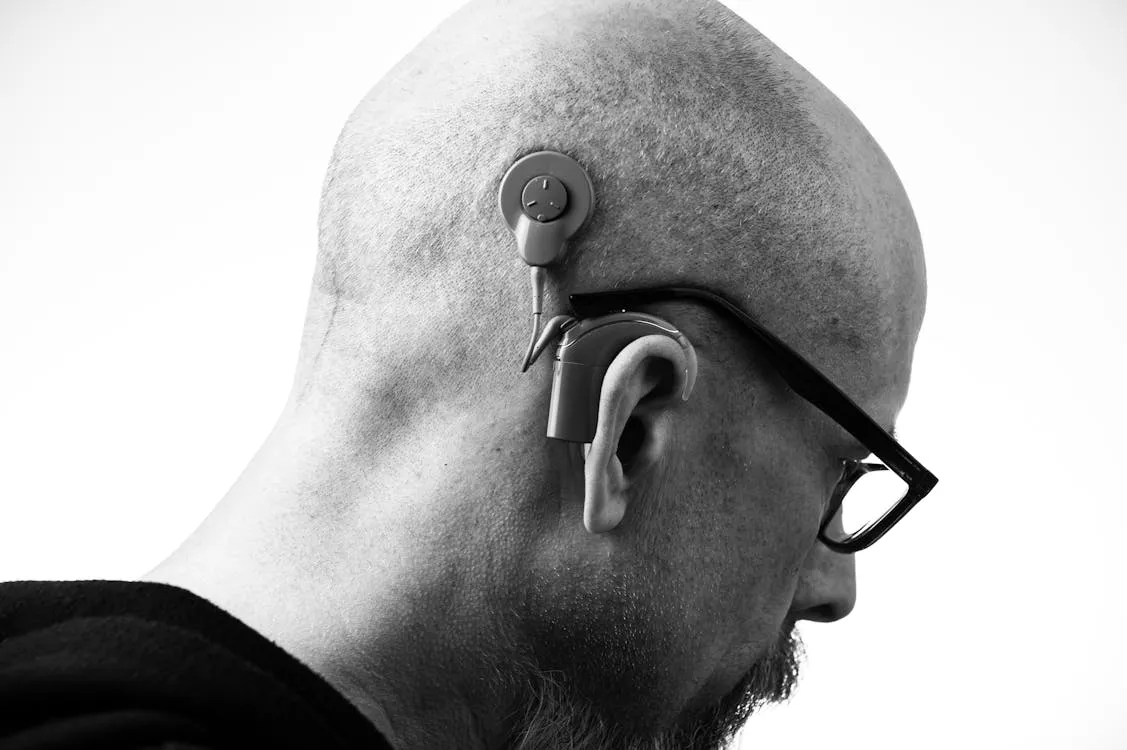
Hearing aids are sound amplification devices. A microphone picks up ambient sound, a processor amplifies specific frequencies based on your audiogram, and a speaker delivers the amplified sound into your ear canal. Modern hearing aids use digital signal processing to reduce background noise and focus on speech frequencies, but they are fundamentally limited by the physics of sound: when background noise is loud enough, amplifying speech also amplifies everything else.
Even the most advanced hearing aids — including the two models that now use real-time AI processing, the Phonak Sphere Infinio and ReSound Vivia (Soundly, 2026) — work by modifying the audio signal. If the signal is too degraded by environmental noise, no amount of processing fully recovers it.
How Captioning Glasses Work
Captioning glasses take a completely different approach. Instead of amplifying sound, they use AI-powered speech recognition to convert spoken words into text, then display that text on a transparent screen built into the lenses. You read what people are saying in real time, overlaid on your normal field of vision.
The key technical differentiator is the microphone array. Captioning glasses like AirCaps use 4 microphones with beamforming technology — creating a directional "cone" that isolates the speaker you're facing while filtering background noise before the speech recognition engine even processes the audio. Research shows beamforming improves speech-to-noise ratio by 3.3 to 13.9 dB (PubMed, 2018). That processing happens at the hardware level, meaning the AI gets a cleaner audio signal to transcribe — which is why captioning glasses can maintain 97% accuracy even in restaurant-level noise.
The Full Comparison Table
This table compares hearing aids and captioning glasses across the specs that matter most for daily use. Hearing aid specs represent premium models ($3,000-$7,000 range). Captioning glasses specs represent AirCaps, which is the most widely adopted captioning glasses model with 5,000+ customers.
| Feature | Hearing Aids (Premium) | Captioning Glasses (AirCaps) |
|---|---|---|
| How it works | Amplifies sound to your ears | Converts speech to text displayed in your lenses |
| Accuracy in quiet | High (depends on audiogram fit) | 97% caption accuracy |
| Accuracy in noise (75+ dBA) | Significantly degraded | 92-97% (4-mic beamforming) |
| Latency | Near-instant (analog signal) | 300ms (speech-to-text processing) |
| Microphones | 2 per ear (typically) | 4 with beamforming array |
| Languages supported | N/A (amplifies all audio) | 60+ with automatic detection |
| Translation | No | Yes — 60+ languages, auto-detect |
| Group conversations | Limited (2-3 speakers max) | Identifies up to 15 speakers |
| Price | $2,000-$7,000 per pair | $599 (no subscription required) |
| Insurance coverage | Varies by state; often partial | HSA/FSA eligible |
| Battery life | 16-30 hours (rechargeable) | 4-8 hours (up to 18 with accessories) |
| Weight | 2-5g per ear | 49g total |
| Prescription lenses | N/A | Any optician, -16 to +16 diopters |
| Requires fitting | Yes (audiologist visit) | No (works out of the box) |
| Ongoing costs | $100-$300/year (batteries, maintenance) | $0 (free tier) or $20/month (Pro) |
| Meeting intelligence | No | Yes — transcripts, summaries, action items |
| Offline mode | Yes (always works offline) | Yes (9 languages, reduced accuracy) |
Which Works Better in Noisy Restaurants?
Restaurants are where hearing aids struggle most and captioning glasses shine. Average restaurant noise levels hit 78 dBA, with bars reaching 81 dBA (NIDCD, 2025). The CDC notes that conversation becomes difficult above 75 dBA, and 25% of New York City restaurants exceed 81 dBA. In the UK, 80% of diners have left a restaurant due to noise levels (PMC, 2022).
Hearing aids were designed for one-on-one conversation in relatively quiet environments. When background noise competes with speech at similar volume levels, the processor cannot reliably separate the two. This is why "I can't hear in restaurants" is the single most common complaint among hearing aid users — and the number one reason people stop wearing them.
Captioning glasses take a fundamentally different approach to the restaurant problem. Instead of trying to amplify the right sounds over the wrong ones, AirCaps uses a 4-microphone beamforming array that creates a directional pickup pattern focused on the speaker in front of you. The background noise is filtered at the hardware level, before the speech recognition AI processes the audio. The result: 92-97% caption accuracy at noise levels where hearing aids deliver significantly diminished performance.
As one AirCaps customer describes it: "Severe hearing loss which is only partially abetted by my hearing aids. When I was sitting around a table, I lost the conversation." After switching to captioning glasses for restaurant conversations, he could follow along again.

How Do They Compare on Accuracy?
Accuracy means different things for each technology — and comparing them requires understanding what each device is actually measuring.
Hearing aid "accuracy" depends entirely on the individual's audiogram, the quality of the fitting, and the environment. A well-fitted premium hearing aid can restore near-normal speech comprehension in quiet settings. But there's no universal accuracy number because every ear is different, and performance degrades as noise increases. The two hearing aids with real-time AI processing (Phonak Sphere Infinio and ReSound Vivia) represent the cutting edge, but they still operate within the fundamental constraints of sound amplification.
Captioning glasses accuracy is more directly measurable: what percentage of spoken words appear correctly as text on the display? AirCaps achieves 97% accuracy with 300ms latency in its Pro tier, and 90%+ accuracy in its free tier. This accuracy holds even in noisy environments because beamforming isolates the speech signal before transcription begins.
The practical difference: in a quiet living room, a well-fitted hearing aid may deliver better moment-to-moment comprehension because there's no reading involved — you simply hear the amplified speech naturally. In a crowded restaurant, a family gathering, or a noisy workplace, captioning glasses maintain consistent accuracy while hearing aid performance drops.
What Does Each One Cost?
Cost is one of the starkest differences between hearing aids and captioning glasses — and the full picture includes more than the sticker price.
| Cost Factor | Hearing Aids | Captioning Glasses (AirCaps) |
|---|---|---|
| Device price | $2,000-$7,000 per pair | $599 |
| Professional fitting | $200-$500 (audiologist) | $0 (no fitting required) |
| Annual maintenance | $100-$300 (batteries, cleaning, adjustments) | $0 |
| Subscription | None | $0 (free tier) or $20/month (Pro) |
| Replacement cycle | Every 3-5 years | TBD (new product category) |
| Insurance | Varies widely by state and plan | HSA/FSA eligible ($599) |
| 5-year total cost | $2,500-$9,000+ | $599-$1,799 (device + optional Pro) |
Hearing aid insurance coverage varies dramatically. Some states mandate coverage, others don't. Medicare does not cover hearing aids (as of 2026). Many private insurance plans offer partial coverage or fixed allowances that don't keep pace with device costs. Out-of-pocket expense remains the primary barrier to hearing aid adoption.
AirCaps captioning glasses cost $599 and are HSA/FSA eligible, which means you can use pre-tax health savings dollars — effectively saving 20-35% depending on your tax bracket. The glasses work on a free tier with unlimited captions in 9 languages at 90%+ accuracy. The Pro tier at $20/month adds 60+ languages, 97%+ accuracy, speaker identification, and AI meeting intelligence. No audiologist visit required.
Unaddressed hearing loss costs the global economy nearly $1 trillion annually (WHO, 2024). The WHO also estimates that every $1 invested in hearing care returns $16 over 10 years — regardless of whether that investment goes toward hearing aids, captioning glasses, or both.
Can You Use Both Together?
Yes — and many people get the best results this way. Hearing aids and captioning glasses solve different parts of the hearing loss problem, and combining them creates a more complete solution than either technology alone.
Hearing aids provide ambient sound awareness: doorbells, car horns, music, environmental cues. They keep you connected to the world of sound in a way that captioning glasses alone cannot. Captioning glasses provide speech comprehension with consistent accuracy regardless of background noise. They excel precisely where hearing aids struggle.
Several AirCaps customers describe this complementary use. One user's otolaryngologist told him: "Now we can stop talking about a cochlear implant" — after adding captioning glasses to his existing hearing solution. Another customer, a cochlear implant wearer, uses AirCaps as a supplement for situations where his implant alone isn't enough.
The practical approach: wear hearing aids for general daily awareness and quiet conversations. Add captioning glasses when you walk into a restaurant, join a group conversation, attend a lecture, or enter any environment where noise makes your hearing aids insufficient. AirCaps weighs just 49g — lighter than most regular eyeglasses — so wearing them alongside hearing aids adds minimal burden.
Which Is Better for Group Conversations?
Group conversations compound the challenges of hearing loss. Multiple speakers talking from different directions, overlapping speech, rapid turn-taking — these scenarios expose the limitations of both technologies, but in different ways.
Hearing aids with directional microphones can focus on one speaker at a time, but struggle when the conversation shifts between people sitting at different positions around a table. Most hearing aids handle 2-3 speakers reasonably well in moderate noise; beyond that, comprehension drops rapidly.
Captioning glasses handle group conversations differently. AirCaps identifies and labels up to 15 different speakers in real time, displaying each person's words with their name or label so you can follow who said what. The 4-mic beamforming array picks up speakers across a wider field than hearing aid microphones, and the AI distinguishes between overlapping voices.
For family dinners — the scenario that comes up most frequently in customer stories — captioning glasses provide something hearing aids cannot: a clear, labeled transcript of who said what, even when multiple family members talk simultaneously or from across a large table.

What About Translation and Other Languages?
This is a category where hearing aids simply don't compete. Hearing aids amplify whatever language is being spoken — they don't translate it. If someone speaks to you in a language you don't understand, louder won't help.
Captioning glasses with translation capabilities convert speech from one language to text in another, displayed in real time on your lenses. AirCaps supports 60+ languages with automatic language detection — the glasses identify what language is being spoken and translate without manual selection. This handles code-switching (when someone alternates between languages mid-sentence) seamlessly.
For multilingual families — a college student visiting grandparents who speak a different language, or an international family gathering where three languages are flying around the table — captioning glasses solve a problem that no hearing device addresses. Translation accuracy runs at approximately 95% with 700ms latency, which is slightly slower than pure captioning but fast enough for natural conversation flow.
For international professionals, AirCaps combines meeting intelligence with translation: real-time translated captions, automatic transcription, AI-generated summaries with action items, and searchable conversation history across languages.
Which Is Right for Your Type of Hearing Loss?
Different types and degrees of hearing loss respond differently to each technology. Here's how the comparison breaks down by condition.
| Condition | Hearing Aids | Captioning Glasses | Best Approach |
|---|---|---|---|
| Mild hearing loss | Effective in most settings | Helpful in noisy environments | Hearing aids primary; captioning glasses for noise |
| Moderate hearing loss | Effective in quiet; limited in noise | Effective in all environments | Both together recommended |
| Severe hearing loss | Limited effectiveness | Consistent 92-97% accuracy | Captioning glasses primary; hearing aids for awareness |
| Profound deafness | Not effective (cochlear implant territory) | Fully effective | Captioning glasses (no sound amplification needed) |
| Meniere's disease | Complicated by fluctuating loss | Works regardless of hearing level | Captioning glasses (consistent despite fluctuations) |
| Age-related loss | First-line treatment | Excellent supplement | Both together; captioning glasses for social settings |
| Single-sided deafness | CROS/BiCROS aids available | Works regardless of which ear | Depends on preference and environment |
| Auditory processing disorder | Limited benefit (hearing is normal) | Highly effective (visual bypass) | Captioning glasses (text bypasses auditory processing) |
AirCaps customers report using captioning glasses for conditions ranging from age-related hearing loss to Meniere's disease, cancer treatment hearing loss, COVID-related hearing loss, and late-adult deafness. The common thread: captioning glasses work consistently regardless of the type or cause of hearing loss because they bypass the auditory system entirely.
For people with auditory processing disorder — where hearing is physiologically normal but the brain struggles to interpret speech — captioning glasses offer a solution that hearing aids cannot. There's nothing to amplify; the visual pathway bypasses the processing bottleneck.

What About Comfort and Appearance?
Both technologies have made significant progress on comfort and discretion, but they approach it differently.
Modern hearing aids are remarkably small. Receiver-in-canal (RIC) models weigh 2-5 grams per ear and are nearly invisible when worn. Behind-the-ear (BTE) models are slightly larger but still discrete. For people concerned about visible assistive devices, hearing aids offer the most subtle option available.
Captioning glasses look like regular eyeglasses. AirCaps frames are designed in collaboration with Bolon Eyewear (a premium eyewear brand) using black acetate with hypoallergenic nose pads. At 49 grams, they're lighter than many designer frames. The binocular MicroLED displays have less than 2% light leakage — meaning the person you're talking to can't see the text on your lenses. They're available in Midnight, Silver, Sage, and Rose.
The comfort tradeoff: hearing aids are lighter and less physically noticeable. Captioning glasses are more visually prominent (they're glasses) but carry less stigma — most people assume you're wearing regular prescription eyewear, not an assistive device. For prescription wearers, captioning glasses replace your existing glasses (AirCaps supports any prescription from -16 to +16 diopters, fitted by any optician) rather than adding another device.
Beyond Hearing: What Else Can Each Device Do?
Modern hearing aids include features beyond amplification: Bluetooth streaming from phones, tinnitus masking sounds, fall detection (some models), and smartphone app control. These are valuable additions, but they all revolve around audio.
Captioning glasses expand into territory hearing aids cannot reach:
- Real-time translation in 60+ languages with automatic language detection
- AI meeting intelligence with transcription, summaries, action items, and searchable history
- Speaker identification labeling up to 15 people in a conversation
- Offline captioning in 9 languages without internet access
- Custom display settings for font size, position, and reading preferences
- Conversation Q&A — ask questions about what was discussed and get instant answers
For professionals, AirCaps serves as both an accessibility device and a productivity tool. Sales teams use the meeting intelligence features to track deal frameworks in real time. Healthcare providers use HIPAA-compliant transcription to reduce charting time. These use cases have nothing to do with hearing loss — they're productivity features that happen to run on the same hardware.
Frequently Asked Questions
Do captioning glasses replace hearing aids?
For most people, no. Captioning glasses and hearing aids are complementary technologies. Hearing aids provide ambient sound awareness and work well in quiet environments. Captioning glasses provide speech-to-text accuracy in noisy environments where hearing aids struggle. Many users achieve the best results by using both — hearing aids for daily awareness and captioning glasses for challenging listening situations like restaurants, group conversations, and meetings.
Are captioning glasses covered by insurance?
Captioning glasses are not typically covered by traditional health insurance in the same way hearing aids are in some states. However, AirCaps is HSA/FSA eligible at $599, meaning you can purchase with pre-tax health savings dollars — saving 20-35% depending on your tax bracket. This is often more straightforward than navigating hearing aid insurance coverage, which varies by state and plan.
How long do captioning glasses batteries last compared to hearing aids?
Hearing aids typically last 16-30 hours on a single charge with rechargeable batteries. AirCaps lasts 4-8 hours on mixed usage. However, AirCaps offers hot-swap Power Capsules that extend battery life to 18 hours of continuous use without removing the glasses. Hearing aids have the advantage for all-day passive wear; captioning glasses require planning for extended use.
Can captioning glasses work for phone calls?
Yes. AirCaps connects via Bluetooth 5.3 to your smartphone (iOS or Android) and can caption phone calls in real time. Hearing aids also stream phone audio via Bluetooth. Both technologies handle phone calls, but captioning glasses add a visual transcript you can reference after the call ends.
What if I have profound hearing loss — are hearing aids still useful?
For profound hearing loss, hearing aids provide limited benefit. Cochlear implants are the primary amplification option at that level. Captioning glasses work fully regardless of hearing level because they bypass the auditory system entirely — converting speech to visual text. Several AirCaps customers use captioning glasses as a supplement to cochlear implants for environments where implants alone aren't sufficient.
Do I need a smartphone for captioning glasses?
AirCaps requires a smartphone (iOS or Android) connected via Bluetooth 5.3. The phone runs the AI processing for speech recognition and translation. Offline mode supports 9 languages (English, Spanish, Chinese, French, German, Italian, Japanese, Korean, Portuguese) with reduced accuracy when internet isn't available. Hearing aids work independently of a smartphone, though many features (streaming, app adjustments) require a phone connection.
How do captioning glasses handle accents and dialects?
AirCaps uses AI speech recognition trained on diverse speech patterns, maintaining 97% accuracy across accents and dialects. The 4-mic beamforming array helps by delivering a cleaner audio signal to the AI, regardless of the speaker's accent. Hearing aids don't process accents differently — they amplify all speech equally — but hearing aid users with hearing loss may struggle more with unfamiliar accents because they receive a degraded audio signal.
Sources: WHO — Deafness and Hearing Loss, 2024. NIDCD — Noise Levels in Restaurants, 2025. Healthy Hearing — Hearing Loss Statistics, 2025. PubMed — Beamforming in Hearing Devices, 2018. Soundly — Hearing Aid Reviews, 2026.
On this page
Table of Contents
▼
Written by
Madhav Lavakare
Co-founder & CEO, AirCaps
Co-founder of AirCaps. Building AI-powered smart glasses for conversation since 2013. Yale graduate, Y Combinator alum. Built his first Google Glass apps at age 13 and has spent 11+ years in speech AI and wearable computing.
Related Articles
Guides
The Complete Guide to Hearing Loss Technology in 2026
Hearing aids, caption glasses, and apps compared for the 1.5B people with hearing loss. Accuracy, cost, and real-world performance data for 2026.

Nirbhay Narang
·
Mar 27, 2026
·
22 min read
Guides
Caption Glasses vs. Hearing Aids: What's the Difference?
Hearing aids amplify sound; caption glasses show real-time text. Learn how they differ, where each excels, and whether you might benefit from both.

AirCaps Team
·
Sep 17, 2026
·
9 min read

Guides
Can't Hear in Restaurants? How Captioning Glasses Solve the #1 Hearing Loss Complaint
Restaurant noise makes hearing aids fail. Learn why captioning glasses with 4-mic beamforming maintain 97% accuracy at 78+ dBA — and how they solve the most common hearing loss frustration.
Madhav Lavakare
·
Apr 4, 2026
·
16 min read
© 2025 AirCaps. All rights reserved.