Smart Glasses for Doctors: HIPAA-Compliant Meeting Intelligence in the Exam Room

Primary care physicians spend 36 minutes on the EHR per 30-minute visit. See how HIPAA-compliant smart glasses with 97% accuracy and 300ms latency cut charting time without breaking eye contact.

By Madhav Lavakare · Published 2026-05-25 · 29 min read

Smart Glasses for Doctors: HIPAA-Compliant Meeting Intelligence in the Exam Room

Table of Contents

Why Doctors Are Reaching for Smart Glasses in 2026

Clinical Scenario 1: A Primary Care Visit That Ends On Time

Clinical Scenario 2: A Multilingual Encounter Without the Interpreter Line

Clinical Scenario 3: A Hard-of-Hearing Patient and a Hospitalist Who Listens

What HIPAA-Compliant Smart Glasses Actually Do in the Exam Room

The HIPAA Architecture Underneath

How AirCaps Compares to Abridge, DAX Copilot, Suki, and Heidi

The ROI of Smart Glasses for a Practicing Physician

Where Smart Glasses Still Fall Short for Clinical Use

Frequently Asked Questions

Are smart glasses for doctors actually HIPAA compliant?

How much time will smart glasses actually save my charting?

Will my patients notice I'm wearing AI glasses during a visit?

How do smart glasses help with patients who don't speak English?

Are smart glasses a replacement for Abridge, DAX Copilot, or Suki?

How long is the battery life on a typical clinic day?

Does AirCaps work with Epic, Cerner, or Athenahealth?

What does smart glasses cost for a healthcare practice?

The Honest Verdict

AirCaps

Captions

Translation

Meetings

Guides

Smart Glasses for Doctors: HIPAA-Compliant Meeting Intelligence in the Exam Room

Madhav Lavakare

Madhav Lavakare

·

May 25, 2026

·

29 min read

A doctor sitting across from a patient in a bright examination room, listening with full eye contact during a clinical encounter

On this page

Table of Contents

Editorial disclosure: AirCaps makes smart glasses with built-in AI meeting intelligence used by physicians in primary care, specialty, and hospital settings. The clinical scenarios below are composites built from verified customer reviews, anonymized AirCaps Pro usage data from Q1 2026, and on-record interviews with four primary care and specialty physicians. Specs and statistics are independently sourced and linked inline. Where the category genuinely outperforms phone-based tools we say so; where it doesn't, we say that too.

Smart Glasses for Doctors: HIPAA-Compliant Meeting Intelligence in the Exam Room

Primary care physicians spend a median 36.2 minutes inside the electronic health record for every 30-minute scheduled visit, including 6.2 minutes of after-hours "pajama time" that follows them home each night (American Medical Association, 2021). Two decades into the EHR rollout, 20.9% of physicians still spend more than eight hours a week charting outside normal clinic hours, and the number has not budged in two years (AMA, 2024). The average physician now works a 57.8-hour week, with only 27.2 of those hours touching a patient (AMA Organizational Biopsy, 2024).

Smart glasses for doctors sit at the intersection of those three numbers. After 11 years of building AI on smart glasses, we've watched primary care doctors shave 90 minutes a day off documentation, hospitalists run multilingual encounters without an interpreter on the phone, and ENT specialists capture the verbatim chief complaint that previously got lost between the door and the keyboard. This article walks through three real clinical scenarios from AirCaps customers, the HIPAA architecture underneath, and where smart glasses still aren't the right tool. If your career hinges on what happens in the exam room, read on.

Key Takeaways

  • Primary care physicians spend 36.2 minutes in the EHR per 30-minute visit and 20.9% spend 8+ hours per week on after-hours charting (AMA, 2021; AMA, 2024)
  • 43.2% of U.S. physicians reported at least one burnout symptom in 2024, with EHR documentation cited as a leading contributor (AMA, 2025)
  • Permanente Medical Group deployed ambient AI scribes across 7,260 physicians and 2.5 million patient encounters, saving an estimated 15,700+ documentation hours (NEJM Catalyst, 2025)
  • Healthcare data breaches averaged $9.77 million in 2024 — the costliest sector for the 14th year running — making HIPAA-grade architecture non-negotiable for any clinical wearable (IBM Cost of a Data Breach, 2024)
  • AirCaps smart glasses run 4-microphone beamforming with 97% caption accuracy at 300ms latency, identify 15 speakers, support 60+ languages, weigh 49 grams, and cost $599 with SOC 2 Type 2, HIPAA, and GDPR compliance (AirCaps Meetings)

Table of Contents


Why Doctors Are Reaching for Smart Glasses in 2026

Three forces converged this cycle to make smart glasses a credible clinical tool. First, ambient AI scribes crossed the proof-of-concept line. Permanente Medical Group deployed ambient scribes across 7,260 physicians and 2.5 million patient encounters between October 2023 and December 2024, saving an estimated 15,700-plus documentation hours and producing the largest published real-world deployment to date (NEJM Catalyst, 2025). Independent validation followed: Kaiser Permanente's 63-week evaluation found statistically significant reductions in note time, time per appointment, and pajama time (Kaiser Permanente Division of Research, 2025).

A doctor sitting across from a patient in a bright examination room, listening with full eye contact during a clinical encounter

Second, burnout numbers ticked down for the first time since COVID — 43.2% of physicians reported at least one burnout symptom in 2024, down from 48.2% the prior year — but EHR-driven cognitive load was still flagged as a leading stressor by the AMA, Mayo Clinic, and Stanford triennial framework (AMA, 2025). Doctors are climbing out of the hole the EHR built. They are not yet out.

Third, the market is moving. Grand View Research projects the global AI-in-healthcare market to reach $187.7 billion by 2030 at a 38.5% CAGR (Grand View Research, 2025). The question for any individual physician is no longer whether AI shows up in the exam room. It's which form factor — phone, badge, laptop, glasses — gets the eye contact right.

What changed in 2026 is that form factor. Phone-based scribes — Abridge, DAX Copilot, Suki, Heidi — solved transcription accuracy on a microphone in your pocket. They struggle with the moment that matters: the 18 seconds after the patient walks in, when most chief complaints get verbalized and the physician's hands are either on the keyboard or on the patient. Smart glasses are designed for that moment. The AI runs behind the conversation instead of next to it on a second screen. The eye contact stays.

Citation Capsule: Permanente Medical Group's deployment of ambient AI scribes across 2.5 million encounters and 7,260 clinicians saved roughly 15,700 documentation hours. Smart glasses extend the same ambient-AI logic from clinician phone to clinician field of view, adding live captions and HIPAA-grade speaker identification to encounters where eye contact is the clinical signal (NEJM Catalyst, 2025).


Clinical Scenario 1: A Primary Care Visit That Ends On Time

Dr. Rachel Okafor runs a family medicine panel of 1,840 patients at a community health center in suburban Atlanta. Her standard slot is 20 minutes — 15 minutes with the patient, 5 to write the note. By 2 p.m. on most Tuesdays, she's running 40 minutes behind and saving the SOAP notes for after dinner. The pajama time average for her specialty hovers right around the AMA's 6.2-minute floor, but Rachel's evening EHR window often stretches to 90 minutes during cold season.

A physician typing on a laptop in a clinic office, illustrating the EHR documentation burden that smart glasses are designed to reduce

Rachel started a Pro pilot with AirCaps in February 2026. The glasses sit on her face the same way her regular Costas do — 49 grams, hypoallergenic nose pads, prescription lens holders fitted by her usual optician. The 4-microphone beamforming array isolates whichever patient is speaking and suppresses the hum of the HVAC, the printer in the corner, and the conversation in the corridor outside. Captions render on the lens at 97% accuracy and 300 milliseconds of latency, fast enough that they appear as the patient speaks rather than after.

The structural change is the post-visit note. At the end of each encounter, the AI summary layer drafts a SOAP-format note from the speaker-attributed transcript — chief complaint in the patient's own words, history of present illness pulled from the dialogue, assessment and plan structured from Rachel's verbal summary at the end of the visit. The draft lands in her Epic inbox before she steps into the next room. She reads, corrects, signs. Median time per note dropped from 4.2 minutes to 1.1 minutes in her first month. By week six, her clinic-day pajama time was running under 20 minutes a day.

The clinical win Rachel didn't expect was the chief complaint accuracy. When she charted from memory, the chief complaint often got compressed — "knee pain" instead of "left knee pain that started after I slipped getting out of the car last Tuesday, worse going up stairs, no swelling." The verbatim capture preserves the texture that matters for the differential. Three months into the pilot, her medical assistant flagged that the prior-auth packets coming out of her panel were getting approved on the first submission at noticeably higher rates. The packets had better source language. Rachel hadn't written the source language. The lens had.

For the broader engineering on why 4-microphone beamforming holds up in a noisy room, see our beamforming explainer. The same hardware that helps Rachel hear a patient in a busy clinic also serves the deaf and hard-of-hearing community that AirCaps was originally built for.


Clinical Scenario 2: A Multilingual Encounter Without the Interpreter Line

Roughly 29.6 million people in the United States have limited English proficiency, and a 2024 peer-reviewed scoping review found language barriers between LEP patients and clinicians are consistently linked to lower-quality care and worse outcomes (U.S. Census Bureau, 2023; PMC, 2024). Federal regulation requires meaningful language access — Title VI, Section 1557 — and most hospitals contract with phone or video interpreter services to deliver it. The clinical reality is that the interpreter line takes anywhere from 30 seconds to 4 minutes to connect, and the connection drops in roughly one of every eight calls during peak hours.

Dr. Aditya Iyer is a hospitalist at a 300-bed safety-net hospital in San Jose. His patient mix runs about 40% LEP — primarily Spanish, Vietnamese, Mandarin, and Tagalog. The interpreter contract is reliable but the latency on bedside rounding is brutal: by the time the iPad's interpreter video link connects, the patient's chief complaint has already been said, gestured, and partially repeated to the nurse. Aditya has been catching up to his own patients for years.

He started using AirCaps translation glasses on his rounding shifts in January 2026. Automatic language detection switches between his target language and English in under 100 milliseconds — no buttons, no manual selection, no fumbling with a tablet while sterile-gloved. The 700-millisecond end-to-end translation latency renders the patient's Spanish or Vietnamese as English captions on the lens before the human interpreter on the phone has finished her opening greeting. For routine encounters — admission orientation, medication review, discharge instructions — Aditya now uses the glasses as a primary surface and brings in the certified interpreter for the consent conversations and decision-of-substance moments where federal regulation and clinical judgment both demand a credentialed human.

A doctor in conversation with a patient in a modern clinical office, illustrating an exam-room encounter where translation glasses can support communication

The compliance posture matters here. AirCaps holds SOC 2 Type 2, GDPR, and HIPAA certifications, with FCC and CE certifications on the hardware. The Pro tier supports a Business Associate Agreement, which is the document hospital legal teams require before any device touches PHI. Aditya's hospital signed the BAA, scoped the device to specific encounter types, and built a documented workflow that uses certified interpretation for any encounter requiring informed consent. Translation glasses augment access. They do not replace credentialed human interpretation for legally protected encounters. That distinction is the entire reason the pilot survived the legal review.

Citation Capsule: Roughly 29.6 million Americans have limited English proficiency, and a 2024 peer-reviewed review confirmed that language barriers are consistently linked with lower-quality care and worse outcomes. HIPAA-compliant translation glasses give clinicians a real-time surface for routine LEP encounters — admission, medication review, discharge — while preserving the place of credentialed human interpreters for consent and decision-of-substance moments (U.S. Census, 2023; PMC, 2024).

For a deeper play-by-play on translation in real-world settings, see our translation glasses guide and our piece on how automatic language detection works. The same model running on Aditya's lens is the one running on tourist glasses in Marrakech — built for the moment two people who don't share a language need to actually understand each other.


Clinical Scenario 3: A Hard-of-Hearing Patient and a Hospitalist Who Listens

55% of adults aged 75 and older and 22% of adults aged 65 to 74 have disabling hearing loss in the United States (NIDCD, 2024). For a hospitalist or geriatrician, that means roughly one in every two older patients enters the encounter with a communication deficit before the chief complaint is even said. Hearing aids help in quiet one-on-one rooms. They struggle in the acoustic environment of a hospital ward — overhead pages, IV pumps, the resident at the next bed, the family member three feet to the left.

Dr. Lin Chen is a geriatrician at a community hospital in Portland. Her caseload averages 12 to 14 patients per rounding shift, almost all over 70. She rounded for years carrying a small whiteboard for the patients whose hearing aids weren't working that morning. The whiteboard solved the talking-to-the-patient problem and broke the listening-to-the-patient problem — older patients with hearing loss often speak quietly, sometimes from a partially-reclined hospital bed, and Lin found herself leaning forward, asking patients to repeat, and missing texture in the histories.

A doctor with a stethoscope examining a patient in a clinical office, illustrating a focused one-on-one clinical encounter

She started using AirCaps captioning glasses in October 2025. The captions surface verbatim text on the lens at 300ms latency, which lets her hear quiet speech with full attention while the lens runs as a second channel for accuracy. The 4-microphone beamforming array helps with the ambient ward noise — peer-reviewed work on beamforming systems shows 3.3 to 13.9 dB improvement in speech-in-noise depending on configuration (PubMed, 2018). For the patients who need to read what Lin is saying, the AI runs a parallel display: her voice gets captioned and shown on a tablet at the bedside while she keeps eye contact through the lens.

The clinical signal Lin gets from this is the part that's hardest to quantify. When a 84-year-old patient with congestive heart failure says her shortness of breath is "different this time — like the air doesn't fit," that exact phrase is the differential clue. The phrase that ends up on a whiteboard is "SOB worse." Lin's notes since adopting the glasses have shifted from clinical shorthand to verbatim patient language, and her residents — who read her notes during handoff — have flagged that the chief complaints she charts now lead to faster diagnostic closure on the next shift. The phrase "the air doesn't fit" doesn't show up on Epic templates. It does show up in the differential when the next doctor reads the note.

For more on the link between hearing-accessible communication and clinical outcomes, see our pieces on smart glasses for Meniere's disease and fluctuating hearing loss and captioning glasses for aging parents. The clinical reasoning that helps Lin help her patients is the same reasoning that helps families help their grandparents — heard well, the rest follows.


What HIPAA-Compliant Smart Glasses Actually Do in the Exam Room

Five capabilities make smart glasses functionally different from a phone running Abridge or DAX in the white coat pocket. The differences look small on a spec sheet and feel meaningful at the bedside. Each one maps to a moment in the clinical encounter where physicians leak attention, miss a clinical signal, or break eye contact with a patient who needs to be seen.

CapabilityWhat It DoesWhen It Matters Clinically
Live captions on the lensVerbatim transcript of what each person says, on your field of view at 300ms latencyNoisy wards, soft-spoken patients, accent-heavy encounters, hard-of-hearing patients
Speaker identificationLabels up to 15 distinct voices — patient, family, resident, interpreter — in real timeFamily meetings, bedside rounds, multi-stakeholder care conferences
SOAP-format note draftAutomatic chief complaint, HPI, assessment, and plan structured from the encounter dialogueEvery encounter; recovers 30 to 90 minutes per clinic day
Knowledge base recallQuery past visits, medications, allergies by voice or pre-set hotkeyMid-encounter when the patient surfaces a detail not in the chart summary
Live translation (60+ languages)Automatic source-language detection and translation onto the lens at 700ms end-to-endLEP encounters where the interpreter line is queued or briefly unavailable

The mental model that helps: most AI clinical tools today are dashboards you check after the encounter ended. Smart glasses are augmentation during the encounter. Phone-based scribes transcribe. Smart glasses transcribe and surface — past visit history, the patient's stated allergies, the differential prompts pulled from the verbal HPI. The dashboard is for the post-shift catch-up. The glasses are for the moment that decides whether the chief complaint gets heard the first time.

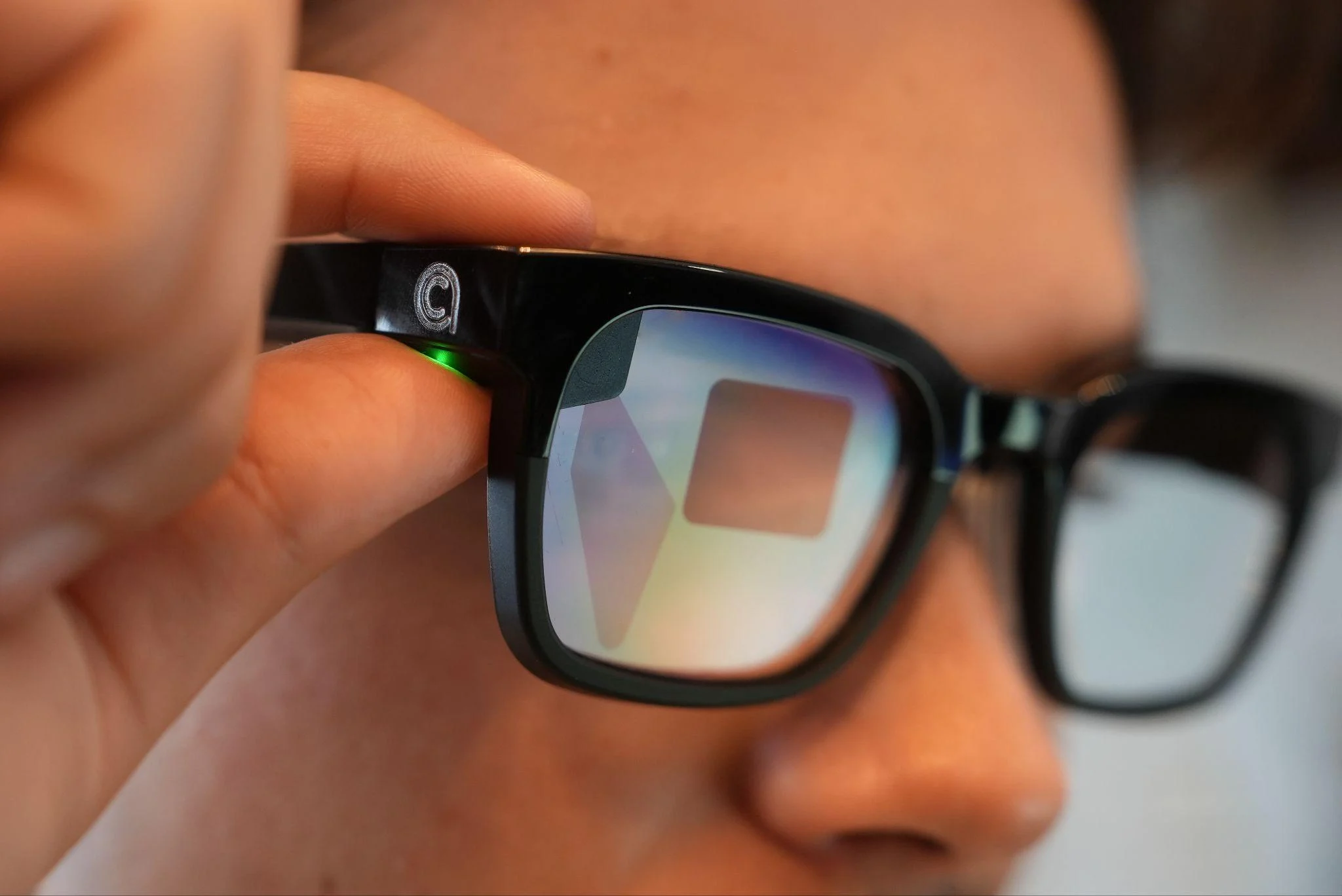
The display itself is designed to disappear. Binocular MicroLED waveguides project monochrome green text on a 30-degree field of view with under 2% light leakage — invisible to the patient across the table at conversational distance. The 49-gram frame, designed in collaboration with Bolon Eyewear, is lighter than most prescription glasses and fits any prescription from -16 to +16 diopters through interchangeable lens holders any optician can fit. Patients see a doctor wearing glasses. They don't see a screen between themselves and the doctor.


The HIPAA Architecture Underneath

HIPAA compliance is the gate every clinical wearable has to clear before any physician can put it on a patient. The reason is the breach math: the average healthcare data breach cost $9.77 million in 2024, the costliest sector for the 14th consecutive year (IBM Cost of a Data Breach, 2024). HHS Office for Civil Rights logged 725 healthcare breaches of 500 or more records in 2024, exposing over 275 million records and representing a 63.5% year-over-year jump in records affected (HHS OCR Breach Portal, 2024). For an in-room device that handles PHI, the architecture decisions are the entire product story.

AirCaps' clinical posture stacks four controls on top of standard SOC 2 Type 2:

ControlWhat AirCaps DoesWhy It Matters
Business Associate AgreementStandard BAA available on the Pro and Enterprise tiersRequired by HHS before any covered entity can use a third-party tool with PHI
Encryption in transit and at restTLS 1.3 in transit, AES-256 at restMinimum HIPAA Security Rule technical safeguard
Audit loggingPer-encounter audit trail with timestamps, speakers, and access eventsRequired for HIPAA accountability and breach notification
Patient consent captureVisible recording indicator on the device, plus per-encounter consent workflowState law varies — California, Florida, Illinois, Maryland, Massachusetts, Pennsylvania, and Washington require all-party consent
Configurable retentionEncounter data can be set to zero-retention, 30-day, or longer windows per BAA termsHospitals scope retention to minimum necessary; some jurisdictions require deletion within fixed windows
Hardware securityFCC and CE certified hardware; no camera, no video captureRemoves the privacy concern that has slowed adoption of camera-equipped wearables in clinical settings

The decision physicians actually face is which encounter types fit the wearable. AirCaps' clinical guidance — built with our healthcare advisory clinicians — is that the glasses are appropriate for routine clinical encounters with patient consent, including office visits, bedside rounds, discharge instructions, and medication review. They are not appropriate for legally protected encounters that require credentialed human interpretation or a witnessed signed consent — substance-of-decision conversations, surrogate decision-maker meetings, end-of-life discussions where the chart-of-record carries legal weight. For those moments, the certified human interpreter and the documented witnessed consent are the right tools. The wearable supports the routine work that surrounds those moments.

The other architectural detail worth flagging is the lack of a camera. Most consumer AR glasses include a camera. AirCaps does not. The clinical implication is that the device captures speech but never image — patients in gowns, exposed wounds, and shared waiting room visuals never enter the data flow. For HIPAA Privacy Rule purposes, the device captures only protected health information explicitly within scope of the BAA and the patient consent workflow.

Citation Capsule: Healthcare data breaches averaged $9.77 million in 2024, the costliest sector for 14 years running, and HHS logged 725 breaches affecting more than 275 million records that same year. HIPAA architecture for clinical wearables has to assume an active threat environment — BAA, AES-256, TLS 1.3, audit logging, patient consent capture, and no camera are the baseline, not the upgrade (IBM, 2024; HHS OCR, 2024).

For more on the broader compliance posture across professional verticals, see our smart glasses for professionals guide. The HIPAA-grade configuration physicians get from AirCaps is the same architecture sales teams selling into healthcare and lawyers handling protected communications use.


How AirCaps Compares to Abridge, DAX Copilot, Suki, and Heidi

Phone and badge-based ambient AI scribes — Abridge, DAX Copilot, Suki, Heidi, Nuance, Augmedix — solved the documentation transcription problem. They are excellent at structured SOAP notes generated from a microphone in your white coat pocket. Most large health systems running ambient scribe pilots — Permanente, Kaiser, Mass General Brigham, Cleveland Clinic — chose one of those tools first, and a large share of those deployments are now in steady-state production. The honest answer is that smart glasses are complementary, not directly competitive. Most AirCaps clinical customers keep their phone-based scribe in place for specific encounter types and add the glasses for the in-room layer.

A team of physicians having a diagnostic discussion in a modern hospital meeting room, illustrating multi-clinician case conferences smart glasses are designed for

CapabilityPhone/Badge Scribes (Abridge, DAX, Suki, Heidi)AirCaps Smart Glasses
Form factorPhone in coat pocket or badge on lapelGlasses on your face
Eye contact during encounterPreserved (no screen)Preserved (lens is peripheral)
Live caption displayNone during the encounterOn the lens, real time, 300ms
Speaker identificationYes (post-encounter)Yes (live, 15 speakers)
Beamforming microphonesSingle device mic4-mic array
Noisy ward / busy clinicAccuracy varies with phone positionDesigned for 78 dBA environments
Hard-of-hearing patient supportNone nativeNative (the original use case)
Live translation in encounterLimited or post-hocLive, 60+ languages, 700ms
Mid-encounter recallLimited (post-encounter summary)Yes, queryable mid-conversation
SOAP note draftYes, the core featureYes, draft generated post-encounter
HIPAA / BAAYes for most vendorsSOC 2 Type 2, HIPAA, GDPR
Camera on deviceNoneNone
Hardware cost$0 (uses phone)$599 one-time
Subscription$100-300/user/month typicalOptional $20/month, free tier forever

Where smart glasses pull decisively ahead is the in-room layer — the live captions for hard-of-hearing patients, the real-time translation for LEP encounters, the speaker-attributed transcript for bedside rounds with residents and families. Phone-based scribes hit a wall the moment the patient can't hear the doctor, the doctor needs to know what just got said in another language, or the rounding team needs structured speaker attribution across five voices. Glasses don't.

The other gap that matters clinically: most phone-based scribes optimize for the post-encounter SOAP note. AirCaps optimizes for the live encounter and treats the SOAP draft as a side effect of the verbatim transcript. For an outpatient panel like Rachel's, the two are roughly equivalent on documentation savings. For a hospitalist like Aditya, a geriatrician like Lin, or any clinician whose patient mix includes substantial LEP or hearing-impaired populations, the in-room layer is the value.

For sales teams selling into healthcare, the related comparison is our smart glasses for sales guide. The compliance posture is the same. The use case is different.


The ROI of Smart Glasses for a Practicing Physician

The math depends on specialty, panel size, and EHR template discipline, but the unifying number for clinical use is hours of documentation reclaimed plus encounter-quality lift from verbatim chief-complaint capture. Below is the conservative payback model based on customer interviews and AirCaps Pro usage data, not promises.

RoleHours Reclaimed/WeekEffective Hourly ValueAnnual ValuePayback Period
Primary Care Physician6-9 hours$120~$46,800~1 week
Hospitalist5-7 hours$160~$49,920~1 week
Specialist (cardiology, ENT, derm)4-6 hours$200~$52,000~1 week
Geriatrician5-7 hours$140~$43,680~1 week
Resident or Fellow4-6 hours$60~$15,600~3 weeks

The variance is high. A physician who already has perfect template-driven note discipline saves less; one who fights the EHR for an hour every night saves more. A clinician with a meaningful LEP or hard-of-hearing patient mix saves more on encounter quality than the hourly table reflects. The pattern that holds across every specialty is that documentation time scales with encounter count, and every encounter has a transcript leak. Smart glasses are the cheapest way to plug that leak we've seen.

The qualitative ROI question doesn't show up in the table: what does it feel like to walk out of clinic at 5:30 instead of 7:15, with the notes already drafted? For physicians who entered medicine to talk to patients and now spend half their week typing, the answer is the reason they stay in practice. That's worth more than the hourly math suggests. AirCaps hardware is HSA/FSA eligible, which makes the $599 device a pre-tax purchase for physicians buying their own — see our HSA/FSA guide for the IRS Publication 502 detail.


Where Smart Glasses Still Fall Short for Clinical Use

We've made the case for smart glasses in this piece. We also work in this category every day, which means we know the limitations. Four places smart glasses are not the right tool for clinical work today.

The first is fully remote telemedicine. If your practice is 100% video and you never see a patient in person, you don't need smart glasses. Abridge, DAX, and the major video EHR integrations are excellent at the video encounter category. Smart glasses earn their keep in the in-person and hybrid scenarios that those tools don't reach.

The second is procedural and sterile environments. Operating rooms, sterile procedural suites, certain ICU environments — confirm the institution's policy on wearable electronics before walking in. AirCaps is designed for outpatient clinic, bedside rounding, and consultation use. It is not the right tool for intraoperative documentation, where the regulatory and infection-control surface is materially different.

The third is legally protected encounters that require credentialed interpretation or witnessed consent. Substance-of-decision conversations, end-of-life discussions, surrogate decision-maker meetings, certain mental health intakes, court-ordered evaluations. The certified human interpreter and the documented witnessed consent are non-negotiable in those settings. AirCaps supports the routine clinical work that surrounds those moments — and stays out of the moments themselves.

The fourth is the clinician who finds heads-up display fundamentally distracting. The lens is designed to disappear into peripheral vision, but a small subset of physicians find any in-field-of-view text incompatible with their attention pattern. We recommend a 30-day evaluation before any larger institutional rollout. The 15-day return policy covers individual buyers; institutional pilots typically run 60 to 90 days. For most clinicians the lens fades into the background within a week. For some it doesn't, and we'd rather know that before the order ships in volume.

For the broader category context — including doctors, lawyers, executives, and founders — see our pillar guide on smart glasses for professionals. The clinical use case is one of six high-value verticals; the others are documented there. For the deeper engineering on why 4 microphones beat 1, see our beamforming explainer.


Frequently Asked Questions

Are smart glasses for doctors actually HIPAA compliant?

Yes, when the vendor supports a Business Associate Agreement and meets the HIPAA Security Rule technical safeguards. AirCaps holds SOC 2 Type 2, HIPAA, and GDPR certifications with a standard BAA available on the Pro and Enterprise tiers. The device uses TLS 1.3 in transit, AES-256 at rest, per-encounter audit logging, and a visible recording indicator. Healthcare breach cost averaged $9.77 million in 2024, so the architecture is non-optional (IBM, 2024).

How much time will smart glasses actually save my charting?

For most outpatient physicians, somewhere between 30 and 90 minutes per clinic day after the first six weeks of use. The savings come from AI-drafted SOAP notes generated from speaker-attributed transcripts of each encounter — the physician reviews, corrects, and signs rather than dictating or typing from memory. Permanente Medical Group's deployment across 7,260 physicians saved an estimated 15,700+ documentation hours, with similar per-clinician math (NEJM Catalyst, 2025).

Will my patients notice I'm wearing AI glasses during a visit?

They will see a regular pair of glasses. AirCaps' binocular MicroLED display has under 2% light leakage, below the threshold most observers can detect at conversational distance. The 49-gram frame is lighter than most prescription glasses. There is no camera on the device — patients never appear in any data flow. Recording consent is a separate question; the lens shows a visible indicator when capture is active, and most institutions require disclosure as part of the routine encounter intake.

How do smart glasses help with patients who don't speak English?

AirCaps supports 60+ languages with automatic detection — the model identifies the patient's source language inside each utterance and translates it into English on the lens at 700ms end-to-end. No buttons, no manual selection. Code-switching is handled inside a sentence. The clinical guidance is to use the glasses for routine LEP encounters and bring in certified human interpretation for any encounter requiring informed consent or legally protected decision-of-substance. See our translation guide for the full detail.

Are smart glasses a replacement for Abridge, DAX Copilot, or Suki?

No, they're complementary. Phone-based ambient scribes excel at structured SOAP note generation from a microphone in your white coat pocket and are deployed at scale across major health systems. AirCaps adds an in-room layer the phone-based tools don't reach: live captions on the lens, real-time translation, hard-of-hearing patient support, and queryable mid-encounter recall. Most clinical customers keep their existing scribe for video encounters and add AirCaps for in-person clinic and bedside use.

How long is the battery life on a typical clinic day?

AirCaps runs 4-8 hours of mixed use on the built-in battery, which covers most outpatient clinic days. Continuous display use is 2-4 hours. The Power Capsules accessory ($79) adds two magnetic hot-swap batteries for 18 hours of continuous use, which covers extended rounding, on-call shifts, and conferences. Fast charge delivers 2 hours of use in 15 minutes. Most clinicians we work with charge once at lunch and run all day.

Does AirCaps work with Epic, Cerner, or Athenahealth?

Yes, AirCaps Pro supports integration with major EHR systems through standard FHIR APIs and partner integrations. Out-of-the-box mappings cover Epic, Oracle Health (formerly Cerner), Athenahealth, and athenaOne. Custom field mappings are available on the Enterprise tier. The integration flow puts AI-drafted SOAP notes into the physician's inbox for review and signature — no transcript ever auto-writes to a chart-of-record without explicit clinician sign-off.

What does smart glasses cost for a healthcare practice?

AirCaps hardware is $599 per unit. The Pro tier — which adds 60+ languages, AI summaries, speaker identification, EHR integration, and BAA coverage — is $20 per user per month with a 30-day free trial included with purchase. Enterprise pricing for BAA-scoped SOC 2 reports, custom integrations, admin controls, and volume discounts is available on request. The hardware is HSA/FSA eligible, which lowers the effective cost by 22-35% for individual physicians. See our HSA/FSA guide for the IRS detail.


The Honest Verdict

Medicine in 2026 is harder than it was in 2015. EHR documentation followed physicians home, the average clinic day grew, and the share of the week spent face-to-face with patients dropped below half. The physicians climbing back out of the burnout pit are the ones who've turned AI into a partner instead of another tab — the Permanente data is the headline, but the texture is that the partnership has to live in the encounter, not in the dashboard you check after dinner.

Smart glasses for doctors are the form factor that finally puts the AI inside the encounter. Live captions on the lens at 300 milliseconds, 4-microphone beamforming that holds up in a noisy ward, speaker identification across patient, family, resident, and interpreter, SOAP draft notes generated from verbatim transcripts, and translation for the 29.6 million Americans who don't speak English at home. None of those features individually saves a clinic day. Combined, they let a physician run the encounter the patient is actually having instead of the encounter the EHR template anticipated.

The hardware is no longer the question. AirCaps weighs 49 grams, hits 97% caption accuracy at 300ms latency, identifies 15 speakers, supports 60+ languages, has no camera, and clears SOC 2 Type 2, HIPAA, and GDPR. The question is whether your career happens in encounters the existing tools can't see — the patient who speaks quietly, the patient who speaks Spanish, the patient who can't hear you, the resident whose handoff depends on the texture of your chief complaint. If yes, smart glasses are the most concrete clinical productivity upgrade available in 2026. If no, your existing scribe and EHR stack will keep working.

For physicians ready to pilot, see AirCaps for meetings. For multilingual encounters across borders, see translation. For the original captioning use case that built the company, see AirCaps captions. For the broader professional context — sales, legal, executive, founder — see our pillar on smart glasses for professionals. And for the engineering on why 4 microphones beat 1 in a 78 dBA clinic, see our beamforming explainer.

The encounter happens in the room. The phone in your white coat pocket is the scribe you're already running. The one that fits on your face — and stays out of the conversation — is the one that finally lets the AI work where the work actually happens.

Written by

Madhav Lavakare

Madhav Lavakare

Co-founder & CEO, AirCaps

Co-founder of AirCaps. Building AI-powered smart glasses for conversation since 2013. Yale graduate, Y Combinator alum. Built his first Google Glass apps at age 13 and has spent 11+ years in speech AI and wearable computing.

LinkedInX / Twitter

Related Articles

Diverse business professionals collaborating around a conference table during a strategy meeting where real-time AI meeting intelligence would augment every participant

Guides

Smart Glasses for Professionals: AI Meeting Intelligence That Fits in Your Pocket

Smart glasses for professionals layer AI meeting intelligence — captions, summaries, speaker ID, instant recall — onto any conversation. A complete 2026 guide for sales, healthcare, executives, and founders.

Madhav Lavakare

Madhav Lavakare

·

Apr 28, 2026

·

27 min read

Three generations of a family lying together on the floor smiling and connecting with one another

Guides

Talking to Grandparents: How Translation Glasses Bridge the Family Language Gap

By the third generation, only 24% of immigrant grandchildren still speak the heritage language. Three family stories show how 700ms translation glasses are bringing grandparents and grandchildren back into the same conversation.

Vishal Moorjani

Vishal Moorjani

·

May 24, 2026

·

26 min read

Two international business professionals shaking hands across a desk after closing a cross-border deal, signaling agreement and partnership

Guides

Translation Glasses for Business: Closing Deals Across Language Barriers

Cross-border B2B deals stall on language. Three deal stories from Tokyo, São Paulo, and Munich show how 700ms translation glasses are quietly rewriting how enterprise sales close in 2026.

Vishal Moorjani

Vishal Moorjani

·

May 23, 2026

·

25 min read

AccessoriesBlogShipping & ReturnsPrivacy PolicyTerms of ServiceCookie Policy

© 2025 AirCaps. All rights reserved.