Captioning Glasses for Aging Parents: What Families Need to Know
55% of adults 75+ have disabling hearing loss (NIDCD, 2024), yet fewer than 1 in 3 ever use hearing aids. A practical family guide to captioning glasses: who they're for, what to look for, and how to set them up for a parent.
By Madhav Lavakare · Published 2026-04-22 · 21 min read
Why Captioning Glasses Matter for Aging Parents
Table of Contents
Why Is Hearing Loss So Underdiagnosed in Older Parents?
Are Captioning Glasses a Good Fit for an Aging Parent?
Captioning Glasses vs. Hearing Aids for Seniors: Which Is Right?
How Does Untreated Hearing Loss Affect Cognitive Health?
What Features Matter Most When Buying for a Parent?
How Do You Set Up Captioning Glasses for a Parent Who Isn't Tech-Savvy?
What Will It Cost, and Can You Use HSA or FSA Funds?
How Do You Talk to a Parent Who Refuses Hearing Help?
Frequently Asked Questions
How do I know if my parent's hearing loss is serious enough for captioning glasses?
Will captioning glasses work if my parent already wears hearing aids?
Can my parent use captioning glasses at a doctor's appointment?
How much does setup cost beyond the device itself?
What if my parent lives alone and I can't be there for setup?
Will my parent's existing eyeglass prescription work with captioning glasses?
What about parents with cognitive decline or early dementia?
Are captioning glasses a better gift than, say, an amplified phone?

Guides
Captioning Glasses for Aging Parents: What Families Need to Know

Madhav Lavakare
·
April 22, 2026
·
21 min read

On this page
Table of Contents
▼
Editorial disclosure: AirCaps manufactures smart glasses with real-time captioning. This article uses AirCaps specifications as reference points where relevant. We try to describe the category honestly — including the scenarios where captioning glasses help, the ones where hearing aids are still the right call, and the family dynamics families tend to run into when bringing assistive technology to an older parent.
Why Captioning Glasses Matter for Aging Parents
Roughly 22% of American adults aged 65-74 and 55% of those 75 and older have disabling hearing loss (NIDCD, 2024), yet fewer than 1 in 3 adults 70+ who could benefit from hearing aids has ever used them. The gap between who needs help and who gets it is the biggest open problem in family health today. For the adult children trying to keep an aging parent engaged at the dinner table, in the car, or on the phone, it's also personal.
Captioning glasses are a new option that didn't exist a decade ago. They convert the speech around your parent into real-time text shown inside a pair of ordinary-looking glasses. No surgery. No $5,000 hearing aid visit. No pretending to follow the conversation. This guide walks through when captioning glasses help aging parents, when they don't, how to choose a device a parent will actually wear, and how to set it up so a less tech-savvy parent can use it independently.
Key Takeaways
- 55% of adults 75+ have disabling hearing loss, and roughly 22% of adults 65-74 do too (NIDCD, 2024)
- Only about 30% of adults 70+ with hearing loss who could benefit from hearing aids have ever used them (NIDCD, 2024)
- The 2024 Lancet Commission names hearing loss the single largest modifiable risk factor for dementia — addressing it could prevent an estimated 7% of global dementia cases (Lancet, 2024)
- 91% of adults 50+ now own a smartphone, and AI use among older adults jumped from 18% to 30% in one year (AARP, 2025) — the tech comfort gap is closing fast
- AirCaps captioning glasses deliver 97% caption accuracy at 300ms latency using 4-mic beamforming, weigh 49 grams, and cost $599 (HSA/FSA eligible, no subscription required)
Table of Contents
- Why Is Hearing Loss So Underdiagnosed in Older Parents?
- Are Captioning Glasses a Good Fit for an Aging Parent?
- Captioning Glasses vs. Hearing Aids for Seniors: Which Is Right?
- How Does Untreated Hearing Loss Affect Cognitive Health?
- What Features Matter Most When Buying for a Parent?
- How Do You Set Up Captioning Glasses for a Parent Who Isn't Tech-Savvy?
- What Will It Cost, and Can You Use HSA or FSA Funds?
- How Do You Talk to a Parent Who Refuses Hearing Help?
- Frequently Asked Questions
Why Is Hearing Loss So Underdiagnosed in Older Parents?
Hearing loss in older adults is dramatically underdiagnosed because it arrives slowly, feels like something else, and carries a stigma most parents would rather not confront. About 28.8 million American adults could benefit from using hearing aids, yet only a small share of those 70+ actually do (NIDCD, 2024). Fifty-nine percent of adults 50+ haven't had a hearing test in the past five years (AARP, 2024), which means most families are operating on guesswork, not data.
The clinical name is presbycusis — age-related hearing loss. It usually starts in the high frequencies, where consonants like s, f, and t live. Vowels stay intact, so your parent can still "hear" speech, they just can't distinguish the words. That's why they'll swear their hearing is fine, then misunderstand every third sentence. From the outside it looks like stubbornness or distraction. From the inside it feels like the world got mumbly.
There's a second driver too: denial. Many parents associate hearing aids with frailty and have watched their own parents wear clunky beige devices. Captioning glasses sidestep that association because they look like eyeglasses — a product category older adults already wear, understand, and don't find embarrassing. That alone changes the adoption conversation.

Are Captioning Glasses a Good Fit for an Aging Parent?
Captioning glasses fit aging parents best in the specific scenarios where hearing aids historically fail: restaurants, family dinners, medical appointments, and group conversations with grandchildren. They're less useful in quiet one-on-one conversations at home where a hearing aid or amplifier already works. The right question isn't "do they need them?" It's "where does their current hearing setup break down, and will captions fix that scenario?"
The clearest signal that a parent is a good candidate is if they've started declining social invitations. Skipping family dinners, avoiding phone calls, disengaging from the grandchildren — these are withdrawal behaviors that track with untreated hearing loss. Multiple verified AirCaps customer reviews describe this pattern: a parent who'd gone quiet at restaurants re-engages after captions arrive in their glasses. One customer described it as "the first response was tears in our family." That's the shape of the fit.
A second signal is unreliable hearing aids. Many parents wear hearing aids that work at home but fail in restaurants, at family gatherings, or in group conversations — exactly where families most want them to participate. Captioning glasses aren't a replacement in that case. They're a complement. Wear the hearing aid for ambient sound, turn on the glasses for conversation. The two technologies cover different problems.
| Signal | What It Looks Like | Captioning Glasses Fit |
|---|---|---|
| Declines invitations to loud venues | Skips restaurant dinners, family birthdays, reunions | Strong fit — this is the core scenario |
| Wears hearing aids but still misses conversation | "My hearing aids don't work in restaurants" | Strong fit as a complement |
| Struggles with doctor appointments | Asks the doctor to repeat, leaves confused about instructions | Strong fit — clinical accuracy matters here |
| Disengages from grandchildren | Grandkids speak quietly or quickly; parent smiles but doesn't respond | Strong fit — high-pitched voices are the hardest for hearing aids |
| Mild loss, quiet lifestyle | Watches TV with captions on, rarely goes out | Weaker fit — TV captions and amplified phones may be enough |
| Severe cognitive decline | Difficulty with new routines, can't manage a smartphone | Case-by-case — simpler solutions often fit better |
Captioning Glasses vs. Hearing Aids for Seniors: Which Is Right?
Hearing aids and captioning glasses solve different problems, and for most aging parents the right answer is both — not either. Hearing aids amplify sound so your parent can hear a doorbell, a car horn, or a grandchild calling from the next room. Captioning glasses turn speech into text so your parent can follow a conversation when amplification isn't enough. A 2024 review of hearing technology adoption found hearing aid use among adults who need them has plateaued near 39% after decades of outreach (PMC, 2025), which suggests amplification alone hasn't solved the problem.
The scenarios split cleanly. Hearing aids win for ambient awareness, TV at home, phone calls with a friend, and quiet one-on-one visits. Captioning glasses win for restaurants, doctor's appointments, multi-person family dinners, religious services, and anywhere background noise overwhelms a hearing aid. The 4-microphone beamforming array in AirCaps — which focuses on the speaker your parent is facing and filters noise from elsewhere — was specifically engineered for the scenarios where traditional single-mic hearing aids break down.
Price is also different. Prescription hearing aids run $4,000 to $6,000 a pair and Medicare generally doesn't cover them (AARP, 2024). AirCaps is $599, HSA/FSA eligible, with a free-forever tier for basic captions. For a family weighing whether to add captioning glasses on top of existing hearing aids, the math is approachable in a way the hearing aid decision rarely is.
| Need | Hearing Aids | Captioning Glasses | Both Together |
|---|---|---|---|
| Hear the doorbell, timer, traffic | Yes | No | Covered by hearing aids |
| Follow a conversation in a quiet room | Yes | Yes | Either works |
| Follow a conversation in a restaurant | Often fails | Yes (97% accuracy) | Glasses shine here |
| Understand the doctor in an exam room | Partial | Yes | Glasses pick up fast speech clearly |
| Family dinner with grandchildren | High voices challenging | Yes | Glasses handle high-pitched voices |
| Music enjoyment | Yes | No (captions don't apply) | Hearing aids only |
| Out-of-pocket cost | $2,000-$6,000 | $599 (HSA/FSA eligible) | Tiered by need |
Most audiologists have never fitted captioning glasses on a patient, which is why families rarely hear about them during a clinical visit. That doesn't mean the audiologist is wrong — it means the profession is still catching up. If your parent's audiologist shrugs when you mention captioning glasses, don't take that as a verdict. The device category is younger than most of the clinical training programs.
How Does Untreated Hearing Loss Affect Cognitive Health?
Untreated hearing loss is the single largest modifiable risk factor for dementia, according to the 2024 Lancet Standing Commission on Dementia Prevention (The Lancet, 2024). The Commission identified 14 modifiable risk factors that account for roughly 45% of global dementia cases, and eliminating hearing loss could prevent an estimated 7% of cases worldwide. That's the largest single-factor estimate in the report — larger than smoking, physical inactivity, or social isolation in isolation.
The mechanism is believed to be partly cognitive load and partly social disengagement. When a brain works harder to parse degraded speech, fewer resources are available for memory formation and comprehension. Meanwhile, people with untreated hearing loss withdraw from conversations, shrinking the social engagement that independently protects cognitive health. The Commission's meta-analysis found a 16% increase in dementia risk for every 10-decibel worsening of hearing (Lancet, 2024) — a dose-response relationship that's now well-established in the research literature.
The AARP Global Council on Brain Health report found that 78% of adults 50+ would be extremely or very likely to address their hearing if they understood the brain-health risks (AARP, 2024). In other words, most parents aren't refusing help — they just don't know the stakes. Framing the conversation around dementia prevention rather than hearing aid adoption moves the needle more than any spec sheet can.
When we've talked to adult children of AirCaps users, the cognitive angle lands differently than the social one. A daughter buying captioning glasses for her 78-year-old father told us: "I didn't care whether he wore them at dinner. I cared about what his brain would look like in five years." That reframe — from social embarrassment to long-term brain health — converts parents who had previously refused to discuss hearing aids. Every family we've spoken to arrived at that frame independently.

What Features Matter Most When Buying for a Parent?
Buying captioning glasses for a parent requires prioritizing different features than buying them for yourself. For a parent, the top considerations are readability (larger font sizes, high contrast), frame comfort (lightweight, adjustable, won't pinch), simplicity of operation (pair once, works forever), and the ability to fit an existing prescription. Raw spec leadership matters less — what matters is whether your parent will actually put the glasses on in the morning.
Font size and display brightness sit at the top of the list. AirCaps lets users adjust font, size, and screen position directly from the companion app — a capability many competitors don't offer. For a parent with age-related macular changes or presbyopia, the difference between an 18-point caption and a 28-point caption is the difference between wearing the device and abandoning it. Binocular MicroLED displays (one per eye) also matter here: monocular systems cause eye strain that older eyes tolerate poorly.
Frame comfort is the other quiet killer. A 49-gram frame — AirCaps weighs less than most regular eyeglasses — sits comfortably across a three-hour dinner or a doctor's appointment. Heavier frames leave red marks on the nose bridge and temples after an hour. Hypoallergenic nose pads, silicone-lined interior surfaces, and prescription compatibility from -16 to +16 diopters through any optician are features your parent will notice even if they can't articulate why.
| Feature | Why It Matters for a Parent | AirCaps Spec |
|---|---|---|
| Adjustable font size and position | Older eyes need larger text; position matters with progressive lenses | Customizable via app |
| Frame weight | Light enough to wear three-hour dinners without fatigue | 49 grams |
| Binocular display | Monocular causes eye strain that older eyes tolerate poorly | Binocular MicroLED, both lenses |
| Caption accuracy in noise | The restaurant scenario is where parents withdraw most | 97% at 78 dBA restaurant noise |
| 4-mic beamforming | Focuses on the person across from your parent; filters ambient chatter | 4 microphones with beamforming |
| Latency | Above 400ms, captions lag behind lips and feel unnatural | 300ms end-to-end |
| Prescription support | Any optician can fit Rx; parent keeps their current eye doctor | -16 to +16 diopters, any optician |
| Setup simplicity | Pair once, works forever; no session-by-session fiddling | One-time Bluetooth pairing with iOS or Android |
| Subscription structure | Fixed income buyers shouldn't face rising monthly fees | Free tier forever; optional $20/mo Pro |
Language support matters if your parent speaks a language other than English at home. Many immigrant families have a grandparent who speaks Spanish, Mandarin, Tagalog, Punjabi, or another heritage language with grandchildren who speak English primarily. Captioning glasses with translation in 60+ languages and automatic detection let a grandparent and grandchild hold a conversation in their respective languages — something no hearing aid can do.
How Do You Set Up Captioning Glasses for a Parent Who Isn't Tech-Savvy?
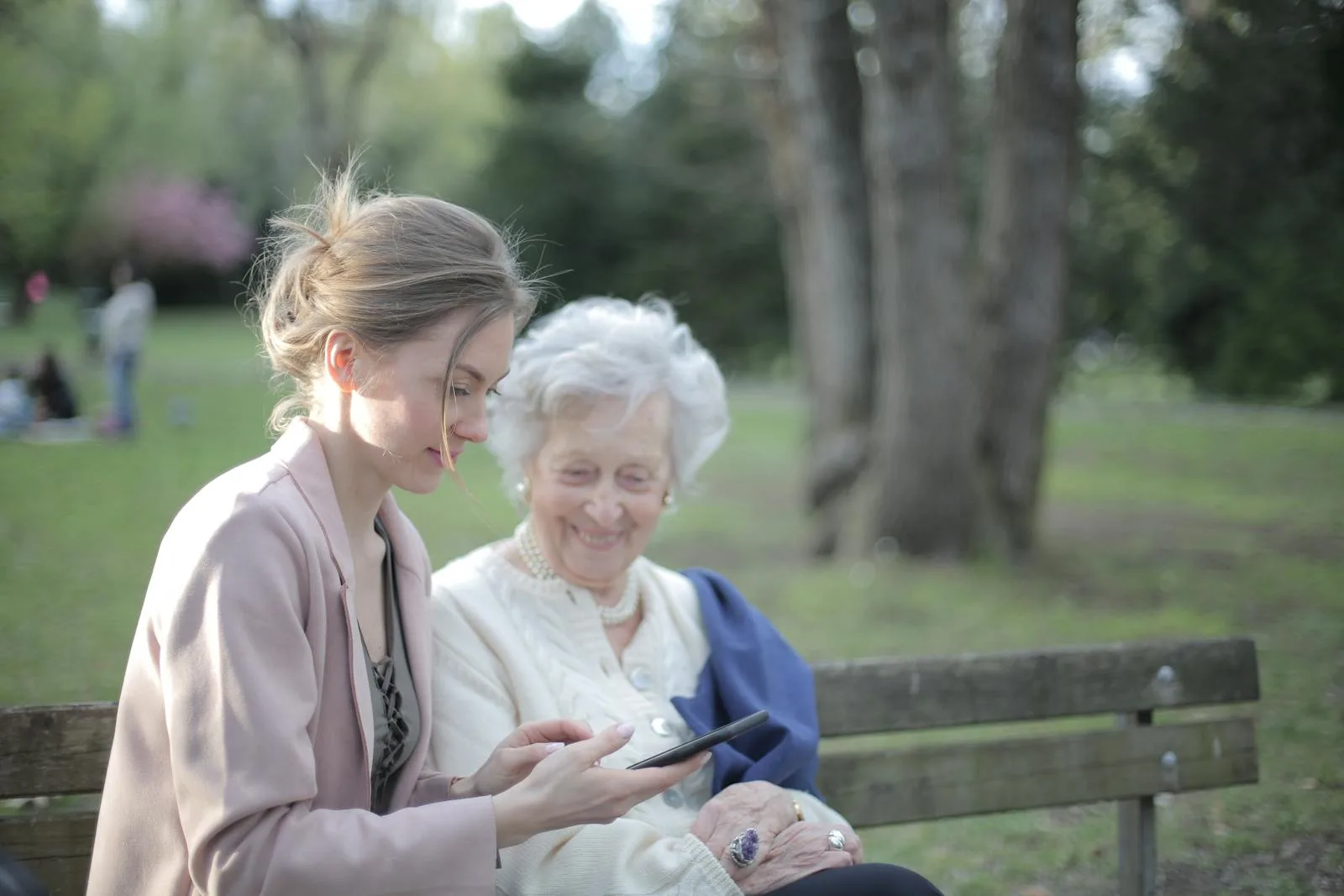
Setup is the moment most adult children worry about, and it's simpler than it looks. The goal is "pair once, never fiddle again." You do the setup on your parent's smartphone during a visit. After that, the glasses wake up, connect automatically, and show captions. Your parent doesn't need to open the app, choose a language, or tap anything. If the device requires ongoing configuration per session, you chose the wrong device.
Here's the six-step setup that works for most families.
-
Update the parent's smartphone to the current OS. AirCaps pairs over Bluetooth 5.3 Low Energy with iOS 15+ or Android 10+, and a current OS makes everything smoother.
-
Install the AirCaps app on the parent's phone, sign in once, and grant microphone and Bluetooth permissions. Then walk them through the one-time onboarding flow with them sitting next to you — not remotely over the phone.
-
Set the defaults the way your parent wants them. Maximum font size, high-contrast captions, English as the primary language, automatic caption start on power-up. Save these as the default so they persist between sessions.
-
Pair the glasses once. Charge them to 100%, open the AirCaps app, tap "Pair New Device," and follow the prompts. The pairing sticks for the life of the device; your parent will never need to do this again.
-
Demonstrate the core usage scenario. Sit across from your parent at their kitchen table, have them put the glasses on, and hold a normal conversation. Let them see the captions appear in real-time. Then repeat at a noisy venue — a coffee shop works — so they see how beamforming handles background noise.
-
Write a one-page cheat sheet and tape it inside their eyeglass case. Three lines: "Press power button to turn on. Put on like normal glasses. Captions appear automatically." Nothing else. The fewer steps on paper, the more your parent will actually use them.
From AirCaps customer support logs, the three most common onboarding blockers for senior users are: outdated smartphone operating systems preventing pairing, microphone permission toggled off during initial setup, and the parent turning the glasses off and then forgetting to turn them back on. All three are one-time fixes during your setup visit. Once past them, daily usage has very low support friction — the 90% daily-usage rate across all AirCaps customers holds up cleanly in the 65+ segment.
What Will It Cost, and Can You Use HSA or FSA Funds?
AirCaps captioning glasses cost $599 and qualify as an assistive medical device, which means the purchase is eligible for pre-tax Health Savings Account and Flexible Spending Account dollars. For most families in the 22-32% federal tax bracket, HSA/FSA purchase lowers the effective cost to roughly $400-$470. Traditional Medicare doesn't cover hearing aids and generally doesn't cover captioning glasses either, but some Medicare Advantage plans and a growing number of state Medicaid programs now include some assistive listening technology.
The cost comparison against alternatives is blunt. Prescription hearing aids run $4,000 to $6,000 a pair at a clinical audiologist; over-the-counter hearing aids start around $800; captioning glasses sit at $300 to $5,000 depending on manufacturer, with AirCaps at $599. The AirCaps free-forever tier means the captions keep working for 9 languages even if your parent never pays the optional $20/month Pro subscription — critical for fixed-income buyers who don't want recurring expenses.
| Option | Price Range | Ongoing Cost | HSA/FSA Eligible |
|---|---|---|---|
| Prescription hearing aids (pair) | $4,000 - $6,000 | Service contracts ~$150/year | Yes |
| Over-the-counter hearing aids | $800 - $2,000 | Batteries and fitting kits | Yes |
| AirCaps captioning glasses | $599 | Free tier forever; optional $20/month Pro | Yes |
| Competing captioning glasses | $300 - $5,000 | Often $10-$30/month subscription required | Varies by product |
| Phone captioning apps | Free - $20/month | Ongoing subscription | Usually no |
A few financial notes worth knowing. FSA dollars carry a December 31 deadline, which is why Q4 is the heaviest buying season for captioning glasses — families use expiring funds on assistive technology. HSA dollars roll over indefinitely, so there's no urgency beyond the purchase itself. Klarna and Affirm offer interest-free installment plans at checkout, which help families smooth cash flow without adding interest cost. AirCaps also provides a Letter of Medical Necessity template for families who need documentation for HSA/FSA reimbursement or insurance submission.
How Do You Talk to a Parent Who Refuses Hearing Help?
A parent who has refused hearing aids for years may still accept captioning glasses, and the reason is mostly about framing. Hearing aids come loaded with baggage — they signal aging, frailty, and a category of medical devices older adults have watched friends struggle with for decades. Captioning glasses look like ordinary eyeglasses, a product category your parent already wears, already trusts, and already knows how to put on. The conversation starts from a different place.
The framing that tends to work is not "you need help hearing." It's "I want you to stay engaged with the family." The AARP research is clear: 78% of adults 50+ would address their hearing if they understood the brain-health risks (AARP, 2024). The dementia connection is often the opener that moves a conversation that was previously stuck. Not "you're getting old." Not "this is for your deafness." Instead, "this protects your brain and keeps you at the table with the grandchildren."
A few practical conversation tactics that land well. Bring it up at a low-stakes moment, not mid-frustration at a noisy restaurant when your parent has already shut down. Lead with a specific scenario your parent cares about — the granddaughter's school play, the doctor's appointment where they missed the medication dosage, the family dinner where they left early. Offer the 15-day return window as a low-commitment trial. And frame the purchase as a gift, not a prescription: the giver posture reduces the defensive response parents have to anything that sounds like "you have a problem."
The most common pattern we see in AirCaps adoption stories is that a parent who refused hearing aids for 5-10 years tries captioning glasses in week one and keeps wearing them. The refusal wasn't about denial of hearing loss — it was about refusing the hearing aid identity. Given a different path with a different object, the same parent often arrives at the same destination. One 82-year-old customer put it plainly: "These look like glasses. Hearing aids look like hearing aids." That sentence carries more weight than any statistic.

Frequently Asked Questions
How do I know if my parent's hearing loss is serious enough for captioning glasses?
The threshold isn't a decibel measurement — it's behavioral. If your parent has withdrawn from family dinners, declines phone calls, or struggles to understand grandchildren, captioning glasses address those specific scenarios regardless of formal diagnosis. About 55% of adults 75+ have disabling hearing loss per NIDCD, so the probability your parent falls into that group increases steeply with age. A professional hearing test is still worth getting for a baseline.
Will captioning glasses work if my parent already wears hearing aids?
Yes, captioning glasses complement hearing aids rather than replace them. Hearing aids handle ambient awareness — doorbells, traffic, phone rings — while captioning glasses convert speech to readable text in noisy or fast-paced conversations. Many AirCaps customers use both: hearing aids throughout the day for general listening, captioning glasses at restaurants, medical appointments, and multi-person family gatherings where hearing aids alone fall short.
Can my parent use captioning glasses at a doctor's appointment?
Yes, and medical appointments are one of the highest-value scenarios. Captioning glasses display exactly what the physician says in real time, which helps your parent catch medication names, dosage schedules, and follow-up instructions they would otherwise miss or misremember. AirCaps is HIPAA compliant and processes audio in a temporary buffer that's discarded after captions render. Bring the glasses to the exam. Tell the physician in advance so they don't startle.
How much does setup cost beyond the device itself?
Zero for AirCaps beyond the $599 device. Both iOS and Android apps are free, the Free Tier works forever with 9 languages and 90%+ accuracy, and optional prescription lenses cost $39 plus standard optician fees at any licensed eye doctor. There are no activation fees, no mandatory subscriptions, and no service contracts. The Pro Tier ($20/month) unlocks 60+ languages and 97%+ accuracy but is optional.
What if my parent lives alone and I can't be there for setup?
Setup can happen over video call, but hands-on is meaningfully easier. If remote setup is the only option, use FaceTime or Zoom with screen-sharing on your parent's phone. Walk through the app install, pairing, and font-size defaults step by step. AirCaps also provides lifetime customer support with a 24-hour response on business days, and at least one customer review on record credits a co-founder personally resolving a setup issue. Ask for that support.
Will my parent's existing eyeglass prescription work with captioning glasses?
Yes. AirCaps accepts prescriptions from -16 to +16 diopters through any licensed optician — you don't have to go through a locked vendor process. Bring the current prescription to your parent's regular eye doctor along with the AirCaps prescription lens holder, and they'll fit custom lenses. Progressive and bifocal lenses work; your optician knows how to handle these. Budget $39 for the holder plus whatever your parent normally pays for lenses.
What about parents with cognitive decline or early dementia?
Captioning glasses help if your parent can still manage a smartphone and follow a conversation when it's displayed in text. For mild cognitive impairment, captions often reduce the cognitive load of parsing degraded speech, which in turn helps comprehension. For moderate-to-severe dementia, the device's tech dependency usually makes a simpler solution — amplified phones, TV caption boxes — a better fit. Case by case. When in doubt, use the 15-day return window to trial it.
Are captioning glasses a better gift than, say, an amplified phone?
For a parent still engaged with family life, yes. Captioning glasses work everywhere your parent goes — restaurants, medical appointments, religious services, grandchildren's school events — whereas amplified phones help in one fixed location. If your parent primarily struggles with phone calls from a stationary landline, an amplified phone is the cheaper, simpler answer. If they struggle with live conversation in the real world, captioning glasses solve the harder problem.
Sources: NIDCD — Quick Statistics About Hearing, Balance, and Dizziness, 2024. NIDCD — Age-Related Hearing Loss (Presbycusis), 2024. The Lancet Standing Commission on Dementia Prevention, 2024. AARP — Hearing Loss and Dementia Press Release, 2024. AARP Global Council on Brain Health — Hearing Report, 2024. AARP — Caregiving in the U.S. 2025, 2025. AARP — 2025 Technology Trends of Older Adults, 2025. WHO — Deafness and Hearing Loss, 2024. PMC — Hearing Aid Adoption Trends (MarkeTrak 2025), 2025. Image credits: Pexels (royalty-free).
On this page
Table of Contents
▼
Written by
Madhav Lavakare
Co-founder & CEO, AirCaps
Co-founder of AirCaps. Building AI-powered smart glasses for conversation since 2013. Yale graduate, Y Combinator alum. Built his first Google Glass apps at age 13 and has spent 11+ years in speech AI and wearable computing.
Related Articles

Guides
Captioning Glasses in Places of Worship: Hearing Sermons, Prayers, and Hymns Again
55% of adults over 75 have disabling hearing loss (NIDCD, 2024), and worship spaces are the hardest rooms to hear in. How captioning glasses restore the sermon, the prayers, and the hymns.
Madhav Lavakare
·
Jul 7, 2026
·
19 min read

Guides
Hearing Loops and Telecoils vs. Captioning Glasses: What Public Venues Need to Know
Only about 34% of hearing aid wearers know they have a telecoil (Hearing Review, 2014). Here's what hearing loops, ALS receivers, and captioning glasses each reach.
Madhav Lavakare
·
Aug 1, 2026
·
22 min read

Guides
Listening Fatigue: The Hidden Cost of Hearing Loss (and How Captions Help)
A systematic review of 24 studies found 67% linked hearing loss to increased fatigue (Holman, 2021). What listening fatigue costs, and where captions help.

Nirbhay Narang
·
Jul 29, 2026
·
23 min read
© 2025 AirCaps. All rights reserved.