Caption Glasses vs. Hearing Aids: What's the Difference?
Hearing aids amplify sound; caption glasses show real-time text. Learn how they differ, where each excels, and whether you might benefit from both.
By AirCaps Team · Published 2026-09-17 · 9 min read
Caption Glasses vs. Hearing Aids: At a Glance
What Are Hearing Aids?
What Are Caption Glasses?
The Key Difference: Hearing Sound vs. Seeing Speech
When Hearing Aids May Be Useful
When Caption Glasses May Be Useful
Can You Use Caption Glasses With Hearing Aids?
Caption Glasses vs. Hearing Aids: Which Is Right for You?
You may be interested in hearing aids if:
You may be interested in caption glasses if:
You may want to explore both if:
Frequently Asked Questions
Can caption glasses replace hearing aids?
Can you use caption glasses with hearing aids?
Do caption glasses amplify sound?
How do caption glasses work?
Are caption glasses the same as hearing aids?

Guides
Caption Glasses vs. Hearing Aids: What's the Difference?

AirCaps Team
·
September 17, 2026
·
9 min read

On this page
Table of Contents
▼
Editorial disclosure: AirCaps manufactures caption glasses. This article compares them with FDA-regulated hearing devices and explains how the two can complement each other. It is informational and is not medical advice.
When you start researching caption glasses vs. hearing aids, it helps to know upfront that they're not competing for the same job. Many people use both together.
Hearing aids amplify and process acoustic sound so it's easier for your ears to pick up. Caption glasses take a different approach: they capture spoken speech, convert it to text using AI, and display it in your field of view. One works through your hearing, the other through your eyes, and for many people the two work well side by side.
This guide walks through how each works, where each tends to help most, and how you might use them together.
Caption Glasses vs. Hearing Aids: At a Glance
| Feature | Hearing Aids and Implants | Caption Glasses |
|---|---|---|
| Primary purpose | Amplify and process acoustic sound or, for implants, convert sound into electrical nerve stimulation | Convert spoken language into real-time visual text |
| Main input | Ambient acoustic sound captured by microphones | Spoken voice captured by frame-mounted microphones |
| Main output | Amplified sound or electrical nerve stimulation | Text displayed in your field of view |
| How information reaches you | Through hearing | Through sight |
| Converts speech to text | No | Yes |
| Background noise handling | Directional microphones and noise reduction help, but speech discrimination can still drop in loud settings | Multi-microphone beamforming can isolate the speaker; transcription still depends on capturing clean audio |
| Multiple speakers | Provides ambient sound, but overlapping conversations in noise can remain difficult | Displays text sequentially and can struggle when several people talk at once |
| Phone and internet dependency | None for basic hearing-aid function | Typically uses a paired smartphone; internet improves cloud features, while supported offline modes vary by product |
| Often best suited for | Everyday sound awareness, casual conversation, music, TV, and quiet-to-moderate settings | Noisy restaurants, lectures, group meetings, high-stakes conversations, and multilingual settings |
| Can they be used together? | Yes | Yes - including alongside many behind-the-ear or receiver-in-canal hearing aids and cochlear implant processors |
What Are Hearing Aids?
Hearing aids are small wearable devices that amplify and process sound so it is more audible to someone with hearing loss. Modern digital hearing aids are more sophisticated than a simple volume boost: they are wearable computers running continuous signal processing tailored to an individual's hearing profile.
Core techniques may include:
- Frequency-specific amplification: Dividing sound into multiple frequency bands and amplifying soft sounds more than loud ones so audio stays within a comfortable range.
- Directional microphones: Focusing on sound from a particular direction while reducing sound from the sides or rear.
- Digital noise reduction: Identifying steady background noise and reducing gain in those frequency bands.
- Feedback management: Canceling the high-pitched whistling that can occur when amplified sound re-enters the microphone.
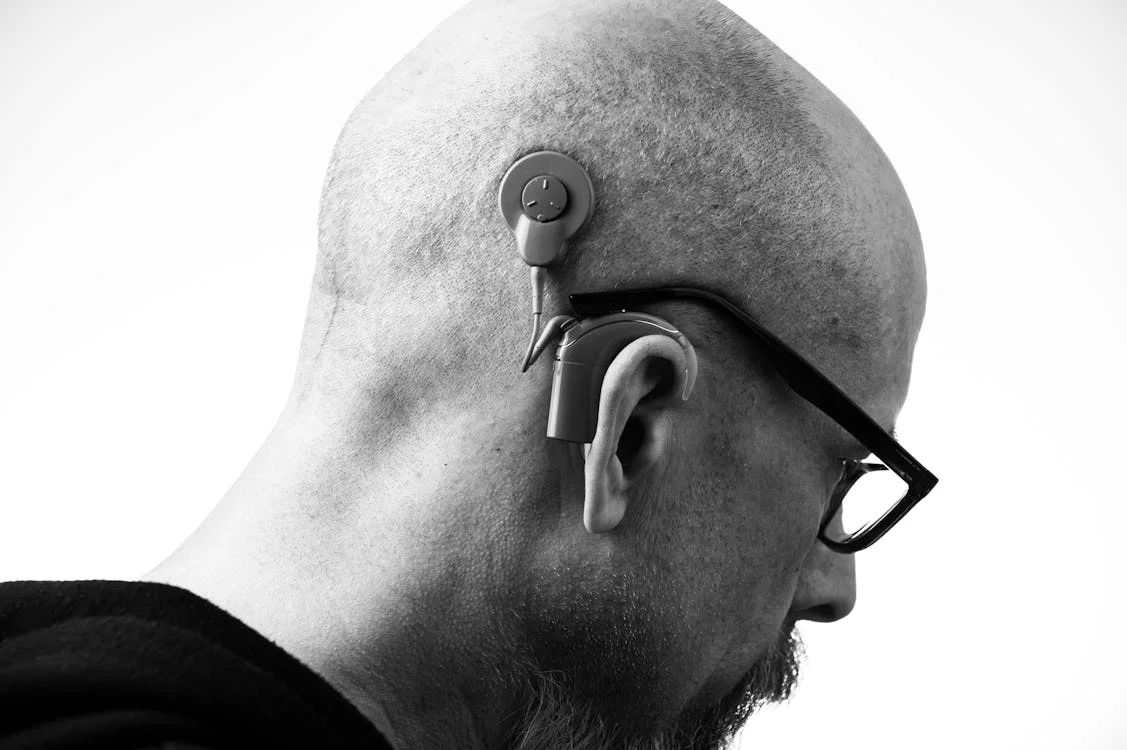
Hearing aids sit alongside a broader spectrum of hearing devices. These include over-the-counter hearing aids for adults with perceived mild-to-moderate hearing loss, bone-anchored systems for some forms of conductive loss, and cochlear implants, which stimulate the auditory nerve for some people with severe-to-profound hearing loss. The FDA regulates hearing aids as medical devices and separately regulates cochlear implants.
What Are Caption Glasses?
Caption glasses are head-worn devices with built-in microphones and a display that shows real-time text of what is being said. The basic process has three steps:
- Audio capture: Frame-mounted microphones pick up nearby speech. Some products use a multi-microphone beamforming array to focus on a speaker.
- Speech recognition: AI processes the captured audio on a paired device, in the cloud, on the glasses, or through a combination of those systems, then converts it into text.
- Optical display: The recognized text appears on a display built into the lens, visible to the wearer.
Because the text appears directly in your line of sight, you can maintain eye contact with the person speaking instead of looking down at a phone or separate screen.
Caption glasses exist in several forms: dedicated devices built specifically for captioning, retrofitted attachments that clip onto standard prescription glasses, and general-purpose smart glasses running captioning software. AirCaps, for example, uses a four-microphone array and a private binocular display.
The Key Difference: Hearing Sound vs. Seeing Speech
- Hearing aids: Process and amplify sound. Information reaches you through hearing, so your auditory system still has to interpret the signal.
- Caption glasses: Convert speech into text. Information reaches you through sight and does not depend on how clearly your ears process the original sound.
This is the crux of the difference: hearing aids help answer "can I hear that sound?" while caption glasses help answer "what exact words were said?"
The NIDCD explains that hearing aids magnify sound vibrations so surviving hair cells can convert them into neural signals. If inner-ear damage is extensive, there are practical limits to what amplification can do. Caption glasses route spoken words through the visual system instead.
When Hearing Aids May Be Useful
Hearing aids are strongest in situations where natural sound awareness matters:
- Environmental awareness: Hearing traffic, sirens, doorbells, alarms, or someone calling from outside your field of view.
- Acoustic nuance: Preserving tone, inflection, laughter, rhythm, and cadence that text cannot fully capture.
- All-day wear: Many modern hearing aids are designed for long, self-contained daily use.
- No line-of-sight requirement: Sound can reach you even if the speaker is facing away or the room is dark.
It is also worth being clear-eyed about their limits. Directional microphones and noise reduction can improve performance, but noisy rooms and overlapping speakers remain challenging. The MarkeTrak 2022 survey found that more than 80% of hearing-aid owners were satisfied overall, while the NIDCD continues to identify noise interference and speech-signal enhancement as active areas of research.
When Caption Glasses May Be Useful
Caption glasses may help most in situations where amplification alone still leaves gaps:
- Loud environments: Busy restaurants, bars, parties, and venues where background noise competes with speech.
- Limited speech discrimination: When amplified speech is louder but not clear enough to understand reliably.
- High-stakes conversations: Medical appointments, legal consultations, and lectures where exact names, terminology, or dosages matter.
- Accents, masks, and fast speech: Visual text can provide another route to understanding unfamiliar or muffled speech.
- Real-time translation: Some caption glasses can translate spoken language into text in another language.
No captioning system is 100% accurate in every environment. Performance depends on microphone quality, background noise, speaker distance, accent coverage, connectivity, and how much speakers overlap.
Can You Use Caption Glasses With Hearing Aids?
Yes. Human speech perception is multimodal: the brain combines sound with visual information to reconstruct speech, particularly in noise. In one controlled study, adding visual speech information produced an average audiovisual benefit of 11 dB, with results ranging from 6 to 15 dB across listeners.
In practice, combining the two technologies may look like this:
- Family dinners and restaurants: Hearing aids provide tone, laughter, and ambient awareness, while captions back up words lost in the noise.
- Classrooms and lectures: Hearing aids support the overall flow while captions help with names and technical terms.
- Medical consultations: Hearing aids support the natural conversation while captions provide a visual check on medication names or dosages.
Caption glasses are intended as a complementary visual layer, not a replacement for medical hearing care. Physical fit varies by frame and hearing device, so people who wear behind-the-ear processors should check comfort before extended use.
Caption Glasses vs. Hearing Aids: Which Is Right for You?
This is not medical advice, but the following framework can help you prepare for a conversation with an audiologist or hearing-care professional.
You may be interested in hearing aids if:
- You have mild-to-moderate sensorineural or conductive hearing loss.
- You want a discreet, all-day, self-contained solution.
- Natural acoustic sound, spatial awareness, music, and TV listening matter to you.
You may be interested in caption glasses if:
- You receive limited speech clarity from amplification alone.
- You have auditory processing difficulties that make spoken language hard to decode.
- You need visual confirmation during important conversations.
- You want real-time translation during travel or international meetings.
- You communicate primarily through visual means.
You may want to explore both if:
- You already wear hearing aids or a cochlear implant but still struggle in noisy environments or group settings.
- You want a backup for medical, legal, academic, or professional conversations where missing a word has real consequences.
If you would like to see one version of caption glasses in practice, AirCaps is built for real-time conversations using a four-microphone array and a private lens display.
Frequently Asked Questions
Can caption glasses replace hearing aids?
No. Caption glasses do not amplify environmental sound or provide the same spatial awareness as hearing aids. They are a visual supplement for speech comprehension, not a substitute for amplification or professional hearing care.
Can you use caption glasses with hearing aids?
Yes. They can often be worn alongside behind-the-ear or receiver-in-canal hearing aids and cochlear implant processors, functioning as a complementary visual layer. Always check the physical fit and comfort of your specific devices.
Do caption glasses amplify sound?
No. They capture speech, convert it into text using AI, and display the text. The audio itself is not amplified or altered for the wearer's ears.
How do caption glasses work?
Microphones capture nearby speech, speech-recognition software converts it into text, and the text appears on a display in the wearer's line of sight.
Are caption glasses the same as hearing aids?
No, although many people use both. Hearing aids improve audibility through the ears, while caption glasses provide visual text through the eyes. They are also regulated differently: hearing aids and cochlear implants are medical devices, while consumer caption glasses such as AirCaps are accessibility electronics rather than hearing aids.
This article is for informational purposes and is not a substitute for professional medical or audiological advice.
Sources and references: NIDCD hearing-aid overview, FDA hearing-aid guidance, FDA OTC hearing-aid guidance, MarkeTrak 2022 hearing-aid benefit and satisfaction study, and audiovisual speech-perception study.
On this page
Table of Contents
▼
Written by
AirCaps Team
AirCaps
Building smart glasses with real-time captions, 60+ language translation, and AI meeting intelligence for the Deaf and Hard of Hearing community and professionals worldwide.
Related Articles
Guides
The Complete Guide to Hearing Loss Technology in 2026
Hearing aids, caption glasses, and apps compared for the 1.5B people with hearing loss. Accuracy, cost, and real-world performance data for 2026.

Nirbhay Narang
·
Mar 27, 2026
·
22 min read
Guides
Captioning Glasses vs. Hearing Aids: A Complete Comparison
Captioning glasses and hearing aids solve hearing loss differently. Compare accuracy in noise, restaurant performance, cost, insurance coverage, and which solution works best for your situation.

Madhav Lavakare
·
Apr 1, 2026
·
17 min read

Guides
Can't Hear in Restaurants? How Captioning Glasses Solve the #1 Hearing Loss Complaint
Restaurant noise makes hearing aids fail. Learn why captioning glasses with 4-mic beamforming maintain 97% accuracy at 78+ dBA — and how they solve the most common hearing loss frustration.
Madhav Lavakare
·
Apr 4, 2026
·
16 min read
© 2025 AirCaps. All rights reserved.