Can You Use Caption Glasses With Hearing Aids or Cochlear Implants?
Can you wear caption glasses with hearing aids or cochlear implants? Here's what's electronically and physically compatible, by device type.
By AirCaps Team · Published 2026-10-21 · 12 min read
With Hearing Aids
With Cochlear Implants
At a Glance: Hearing Aids vs. Captioning Glasses
How Many People Does This Affect?
Why Would Someone Use Both?
Hearing Aids and Glasses: The Physical Fit Question
What About Cochlear Implants?
Can Captioning Glasses Interfere With Hearing Aids?
What Should You Look For in Captioning Glasses If You Wear Hearing Aids?
How AirCaps Was Designed With Deaf and Hard-of-Hearing Users in Mind
AirCaps and Hearing Aids: What We Know
Practical Considerations by Device Type
Can Captioning Glasses Replace Hearing Aids?
Frequently Asked Questions
Can you wear caption glasses with hearing aids?
Can you wear caption glasses with a cochlear implant?
Do captioning glasses interfere with hearing aids?
Can people with BTE hearing aids wear captioning glasses?
Are captioning glasses a replacement for hearing aids?
Are captioning glasses useful for people with cochlear implants?

Guides
Can You Use Caption Glasses With Hearing Aids or Cochlear Implants?

AirCaps Team
·
October 21, 2026
·
12 min read
On this page
Table of Contents
▼
If you already wear hearing aids or a cochlear implant, you can generally wear caption glasses at the same time—but "generally" is doing some work in that sentence. Electronically, the two devices don't interfere with each other. Physically, whether they sit comfortably together depends on what type of hearing aid or processor you wear. In-the-ear devices and off-the-ear cochlear implant processors have essentially no conflict with glasses. Behind-the-ear devices share space with your glasses temples, so fit becomes more of a factor. Here's what actually determines compatibility, and what to consider before choosing captioning glasses.
Short answer: yes, for both—with physical fit depending on your specific device.
With Hearing Aids
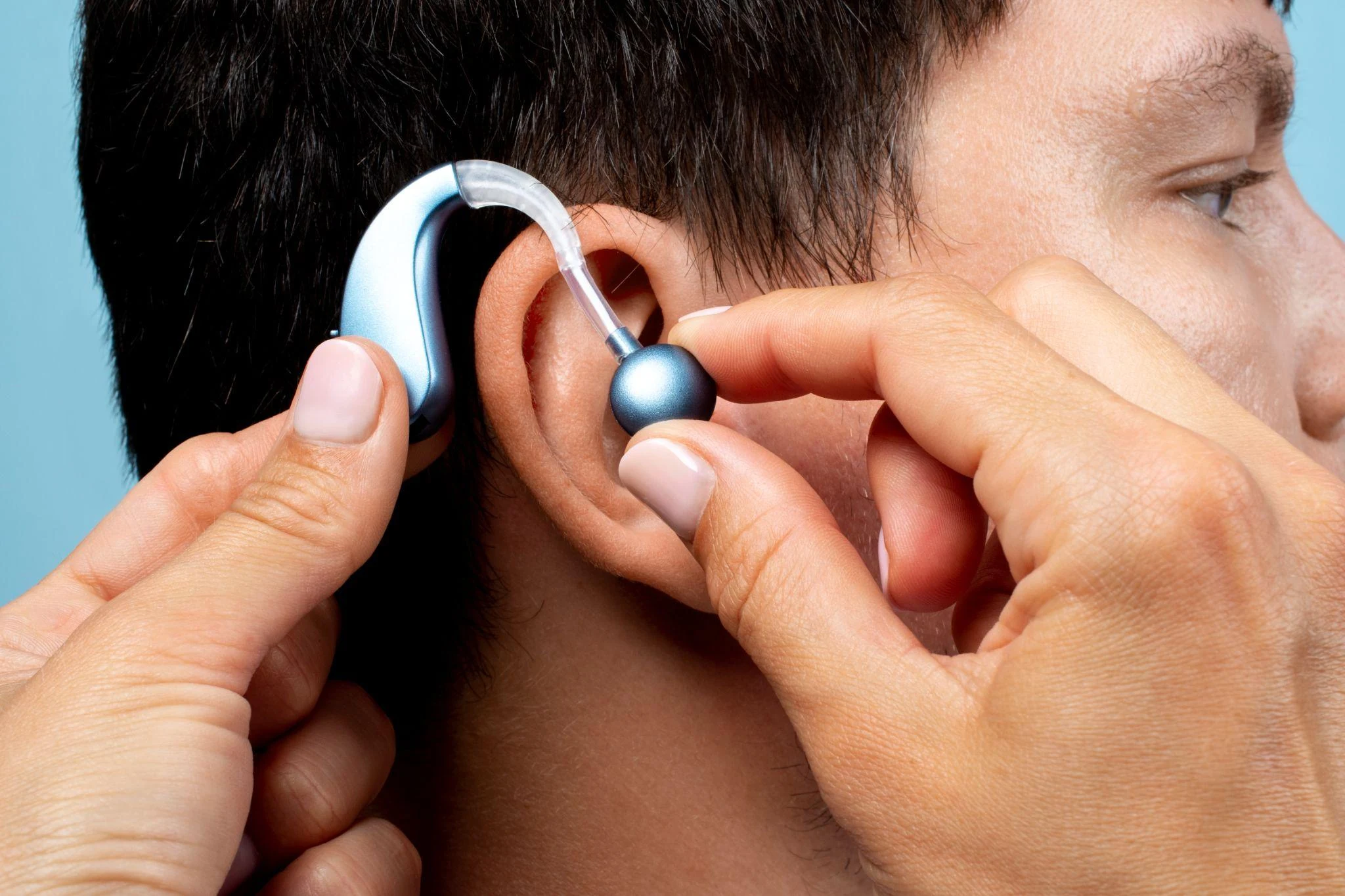
Caption glasses can be worn alongside hearing aids. In-the-ear (ITE), in-the-canal (ITC), completely-in-canal (CIC), and invisible-in-canal (IIC) hearing aids sit entirely within or at the opening of the ear canal, so they have zero physical interaction with glasses temples. Receiver-in-canal (RIC) and receiver-in-ear (RIE) hearing aids have a smaller housing behind the ear and a thin wire, making them highly compatible with glasses. Behind-the-ear (BTE) hearing aids have the largest housing and share the most space with glasses temples, so comfort is more fit-dependent.
With Cochlear Implants
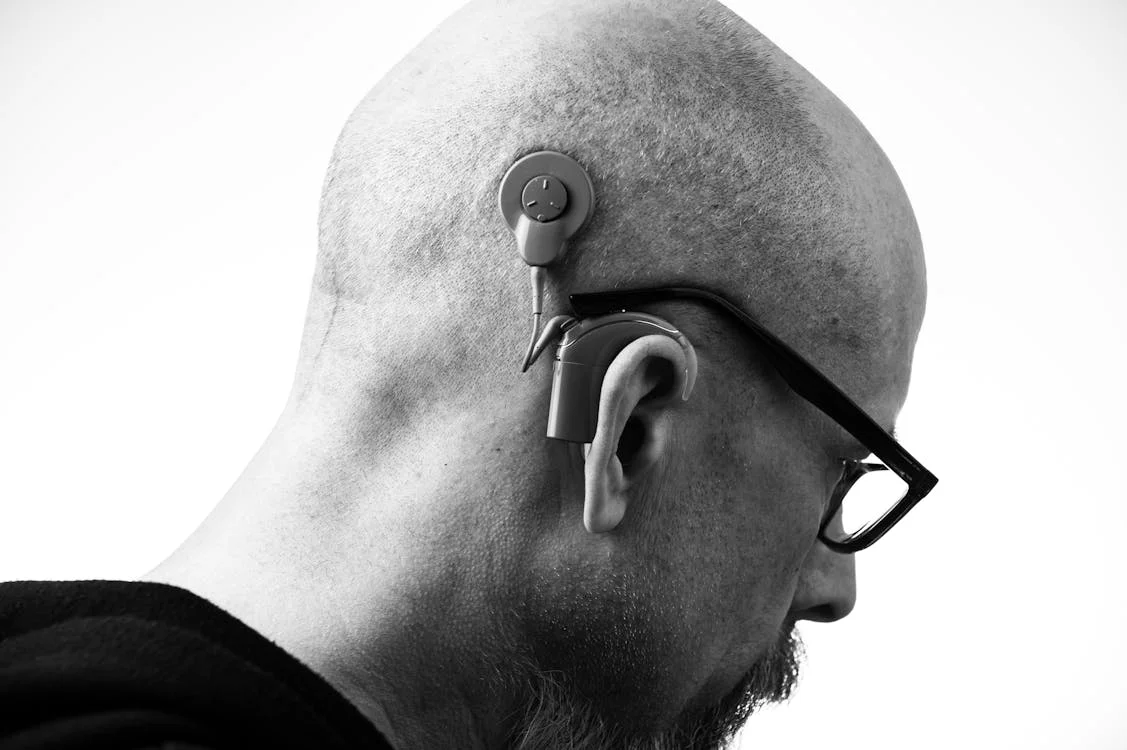
The same general pattern holds for cochlear implants. Off-the-ear processors—single-unit designs like the Cochlear Kanso 2 or MED-EL RONDO 3—sit on the scalp, anchored magnetically, with zero contact with the pinna, so they have no physical conflict with glasses. Behind-the-ear processors, like the Cochlear Nucleus 8/7 or the Advanced Bionics Naída CI M90, sit behind the ear with a cable running to a magnet on the scalp, sharing space with glasses temples similarly to BTE hearing aids.
Electronically, there's no documented radiofrequency or electromagnetic interference between modern captioning glasses (Bluetooth Low Energy or Wi-Fi, 2.4 GHz) and digital hearing aids or cochlear implant processors, which typically use Bluetooth LE Audio, ASHA, MFi, or magnetic induction on similar frequency bands with channel-hopping to avoid collisions.
At a Glance: Hearing Aids vs. Captioning Glasses
| Hearing Aids / Cochlear Implants | Captioning Glasses | |
|---|---|---|
| Primary purpose | Amplify sound or stimulate the auditory nerve directly | Convert spoken language into real-time visual text |
| Main output | Amplified acoustic sound, or electrical nerve stimulation | Text displayed in your field of view |
| How information reaches you | Through hearing | Through sight |
| Converts speech to text | No | Yes |
| Physical considerations | Varies by style—in-ear and off-the-ear devices have no glasses conflict; BTE devices share space with glasses temples | Slim, flat temples reduce pressure against BTE devices; thicker temples can crowd the space behind the ear |
| Can they be used together? | Yes | Yes |
How Many People Does This Affect?
According to the National Institute on Deafness and Other Communication Disorders (NIDCD), roughly 37.5 million U.S. adults report some trouble hearing, and an estimated 28.8 million could benefit from hearing aids. Actual use is lower than that—around 16% of adults aged 20–69 who could benefit use them, rising to about 30% among adults 70 and older, for a total of roughly 7.3–7.5 million active U.S. hearing aid users.
Cochlear implants are a smaller population: NIDCD and FDA data put active U.S. cochlear implant users at an estimated 180,000–210,000, out of roughly 183,000 cumulative devices implanted in adults and children. There's currently no reliable national estimate of how many captioning glasses users also wear hearing aids or cochlear implants—it's still an emerging accessibility category that isn't tracked at a population level.
Why Would Someone Use Both?

Hearing aids and cochlear implants don't stop being useful once you add captions—the two work through different channels and can reinforce each other.
Speech perception is naturally multimodal: your brain combines what it hears with visual cues, including written text, to reconstruct speech, particularly in noisy environments. Where hearing aids apply amplification and directional filtering, real background noise can still cause words to be misheard or lost—captions provide a visual channel that doesn't depend on how clean the acoustic signal is.
A few reasons someone might use both:
- Severe background noise. When ambient noise overwhelms directional microphones, captions fill in the words that got lost acoustically.
- Reducing listening effort. Research published in Trends in Hearing and by NIDCD has found that hard-of-hearing listeners expend significant cognitive effort decoding degraded acoustic signals—visual text lets the brain cross-check misheard words instantly rather than working to reconstruct them.
- High-frequency hearing loss. Even with a well-fitted hearing aid, severe high-frequency loss can limit clarity. Captions ensure critical details—numbers, names, medication dosages—come through accurately regardless of acoustic roll-off.
| Environment | What the Hearing Aid / CI Does | What Caption Glasses Add |
|---|---|---|
| Noisy restaurant | Directional mic filters background noise | Fills in speech lost to the noise |
| University lecture | Amplifies the speaker's voice | Provides a precise transcript |
| Medical appointment | Captures tone and conversational nuance | Confirms exact drug names and doses |
| Theater or cinema | Delivers the ambient soundscape | Delivers direct dialogue text |
| Group conversation | Provides spatial awareness of speakers | Tracks rapid speaker transitions |
Hearing Aids and Glasses: The Physical Fit Question
The space behind your ear—the post-auricular sulcus—averages about 5–8mm wide. That's the shared real estate glasses temples and behind-the-ear devices are both competing for.
- BTE hearing aids have the largest housing (roughly 25–40mm long, 6–9mm thick) and sit fully behind the pinna, so they have the most potential to compete for space with a glasses temple.
- RIC/RIE hearing aids have a smaller housing (roughly 15–25mm long, 4–6mm thick) with just a thin wire running over the ear, making it easier to slip glasses temples in alongside them.
- ITE, ITC, CIC, and IIC hearing aids sit inside the ear itself, with no component behind the ear at all—zero interaction with glasses.
When a BTE device and a glasses temple do compete for that space, a few things can happen: the temple can push the pinna outward or press into the skin, prolonged pressure can cause soreness, and if a temple shifts a hearing aid's microphone position, it can occasionally trigger acoustic feedback (a whistling sound). Thin, flat temples that lie close to the skull reduce all of these issues—this is standard audiologist guidance for eyewear generally, not specific to captioning glasses.
What About Cochlear Implants?
Cochlear implant processors follow a similar pattern, with two broad categories:
Behind-the-ear processors—like the Cochlear Nucleus 8/7, MED-EL SONNET 2/3, or Advanced Bionics Naída CI M90—sit behind the ear with an earhook, connected by a cable to a magnetic coil on the scalp. These share space with glasses temples the same way BTE hearing aids do, and manufacturers publish specific guidance for wearing them with eyewear:
- Cochlear Ltd recommends putting glasses on first, seating the temple flush against the head, then positioning the processor behind the ear next to (or slightly over) the temple, depending on what's comfortable.
- MED-EL recommends eyewear with thin, flat temple arms, and advises against wide or curved temple tips, which can push the processor outward and risk dislodging the head coil magnet.
Off-the-ear processors—single-unit designs like the Cochlear Kanso 2 or MED-EL RONDO 3—sit on the scalp rather than behind the ear, with no pinna contact at all. These have no physical conflict with glasses of any temple thickness.
The main CI-specific fit issue to watch for: inserting or removing glasses can occasionally snag the cable connecting a BTE processor to its head coil, which can pull the magnet loose. Routing the cable outside the glasses temple, or removing glasses by lifting them straight up rather than pulling them back off the ears, helps avoid this.

Can Captioning Glasses Interfere With Hearing Aids?
It's worth separating this into the different types of "interference" people usually worry about.
Physical interference—possible, but device-dependent. As covered above, this mainly affects BTE hearing aids and BTE cochlear implant processors sharing space with glasses temples. In-ear and off-the-ear devices aren't affected.
Electronic interference—no documented issue. Captioning glasses use standard Bluetooth Low Energy or Wi-Fi (2.4 GHz), and modern digital hearing aids and CI processors use their own dedicated 2.4 GHz protocols or magnetic induction, with channel-hopping designed to prevent cross-device interference.
Telecoil interference—no documented issue. Telecoils pick up low-frequency magnetic fields from induction loops or telephones. Captioning glasses run on low-voltage DC power with shielded circuit boards, producing negligible magnetic emissions.
Connectivity—no conflict. iOS and Android both support multiple simultaneous Bluetooth connections, so a smartphone can maintain a data connection to captioning glasses (for transcription) and an audio connection to hearing aids at the same time without issue.
Comfort over long wear—this is the main real consideration, and it comes back to temple thickness and BTE device placement rather than anything electronic.
What Should You Look For in Captioning Glasses If You Wear Hearing Aids?
Based on how the physical fit issues above actually play out, a few practical factors matter most:
- Temple thickness—thinner, flatter temples leave more room in the post-auricular space for a BTE hearing aid or CI processor.
- Where the electronics and battery sit—designs that distribute weight through the temple rather than concentrating it right behind the ear reduce pressure points.
- How the frame is put on and taken off—lifting glasses straight up and forward, rather than pulling them back over the ears, reduces the risk of snagging a hearing aid tube or a cochlear implant coil cable.
These are general ergonomic considerations that apply to any glasses worn with BTE hearing devices, not claims specific to any one product.
How AirCaps Was Designed With Deaf and Hard-of-Hearing Users in Mind
AirCaps was designed with Deaf and Hard-of-Hearing users in mind, including a narrower profile behind the ears and a battery layout intended to avoid unnecessary bulk in that area. This is AirCaps' stated design intent, not a claim backed by an independent, peer-reviewed ergonomic study comparing AirCaps specifically against other smart glasses for hearing-aid fit.
AirCaps uses a standard optical-style temple, a different design category from bulky industrial AR headsets that can create obvious fit conflicts with behind-the-ear hearing devices. AirCaps' published specifications list the frame at 49 grams.
AirCaps and Hearing Aids: What We Know
- AirCaps is physically compatible with hearing aids, with the best fit expected from in-ear devices, RIC devices, or slim-temple BTE devices.
- AirCaps is compatible with off-the-ear cochlear implant processors, with fit for BTE processors depending on the specific device.
- Electronic compatibility (Bluetooth/Wi-Fi vs. hearing aid protocols) is a general technical characteristic of modern digital hearing devices, not something specific to AirCaps.
Practical Considerations by Device Type
| Your Device | What to Consider When Wearing Captioning Glasses |
|---|---|
| BTE hearing aids | Look for thin, flat glasses temples; consider donning glasses before the hearing aid, and removing glasses by lifting up and forward rather than pulling back |
| RIC/RIE hearing aids | Generally easy to combine with glasses—the thin wire creates minimal obstruction, though very thick temples can still add some pressure |
| In-ear hearing aids (ITE/ITC/CIC/IIC) | No physical interaction with glasses temples—fit is not a factor |
| Off-the-ear cochlear implant processor (e.g., Kanso 2, RONDO 3) | No pinna contact—fit is not a factor |
| Behind-the-ear cochlear implant processor | Route the coil cable outside the glasses temple where possible, and follow your processor manufacturer's eyewear guidance |
Can Captioning Glasses Replace Hearing Aids?
No—and that's not really what they're built to do. Hearing aids and cochlear implants deliver sound or auditory-nerve stimulation; captioning glasses convert speech to text. These are different functions that address different aspects of communication, and the available research points to them being complementary for many users rather than substitutes for one another. Someone with mild-to-moderate hearing loss who wants natural sound and spatial awareness may be well served by a hearing aid alone. Someone who already uses hearing aids or a cochlear implant but still struggles in loud, multi-speaker, or high-stakes settings may find real value in adding captions. Whether either—or both—makes sense for you is worth discussing with your audiologist or hearing care provider.
Caption glasses and hearing aids or cochlear implants aren't competing technologies—they work through different channels and can complement each other. Electronic compatibility isn't really in question; physical fit is what varies, and it comes down to your specific device. In-ear hearing aids and off-the-ear cochlear implant processors have no conflict with glasses at all. Behind-the-ear devices share space with glasses temples, so thinner, flatter frame design matters more. If you're exploring captioning glasses alongside a hearing aid or cochlear implant, AirCaps captioning glasses is one option built around real-time captions displayed directly in your field of view.
Frequently Asked Questions
Can you wear caption glasses with hearing aids?
Generally, yes. Fit depends on the hearing aid style—in-ear and receiver-in-canal devices have little to no conflict with glasses temples, while behind-the-ear devices share space with the temple and benefit from a thinner, flatter design.
Can you wear caption glasses with a cochlear implant?
Generally, yes. Off-the-ear processors (like the Kanso 2 or RONDO 3) have no physical conflict with glasses. Behind-the-ear processors share space with glasses temples similarly to BTE hearing aids, and manufacturers publish specific eyewear guidance for their devices.
Do captioning glasses interfere with hearing aids?
Not electronically—there's no documented radiofrequency interference between captioning glasses and modern digital hearing aids or cochlear implants. Physical interference is possible with behind-the-ear devices depending on temple thickness, but this is a fit consideration, not an electronic one.
Can people with BTE hearing aids wear captioning glasses?
Yes, though comfort depends more on frame design than with other hearing aid styles. Thin, flat temples and mindful donning and removal reduce pressure and the risk of dislodging the hearing aid.
Are captioning glasses a replacement for hearing aids?
No. They serve different functions—hearing aids amplify sound, captioning glasses display text—and are generally considered complementary rather than substitutes.
Are captioning glasses useful for people with cochlear implants?
They can be, particularly in noisy or high-stakes situations where visual confirmation of speech is helpful alongside what the processor delivers acoustically. As with hearing aids, physical fit depends on whether the processor is worn behind the ear or off the ear.
This article is for informational purposes and is not a substitute for professional medical or audiological advice.
Sources and references: NIDCD Quick Statistics About Hearing, Cochlear guidance for wearing glasses with sound processors, and MED-EL wearer guides.
On this page
Table of Contents
▼
Written by
AirCaps Team
AirCaps
Building smart glasses with real-time captions, 60+ language translation, and AI meeting intelligence for the Deaf and Hard of Hearing community and professionals worldwide.
Related Articles

Guides
Caption Glasses vs. Hearing Aids: What's the Difference?
Hearing aids amplify sound; caption glasses show real-time text. Learn how they differ, where each excels, and whether you might benefit from both.
AirCaps Team
·
Sep 17, 2026
·
9 min read
Guides
The Complete Guide to Hearing Loss Technology in 2026
Hearing aids, caption glasses, and apps compared for the 1.5B people with hearing loss. Accuracy, cost, and real-world performance data for 2026.

Nirbhay Narang
·
Mar 27, 2026
·
22 min read
Guides
Captioning Glasses vs. Hearing Aids: A Complete Comparison
Captioning glasses and hearing aids solve hearing loss differently. Compare accuracy in noise, restaurant performance, cost, insurance coverage, and which solution works best for your situation.

Madhav Lavakare
·
Apr 1, 2026
·
17 min read
© 2025 AirCaps. All rights reserved.