Captioning Glasses at Concerts and Live Music: Reading Lyrics and Crowd Conversations in Real Time
Concerts hit 94-110 dBA (NIDCD, 2024), loud enough to bury lyrics and every word your friends say. How captioning glasses put the words back in your field of view in real time.
By Madhav Lavakare · Published 2026-07-14 · 18 min read
Why Live Music Is the Hardest Room of All
Table of Contents
How Loud Live Music Actually Gets
The Two Things a Loud Show Steals
Why Hearing Aids and Venue Access Fall Short
How Captioning Glasses Bring Back the Lyrics
Reading Crowd Conversations Between Sets
What Captioning Glasses Will Not Do
Choosing Captioning Glasses for Concerts
Frequently Asked Questions
Can captioning glasses show song lyrics during a live concert?
Are captioning glasses hearing protection for loud concerts?
Do venues have to provide captioning at concerts?
Can captioning glasses help me talk to friends at a loud bar or venue?
Will captioning glasses work for a concert in another language?

Guides
Captioning Glasses at Concerts and Live Music: Reading Lyrics and Crowd Conversations in Real Time

Madhav Lavakare
·
July 14, 2026
·
18 min read
On this page
Table of Contents
▼
Editorial disclosure: AirCaps builds captioning smart glasses, and live music is one of the settings customers ask about most — both people with hearing loss and people who simply cannot follow a friend over a wall of sound. This piece argues that captioning glasses can restore access to lyrics, stage announcements, and the conversations happening around you, and we hold to that honestly. Captioning glasses are not a hearing aid, not hearing protection, and not a cure. Statistics are independently sourced and linked inline, and AirCaps specifications appear only where they bear on the argument.
Why Live Music Is the Hardest Room of All
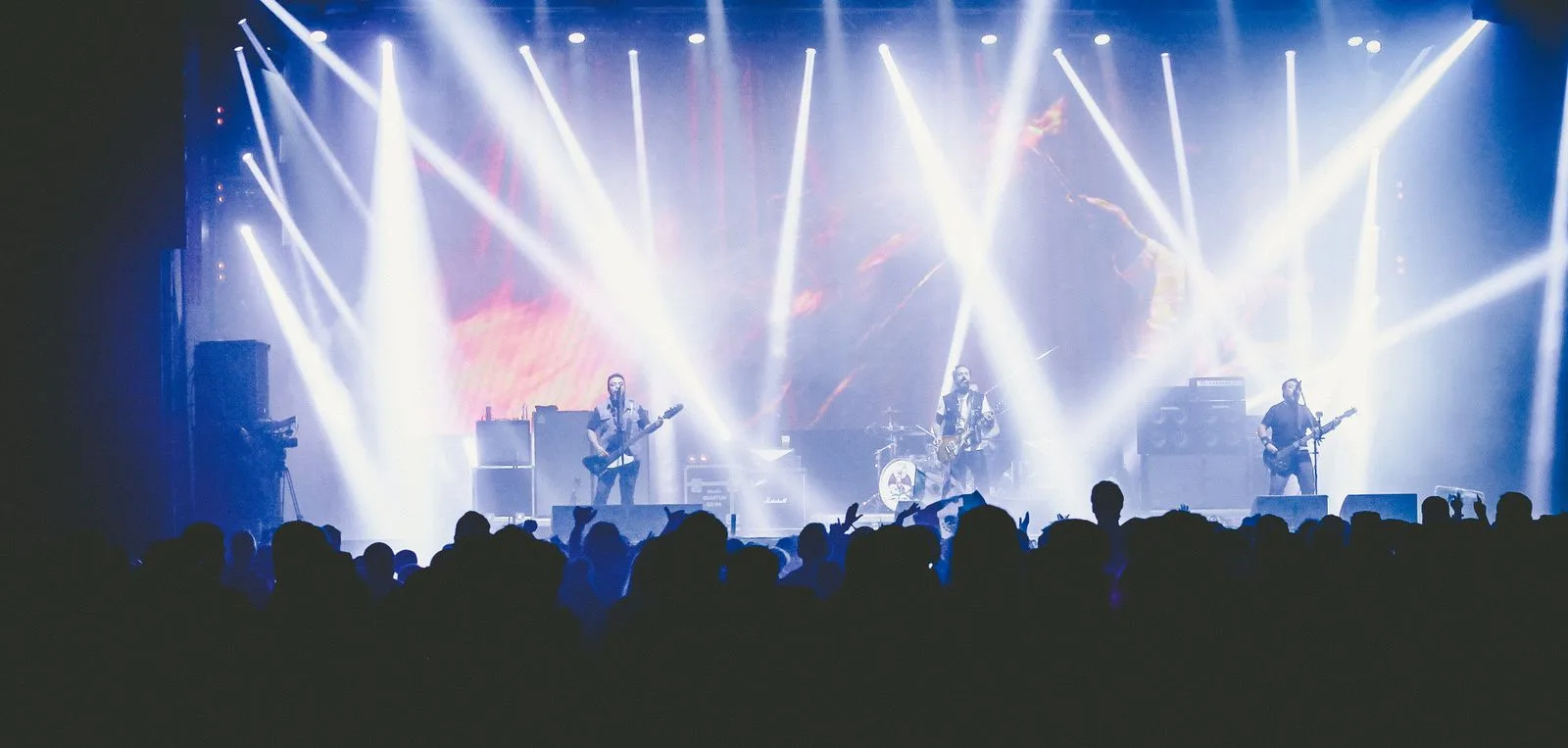
A live concert runs between 94 and 110 dBA, well past the 85 dBA where repeated exposure starts to cause permanent hearing loss (NIDCD, 2024). That single fact explains two problems at once. The volume that makes live music thrilling is the same volume that damages hearing over time and drowns out every spoken word in the room — the lyrics from the stage, the announcement between songs, and the friend shouting in your ear.
So live music sits at a strange intersection. It is where a lot of hearing loss begins, and it is one of the places that loss hurts most. If you already have hearing loss, the lyrics blur into the mix and your friends become mouths you cannot read in the dark. Captioning glasses take a different route than turning things up: they render whoever is miked, or whoever is facing you, as live text in your field of view, so you can read the show and the conversation in real time.
Key Takeaways
- Concerts and sporting events reach 94-110 dBA, past the 85 dBA threshold where repeated exposure causes permanent hearing loss (NIDCD, 2024)
- Over 1 billion young adults are at risk of avoidable hearing loss from unsafe listening, largely loud venues and personal audio (WHO, 2024)
- Musicians carry far higher rates of tinnitus (42.6% vs 13.2%) and hearing loss (25.7% vs 11.6%) than non-musicians (PMC meta-analysis, 2025)
- Speech intelligibility for hearing-impaired listeners collapses toward zero as background noise approaches 71 dBA — far quieter than a concert (PMC, 2022)
- AirCaps captioning glasses deliver 97% caption accuracy at 300ms latency using 4-microphone beamforming, weigh 49 grams, run binocular MicroLED displays, add 60+ language translation, and cost $599 (HSA/FSA eligible, no required subscription)
Table of Contents
- How Loud Live Music Actually Gets
- The Two Things a Loud Show Steals
- Why Hearing Aids and Venue Access Fall Short
- How Captioning Glasses Bring Back the Lyrics
- Reading Crowd Conversations Between Sets
- What Captioning Glasses Will Not Do
- Choosing Captioning Glasses for Concerts
- Frequently Asked Questions
How Loud Live Music Actually Gets
A concert is loud enough to be a medical event, not just a sensory one. Sporting events and concerts measure between 94 and 110 dBA, and long or repeated exposure at or above 85 dBA can cause permanent hearing loss (NIDCD, 2024). Every 3 dB roughly doubles the sound energy hitting your ear, so a 100 dBA show is not a little louder than an 85 dBA threshold — it is dramatically more punishing.
The people making the music pay for it first. A 2025 systematic review and meta-analysis of 67 studies covering more than 28,000 people found musicians report tinnitus at 42.6% versus 13.2% in non-musicians, hearing loss at 25.7% versus 11.6%, and hyperacusis at 37.3% versus 15.3% (PMC, 2025). The stage is the loudest seat in the house, and the numbers show it.
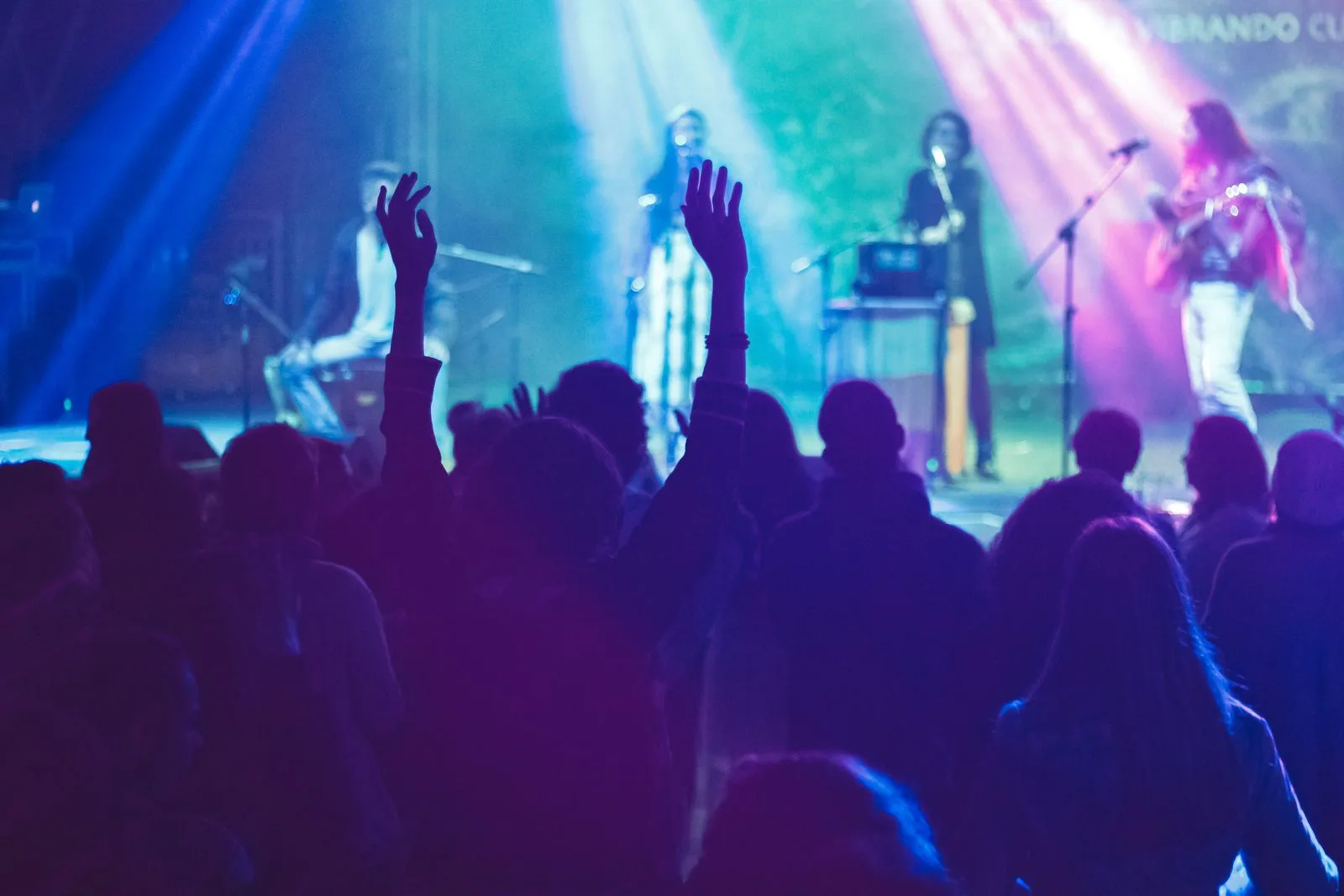
Audiences are not safe either. The WHO estimates that over 1 billion young adults are at risk of permanent, avoidable hearing loss from unsafe listening practices, which include loud venues and personal audio (WHO, 2024). In the US, as many as 40 million adults under 70 already show hearing-loss features from noise, and up to 17% of teens have test results suggestive of noise-induced damage (NIDCD, 2024). Live music is quietly manufacturing the audience that will one day need captions.
Citation capsule: Concerts and sporting events reach 94-110 dBA, well beyond the 85 dBA threshold where repeated exposure causes permanent hearing loss (NIDCD, 2024). Because over 1 billion young adults are at risk of avoidable hearing loss from unsafe listening (WHO, 2024), live music is both a leading cause of hearing loss and one of the settings that loss most affects.
The Two Things a Loud Show Steals
A loud show takes two different things from you, and most people only notice the first. It takes the lyrics and stage patter you came to hear, and it takes the conversation with the people you came with. Both losses trace to the same cause: speech falls apart in noise, and a concert is nothing but noise by design.
The threshold is lower than you would guess. In a study of speech in background sound, intelligibility for older and hearing-impaired listeners fell toward zero as noise approached 71 dBA, and the authors recommended keeping backgrounds below 50 dBA for comprehension (PMC, 2022). A concert runs 30 to 40 dBA above that ceiling. Even a person with completely typical hearing loses the words; a person with hearing loss loses everything.
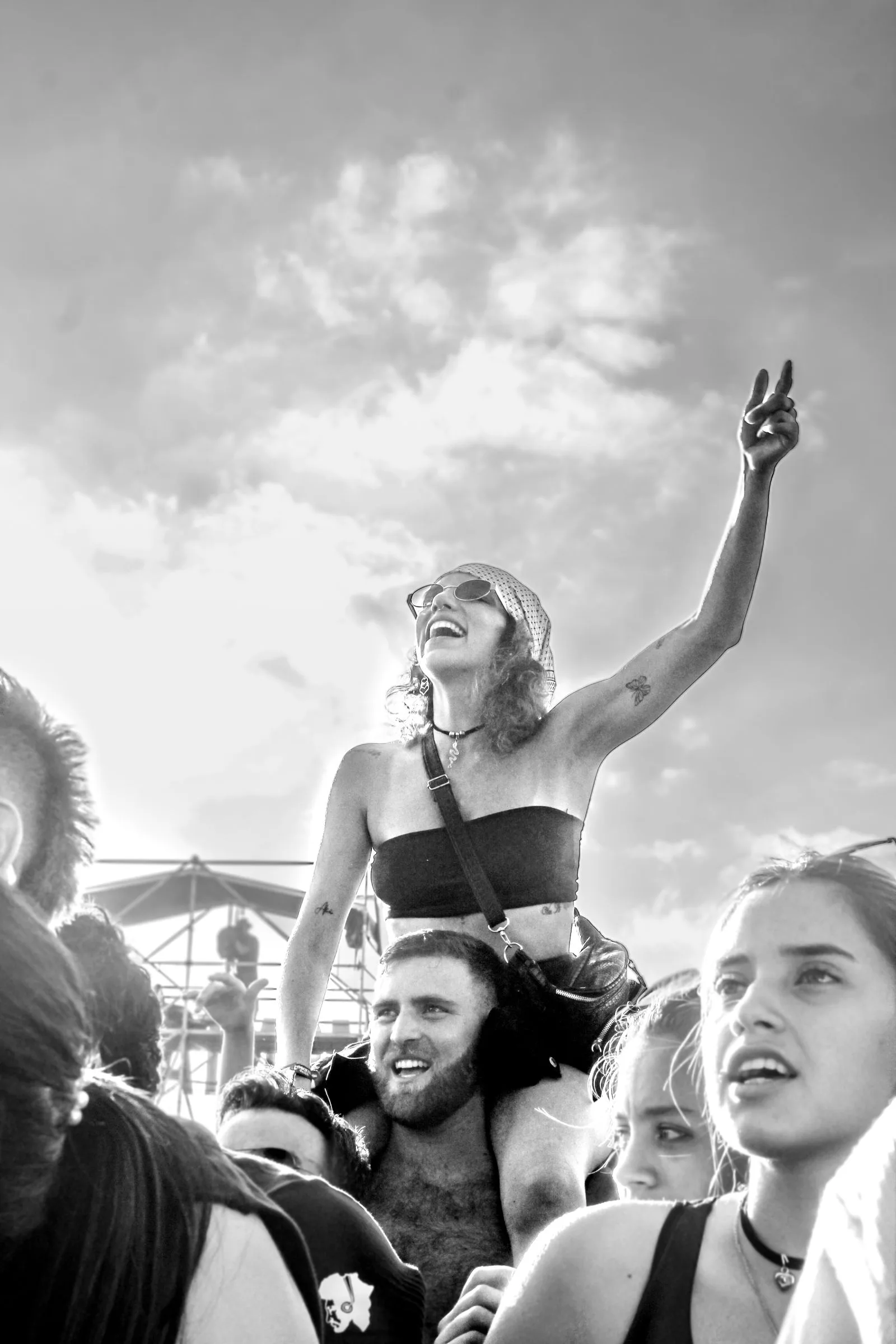
That is why the friend leaning into your ear at a festival still does not land. It is why the singer's between-song story, the setlist change, the "this next one is for someone special" — all of it dissolves. For someone with hearing loss, the emotional core of live music, the words, is exactly the part the room destroys. The volume you can feel in your chest is the same volume erasing the meaning.
Citation capsule: Speech intelligibility for hearing-impaired listeners collapses toward zero as background noise nears 71 dBA, with comprehension requiring levels below 50 dBA (PMC, 2022). A concert at 94-110 dBA sits far above that ceiling, which is why both lyrics from the stage and conversations with friends become unintelligible in the same instant.
Why Hearing Aids and Venue Access Fall Short
Hearing aids are built for conversation, not for a wall of amplified music. Amplification turns up whatever reaches the microphone, so at a concert it turns up 100-plus decibels of everything — the point of a hearing aid is to lift a quiet voice out of a quiet room, and a venue offers neither. Many wearers simply take their aids out at shows to avoid discomfort, which leaves them with no access to the words at all.
Venue accessibility is supposed to fill that gap, but it rarely does in practice. Under the ADA, venues must provide auxiliary aids such as qualified interpreters or real-time captioning for effective communication (ADA.gov, and see the National Association of the Deaf). In reality, sign-language interpreters at concerts are the exception, usually requested weeks ahead for major tours, positioned off to one side, and absent entirely at the club show or the local festival.

There is also the matter of who a stage interpreter serves. A brilliant ASL interpreter is a gift to the Deaf community that signs, but many people with acquired or age-related hearing loss do not sign — they read. For them, and for the hard-of-hearing person who just wants to catch the lyrics, the available accommodation often does not match the need. A wearer-controlled tool flips the model: instead of hoping the venue booked access for you, you bring your own, and it works at the arena tour and the basement show alike. That is the case for real-time captions you carry in.
Citation capsule: The ADA requires venues to provide auxiliary aids like qualified interpreters or real-time captioning for effective communication (ADA.gov), yet interpreters at concerts are rare, pre-booked, and serve signers rather than the many people with acquired hearing loss who read instead. A wearer-controlled captioning device provides access independent of whether a specific venue arranged it.
How Captioning Glasses Bring Back the Lyrics
Captioning glasses solve the concert problem the way a subtitle track solves a foreign film: they convert speech and lyrics into live text you read in your field of view, while you keep watching the stage. Instead of fighting the acoustics with more volume, they add a visual channel that the noise cannot touch. You glance up at the band and read what is being sung or said in step with the moment.
The engineering is what makes this survive a 100 dBA room. AirCaps uses a 4-microphone beamforming array that locks onto a target source and suppresses the surrounding wash, then transcribes at 97% accuracy with 300ms end-to-end latency — fast enough that the text tracks the voice rather than trailing it. Beamforming is not marketing garnish here: measured directional arrays improve speech reception thresholds by 2.6 to 2.9 dB and deliver up to 6.6 dB of physical signal-to-noise benefit (PMC, 2022), which is meaningful help in exactly the noise a venue throws at you.
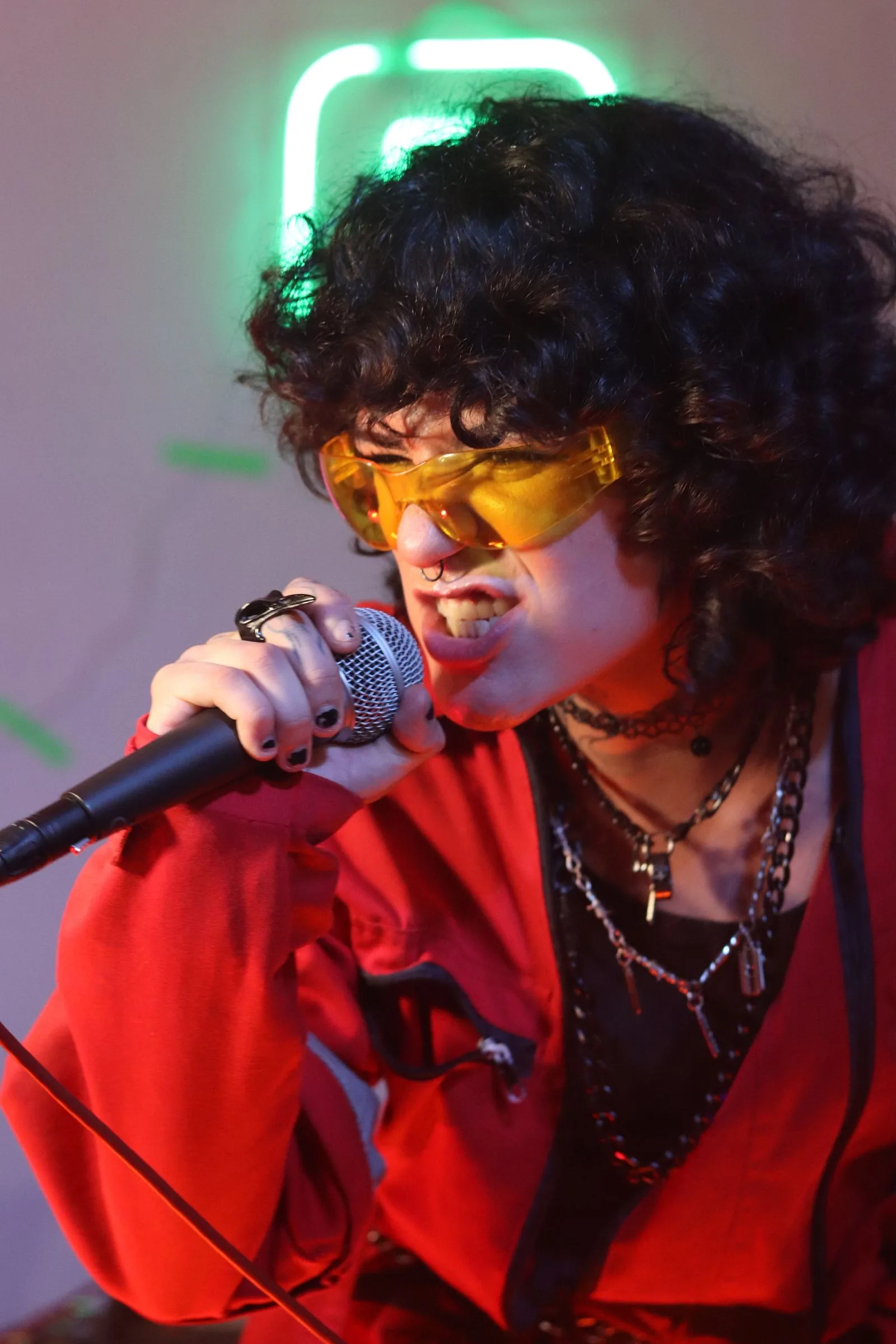
The rest of the hardware is built for a long night on your feet. The text renders on binocular MicroLED displays, one per eye, so there is no eye strain across a two-hour set, and light leakage stays under 2%, keeping your captions private in a dark room. The frame weighs 49 grams, lighter than most prescription eyewear, and light leakage that low means the person next to you sees ordinary glasses, not a screen. For songs whose words are known, following the live performance line by line turns a blur back into a singalong.
Citation capsule: Captioning glasses convert live speech and lyrics into text in the wearer's field of view, adding a visual channel that concert noise cannot degrade. AirCaps delivers 97% caption accuracy at 300ms latency through a 4-microphone beamforming array — and beamforming provides up to 6.6 dB of measured signal-to-noise benefit in noise (PMC, 2022) — on binocular MicroLED displays at 49 grams.
Reading Crowd Conversations Between Sets
The show is only half of a night out. The other half is the conversation — the pre-show catch-up at the bar, the shouted verdict between sets, the plan for where to eat after. This is where a loud venue quietly isolates people with hearing loss, because a bar can run 85 dBA on its own before a band even starts (PMC, 2022), and speech comprehension has already broken down by then.
Here the beamforming array earns its keep in a way amplification cannot. When you face the friend talking to you, the 4-microphone array steers toward that voice and filters the crowd around it, then displays their words as captions you read directly. Speaker identification labels up to 15 distinct voices, so a three-way conversation at a high-top does not become a guessing game about who just said what. You stay in the group instead of smiling and nodding through it.
That is the difference between attending an event and belonging to it. The person who used to dread the loud after-party — because the music was fine but the talking was impossible — gets the social half of the night back. Because the same technology powers structured meeting capture, the words can even be kept as a searchable record if you want to revisit a plan made over the noise.
Citation capsule: A busy bar can reach 85 dBA before a band starts (PMC, 2022), past the point where speech comprehension breaks down. Captioning glasses use a 4-microphone beamforming array to steer toward the person facing the wearer and label up to 15 speakers, turning crowd conversation between sets into readable text.
What Captioning Glasses Will Not Do
Honesty serves a reader better than a sales pitch, so here are the limits. Captioning glasses are not a hearing aid and do not restore hearing — they show text, they do not amplify sound. Just as important, they are not hearing protection. If you are going to a loud show, wear proper earplugs regardless, because captions protect your access to the words, not your ears from the volume.
They also transcribe words, not music. A caption can carry a lyric and a stage announcement, but it cannot convey a guitar tone, a key change, or the swell of a chorus. For the sound of music itself, nothing replaces hearing it, and where hearing aids or a venue's assistive listening system help with sound, captioning glasses complement them rather than compete. The honest promise is access to the words, delivered in real time, not a replacement for the sonic experience.
Caption quality also has hard cases, and a concert contains several. Heavy vocal effects, fast or slurred lyrics, thick accents, and overlapping voices are genuinely difficult, and no system transcribes a screamed bridge over a distorted guitar perfectly. Latency and accuracy specifications matter precisely because a laggy, error-filled transcript adds effort instead of removing it. The right expectation is a large, reliable gain in access to spoken words and clear vocals, not flawless capture of every syllable in a loud, chaotic room.
Choosing Captioning Glasses for Concerts
If you want to try captions for live music, a few features outrank the rest. The room is loud, dark, and long, and the source you care about is often far away, so microphone quality, latency, display comfort, and privacy matter more than anything on a spec sheet. The table below lays out what to check and where AirCaps lands.
| Feature | Why It Matters at a Show | AirCaps Spec |
|---|---|---|
| Microphone array | Beamforming isolates a voice or the stage feed from crowd and music noise | 4 microphones with directional beamforming |
| Caption latency | Text must track the lyric or reply in the moment, not trail it | 300ms end-to-end |
| Caption accuracy | Errors force re-reading and break the flow of a song or conversation | 97% accuracy (Pro tier) |
| Display configuration | Binocular displays avoid eye strain across a full set | Binocular MicroLED, both lenses |
| Display privacy | Low light leakage keeps captions invisible in a dark venue | Under 2% light leakage |
| Speaker identification | Labels who is talking in a loud group between sets | Up to 15 distinct speakers labeled |
| Frame weight | All-night comfort so the glasses are not a distraction | 49 grams; lighter than most eyewear |
| Language translation | Follow a foreign-language act or international festival lineup | 60+ languages, automatic detection |
| Battery and swap | A full concert plus travel time without dying | 4-8 hrs; hot-swap capsules extend to 18 hrs |
| Cost and eligibility | Pre-tax health dollars lower the effective price | $599, HSA/FSA eligible |
At $599 with HSA/FSA eligibility, the effective post-tax cost for most buyers in the 22 to 32% federal bracket lands around $400 to $470, and there is no required subscription — the captions work free forever, with an optional Pro tier at $20/month for the highest accuracy and 60+ languages. The 15-day return window means you can test the glasses at an actual show, from the opening act through the encore, before deciding.
The honest framing to close on: if loud rooms have taken the lyrics and left you nodding along to conversations you cannot hear, captioning glasses give you a way to read both back in real time, without waiting for a venue to book access on your behalf. Pair them with everyday captions for the rest of your week and proper earplugs for the volume, and you are protecting your hearing and your access at the same time.
Frequently Asked Questions
Can captioning glasses show song lyrics during a live concert?
They transcribe the vocals and speech they capture, which for clearly sung songs means the lyrics appear as live text in your field of view. Accuracy depends on the mix — clear vocals transcribe well, while heavy effects, screaming, or lyrics buried under distortion are harder. AirCaps runs 97% caption accuracy at 300ms latency, so for most vocal-forward performances you can follow along line by line.
Are captioning glasses hearing protection for loud concerts?
No, and this matters. Captioning glasses show text; they do not reduce the volume reaching your ears. Because concerts run 94-110 dBA, past the 85 dBA damage threshold (NIDCD, 2024), you should wear proper earplugs at loud shows regardless of whether you use captions. The glasses protect your access to the words; earplugs protect your hearing from the sound.
Do venues have to provide captioning at concerts?
Under the ADA, venues must provide auxiliary aids such as qualified interpreters or real-time captioning for effective communication (ADA.gov). In practice, sign-language interpreters at concerts are rare, must be requested well in advance, and serve signers rather than the many people with acquired hearing loss who read instead. A wearer-controlled captioning device provides access independent of what a specific venue arranged.
Can captioning glasses help me talk to friends at a loud bar or venue?
Yes. When you face the person speaking, the 4-microphone beamforming array steers toward their voice and filters the surrounding crowd, then displays their words as captions. Speaker identification labels up to 15 voices in a group. This is valuable because a busy bar can reach 85 dBA on its own (PMC, 2022), the level where speech comprehension already breaks down.
Will captioning glasses work for a concert in another language?
Yes. AirCaps supports 60+ languages with automatic detection, so you can follow a foreign-language act or an international festival lineup with the vocals and stage announcements rendered into a language you read. Translation runs at slightly higher latency than same-language captions but remains within conversational pace. This turns a language barrier at a live show into readable text rather than a lost performance.
Sources: WHO — Deafness and Hearing Loss, 2024. NIDCD — Noise-Induced Hearing Loss, 2024. NIDCD — Quick Statistics About Hearing, 2024. PMC — Auditory Symptoms Among Musicians: A Systematic Review and Meta-analysis, 2025. PMC — Speech Intelligibility and Ambient Noise, 2022. PMC — Beamforming and Noise Reduction Benefit, 2022. ADA.gov — Effective Communication. National Association of the Deaf — When Is Captioning Required?. Image credits: Pexels (royalty-free).
On this page
Table of Contents
▼
Written by
Madhav Lavakare
Co-founder & CEO, AirCaps
Co-founder of AirCaps. Building AI-powered smart glasses for conversation since 2013. Yale graduate, Y Combinator alum. Built his first Google Glass apps at age 13 and has spent 11+ years in speech AI and wearable computing.
Related Articles

Guides
Captioning Glasses in Places of Worship: Hearing Sermons, Prayers, and Hymns Again
55% of adults over 75 have disabling hearing loss (NIDCD, 2024), and worship spaces are the hardest rooms to hear in. How captioning glasses restore the sermon, the prayers, and the hymns.
Madhav Lavakare
·
Jul 7, 2026
·
19 min read
Guides
Hearing Loops and Telecoils vs. Captioning Glasses: What Public Venues Need to Know
Only about 34% of hearing aid wearers know they have a telecoil (Hearing Review, 2014). Here's what hearing loops, ALS receivers, and captioning glasses each reach.
Madhav Lavakare
·
Aug 1, 2026
·
22 min read
Guides
Listening Fatigue: The Hidden Cost of Hearing Loss (and How Captions Help)
A systematic review of 24 studies found 67% linked hearing loss to increased fatigue (Holman, 2021). What listening fatigue costs, and where captions help.

Nirbhay Narang
·
Jul 29, 2026
·
23 min read
© 2025 AirCaps. All rights reserved.