Captioning Glasses in Places of Worship: Hearing Sermons, Prayers, and Hymns Again
55% of adults over 75 have disabling hearing loss (NIDCD, 2024), and worship spaces are the hardest rooms to hear in. How captioning glasses restore the sermon, the prayers, and the hymns.
By Madhav Lavakare · Published 2026-07-07 · 19 min read
Why Worship Is One of the Hardest Places to Hear
Table of Contents
Why Hearing Loss Sits in the Front Pew
What Makes a Sanctuary So Hard to Hear In
Why Hearing Aids Struggle in Church
Why Houses of Worship Rarely Fix It
How Captioning Glasses Change the Service
Following Hymns, Prayers, and Liturgy
What Captioning Glasses Will Not Do
Choosing Captioning Glasses for Worship
Frequently Asked Questions
Do captioning glasses work in a church with no assistive listening system?
Can captioning glasses help me follow hymns and sung worship?
Why do my hearing aids fail at church but work at home?
Are captioning glasses a replacement for hearing aids at worship?
Can captioning glasses translate a service into another language?

Guides
Captioning Glasses in Places of Worship: Hearing Sermons, Prayers, and Hymns Again

Madhav Lavakare
·
July 7, 2026
·
19 min read
On this page
Table of Contents
▼
Editorial disclosure: AirCaps builds captioning smart glasses, and many of our customers first noticed their hearing loss in exactly the setting this article covers — a house of worship. This piece argues that captioning glasses can restore access to sermons, prayers, and hymns, and we hold to that honestly. Captioning glasses are not a hearing aid or a cure, and where hearing loops, hearing aids, or a clinician are the better answer, we say so. Statistics are independently sourced and linked inline. AirCaps specifications appear only where they bear on the argument.
Why Worship Is One of the Hardest Places to Hear
Nearly half of adults over 75 live with disabling hearing loss — 55% of them, according to the NIDCD (2024). That same age group attends religious services at some of the highest rates of any demographic. Put those two facts together and you get a painful overlap: the people most likely to be sitting in the pews are also the people least able to hear what happens there.
Worship spaces make it worse. Cathedrals and sanctuaries were built to carry organ music and echo, not to deliver a clear sentence to someone in row twelve. The result is that a person can attend faithfully for years and slowly lose the sermon, the responsive prayers, and the words of the hymns — the very things that make the service a service. Captioning glasses put those words back in front of your eyes, in real time, without asking anyone else to change a thing.
Key Takeaways
- About 1 in 3 US adults aged 65-74 has hearing loss, and 55% of those over 75 have disabling hearing loss (NIDCD, 2024) — the same ages that attend worship most often (Pew Research, 2025)
- Large cathedrals have reverberation times of 8 to 11 seconds against roughly 1 second for clear speech, so echo alone can destroy intelligibility (Larson Davis, 2023)
- Houses of worship are completely exempt from ADA Title III, so assistive listening is voluntary and often absent (ADA National Network, 2018)
- Hearing loss is linked to higher loneliness and social isolation, and worship is a community many people withdraw from as hearing fades (PMC systematic review, 2021)
- AirCaps captioning glasses deliver 97% caption accuracy at 300ms latency using 4-microphone beamforming, weigh 49 grams, run binocular MicroLED displays, add 60+ language translation, and cost $599 (HSA/FSA eligible, no required subscription)
Table of Contents
- Why Hearing Loss Sits in the Front Pew
- What Makes a Sanctuary So Hard to Hear In
- Why Hearing Aids Struggle in Church
- Why Houses of Worship Rarely Fix It
- How Captioning Glasses Change the Service
- Following Hymns, Prayers, and Liturgy
- What Captioning Glasses Will Not Do
- Choosing Captioning Glasses for Worship
- Frequently Asked Questions
Why Hearing Loss Sits in the Front Pew
Congregations skew older, and hearing loss climbs steeply with age. One in three US adults aged 65-74 has hearing loss, and among those 75 and older, 55% have disabling hearing loss (NIDCD, 2024). Older adults also attend worship at roughly twice the rate of younger ones — 49% attend at least monthly versus 25% (Pew Research, 2025). The audience most devoted to being there is the one straining hardest to follow along.
Zoom out and the scale is enormous. More than 1.5 billion people worldwide live with some degree of hearing loss, a figure the WHO projects will reach 2.5 billion by 2050 (WHO, 2025). In any given sanctuary of a few hundred people, dozens are quietly missing pieces of every service.
The cost is not only spiritual. Hearing loss is consistently associated with greater loneliness and social isolation, as people withdraw from the activities they can no longer follow (PMC systematic review, 2021). For a lot of older adults, worship is their most reliable weekly community. When the words blur, the fellowship hour afterward blurs too, and the temptation to simply stop coming grows.
Citation capsule: Among US adults 75 and older, 55% have disabling hearing loss, and about one in three of those aged 65-74 has hearing loss (NIDCD, 2024). Because older adults attend religious services at nearly double the rate of younger ones (Pew Research, 2025), worship gatherings concentrate the exact population most affected by hearing loss.
What Makes a Sanctuary So Hard to Hear In
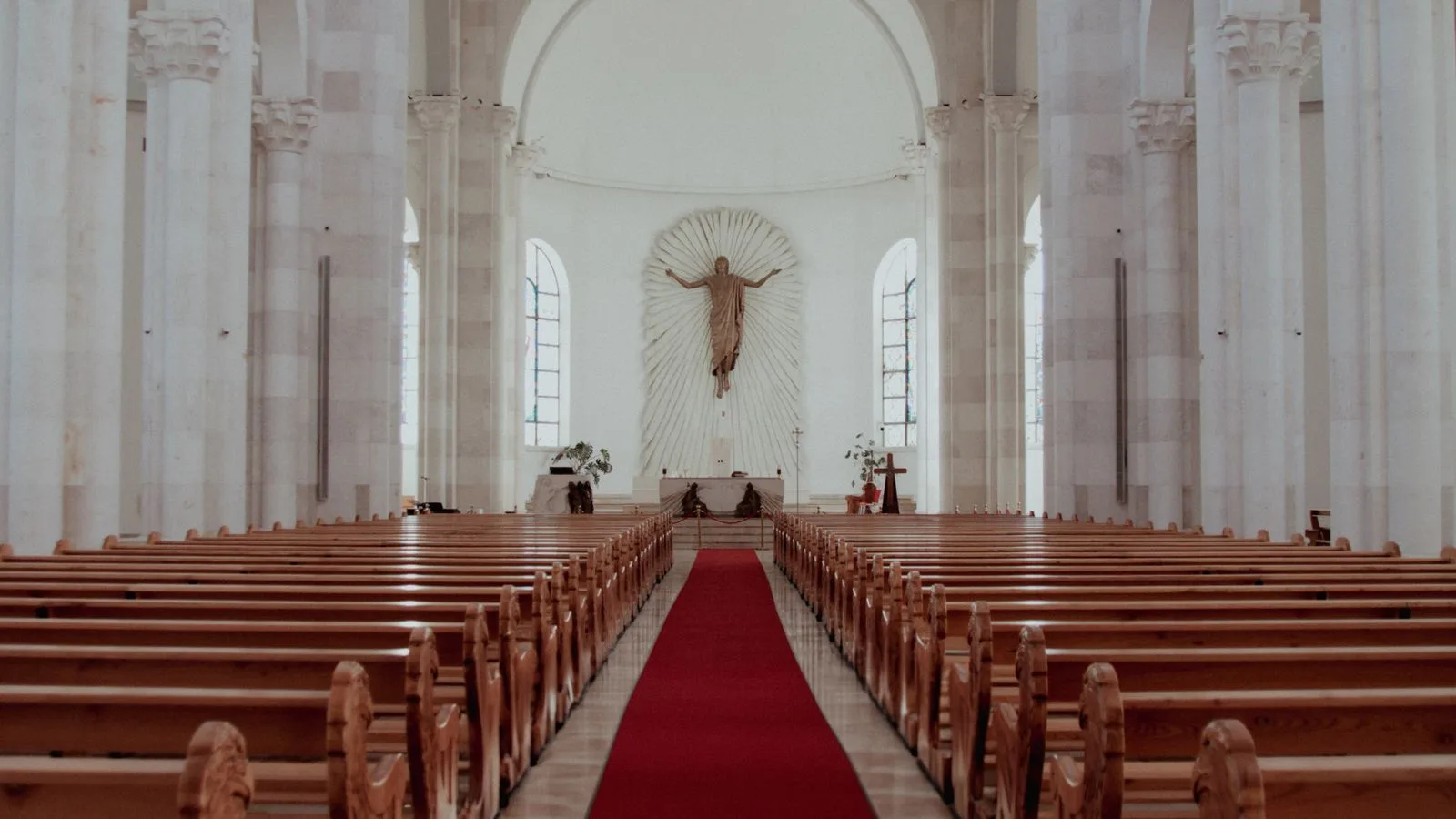
The problem is not just your ears — it is the room. Large cathedrals have reverberation times of 8 to 11 seconds, with St. Paul's in London measuring close to 11 seconds when empty, against roughly 1 second considered ideal for clear speech (Larson Davis, 2023). When sound lingers that long, each word smears into the next before your brain can resolve it.
That smearing is called reverberation, and it is the enemy of intelligibility. A study of church acoustics found reverberation times ranging from a speech-friendly 1.18 seconds in a contemporary building up to over 5 seconds in a modern concrete church that produced "poor speech comprehension," while a Gothic cathedral measured near 3.7 seconds (ScienceDirect, 2011). The acoustic character of worship spaces directly shapes how well speech carries and how it lands emotionally (Journal of the Acoustical Society of America, 2024).
Now add the standard obstacles: a speaker who is thirty or more feet away, an organ, a shuffling congregation, and a distance too far for lip-reading. Both normal-hearing and hearing-impaired listeners lose sentence intelligibility under reverberation and noise, and the loss is disproportionately severe for those with hearing loss (Journal of Speech, Language, and Hearing Research, 2010). This is exactly the acoustic trap a sanctuary sets.
Citation capsule: Large cathedrals reverberate for 8 to 11 seconds versus the roughly 1 second ideal for speech (Larson Davis, 2023), and measured churches range from 1.18 seconds up to over 5 seconds of "poor speech comprehension" (ScienceDirect, 2011). Because reverberation and noise reduce sentence intelligibility most sharply for people with hearing loss (JSLHR, 2010), worship acoustics are a worst-case listening environment.
Why Hearing Aids Struggle in Church
Hearing aids are essential, but a large sanctuary is close to their worst case. Directional microphones in hearing aids improve speech in noise, yet they "often fail to provide benefit" when the talker is far away, when noise comes from many directions, or in heavy reverberation (Egyptian Journal of Otolaryngology, 2025). A worship space delivers all three problems at once.
The physics are simple. Amplification turns up whatever reaches the microphone, so in a reverberant room it turns up the echo along with the voice you want. A hearing aid tuned for a quiet living room can leave the preacher's words tangled in reflections bouncing off stone and glass. This is why so many congregants say their aids work fine at home and fail in the pews.
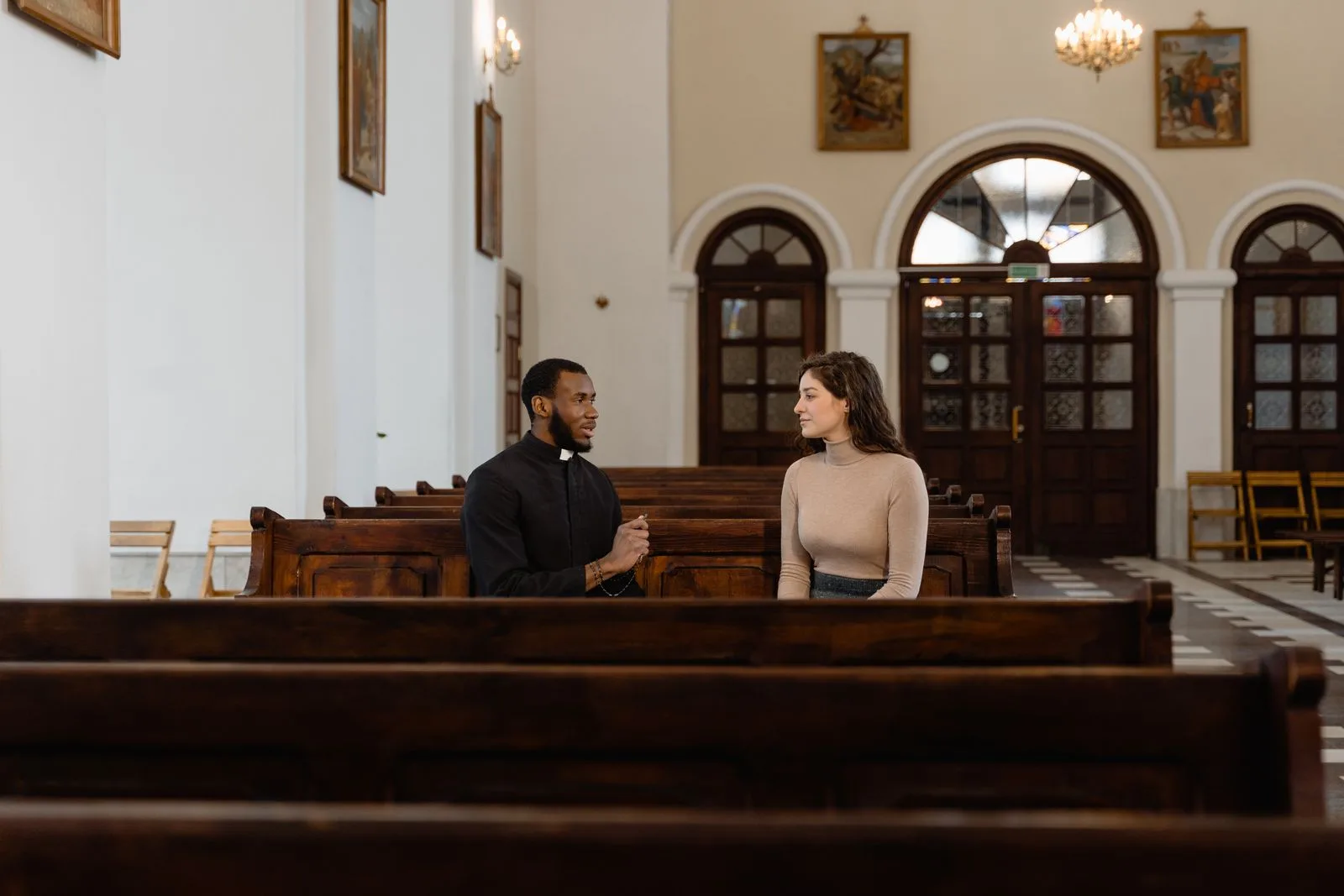
None of this means hearing aids are the wrong tool — they remain the first line for everyday hearing, and many worship spaces that install hearing loops let a telecoil-equipped aid stream sound directly. The point is narrower: in the specific geometry of a sanctuary, amplification alone frequently is not enough, and a visual channel that reads the words instead of fighting the acoustics closes the gap. That is where real-time captions enter the picture.
Why Houses of Worship Rarely Fix It
Here is the part few people know: houses of worship are completely exempt from the accessibility requirements most public buildings must meet. Religious entities are exempt from ADA Title III — "all of their facilities, programs, and activities, whether religious or secular in nature, are exempt" (ADA National Network, 2018). No law requires a church, synagogue, mosque, or temple to provide assistive listening at all.
That exemption changes everything about who solves the problem. In a movie theater or a courtroom, accessibility is mandated. In a sanctuary, it is voluntary — dependent on budget, awareness, and whether anyone on the committee happens to have hearing loss. Hearing loops are considered the gold standard for large-area listening, and the Hearing Loss Association of America runs a national "Get in the Hearing Loop" campaign precisely because adoption remains low.
Even where systems exist, they carry conditions. A hearing loop only helps if your hearing aid has an active telecoil and you know how to switch it on. An FM or infrared system means finding the usher, signing out a receiver, and wearing a headset that marks you out. The friction is real, and it lands on the individual. A wearer-controlled tool flips that equation: instead of hoping the building accommodates you, you bring your own access and it works in any building, looped or not.
Citation capsule: Houses of worship are completely exempt from ADA Title III, meaning no law requires them to provide assistive listening (ADA National Network, 2018). Because accessibility in worship is voluntary and hearing loops remain under-adopted (HLAA), a wearer-controlled solution that works in any building shifts access from the institution to the individual.
How Captioning Glasses Change the Service
Captioning glasses solve the worship problem from a different angle than amplification: instead of making the room louder, they render whoever is speaking as live text in your field of view. You read the sermon as it is delivered, glance up at the pulpit, and stay in the service rather than decoding it by ear. Nobody around you sees anything, and no receiver changes hands.
The engineering is what makes this work in a hard room. AirCaps uses a 4-microphone beamforming array that locks onto the person speaking and filters the reverberant wash around them, then transcribes at 97% accuracy with 300ms end-to-end latency — inside the window where captions arrive in step with the voice instead of trailing it. The text renders on binocular MicroLED displays, one per eye, so there is no eye strain across a long service, and light leakage stays under 2%, keeping your captions private. The frame weighs 49 grams, lighter than most prescription eyewear, which matters when you wear it for an hour or more.
Because the glasses come to you rather than depending on the building, they work identically in a looped megachurch and a 200-year-old chapel with no system at all. Speaker identification labels up to 15 distinct voices, so responsive readings and back-and-forth liturgy stop being a guessing game about who is speaking. For the many congregants who also want a record, the same technology behind AirCaps meeting mode can keep a searchable transcript of the homily to revisit later in the week.
Citation capsule: Captioning glasses display live speech as text in the wearer's field of view, sidestepping the reverberation that defeats amplification. AirCaps delivers 97% caption accuracy at 300ms latency through a 4-microphone beamforming array, on binocular MicroLED displays at 49 grams — a wearer-controlled tool that works in any worship space regardless of whether the building has an assistive listening system.
Following Hymns, Prayers, and Liturgy
A sermon is not the whole service. Hymns, responsive prayers, creeds, and call-and-response liturgy are where hearing loss quietly excludes people, because you cannot join what you cannot follow. Reading the words in real time lets you sing the verse, say the prayer on cue, and respond in time with everyone around you. That participation is the difference between attending a service and belonging to one.
Music adds its own wrinkle, and here honesty matters: captioning glasses transcribe spoken and sung words, not melody. What they restore is the text of the hymn and the timing of the liturgy, so you know which verse the congregation is on and what the leader just prayed. There is even evidence that group singing itself helps — short-term choir singing has been shown to support speech-in-noise perception in older adults with age-related hearing loss (PMC, 2019).
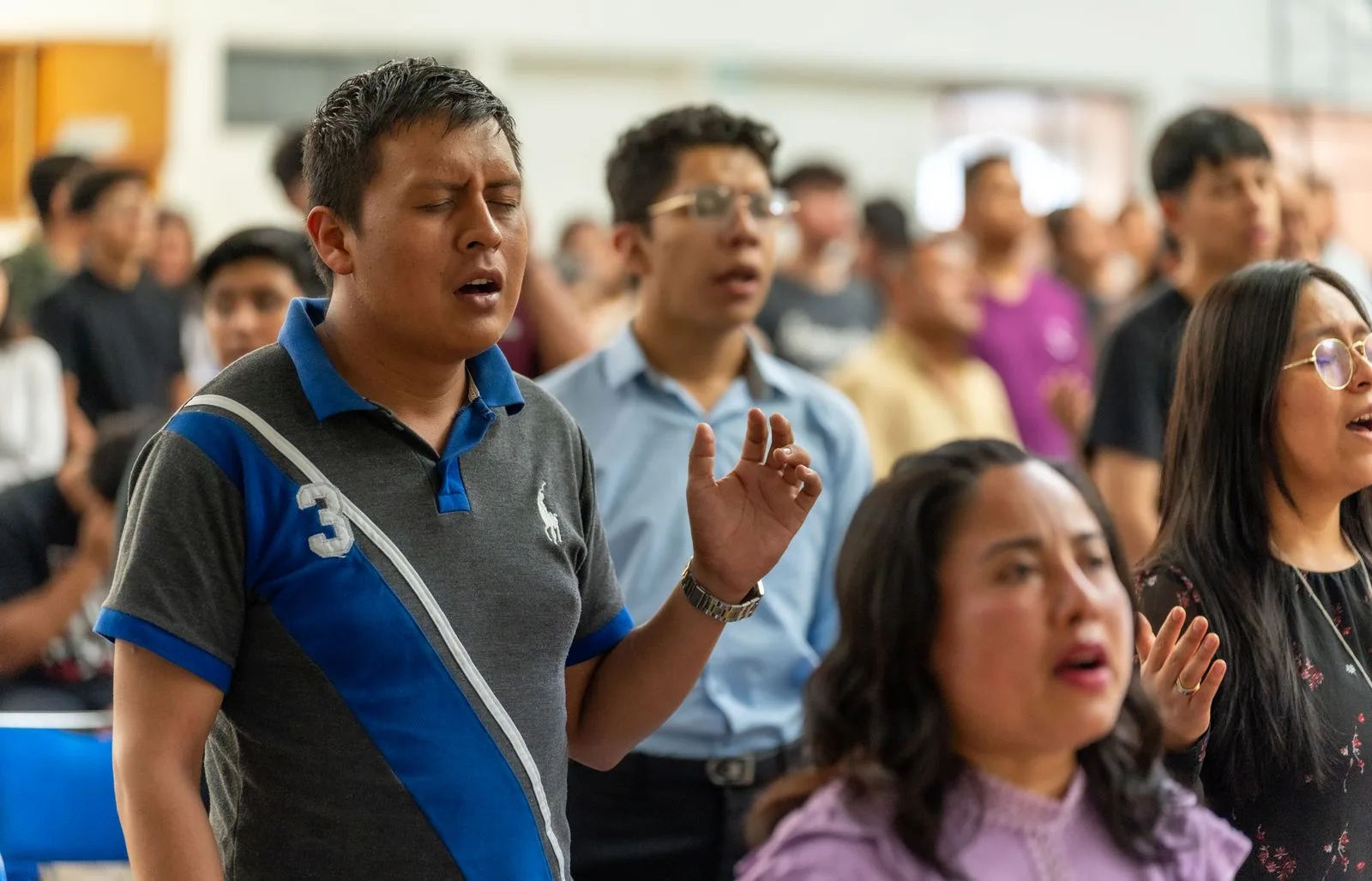
For multilingual and immigrant congregations, the same device does double duty. AirCaps handles 60+ language translation with automatic detection, so a Spanish-speaking grandmother can follow an English service, or a visitor can follow a Latin Mass, a Hebrew prayer, or an Arabic sermon rendered into a language they read. The words that bind a congregation together stop depending on which language you were raised in.
What Captioning Glasses Will Not Do
Honesty serves the reader better than a sales pitch, so here are the limits. Captioning glasses are not a hearing aid and do not restore hearing — they show text, they do not amplify sound. They will not convey the timbre of an organ, the swell of a choir, or the tone of a voice. If your goal is to hear music richly, hearing aids and, where available, a hearing loop are the right tools, and captioning glasses complement them rather than replace them.
They also depend on caption quality. A laggy or error-filled transcript adds effort instead of removing it, which is exactly why accuracy and latency specifications are not marketing trivia — they are the difference between relief and irritation. Fast, unfamiliar liturgical language and overlapping voices are genuinely hard, and no system is perfect at them. The right expectation is a large, reliable gain in access to the spoken and sung words, not flawless transcription of every whispered aside.
One more practical note: the glasses need a paired smartphone and a charge. For most services that is a non-issue, but a person who wants zero setup and zero devices may still prefer a fixed loop where one exists. The strongest position is layered — hearing aids for everyday sound, a loop when the building offers one, and captioning glasses for the words that reverberation would otherwise steal.
Choosing Captioning Glasses for Worship
If you decide captions are worth trying for worship, a handful of features matter more than the rest. The service is long, the room is reverberant, and the speaker is often far away, so microphone quality, latency, comfort, and clear text outrank everything else. The table below lays out what to check and where AirCaps lands.
| Feature | Why It Matters in Worship | AirCaps Spec |
|---|---|---|
| Microphone array | Beamforming isolates a distant speaker from reverberation and crowd noise | 4 microphones with directional beamforming |
| Caption latency | Text must arrive in step with liturgy so you can respond on cue | 300ms end-to-end |
| Caption accuracy | Errors force re-reading and break the thread of a prayer or sermon | 97% accuracy (Pro tier) |
| Display configuration | Binocular displays avoid eye strain over a full-length service | Binocular MicroLED, both lenses |
| Frame weight | All-service comfort so the device itself is not a distraction | 49 grams; lighter than most eyewear |
| Speaker identification | Labels who is reading during responsive and call-and-response portions | Up to 15 distinct speakers labeled |
| Language translation | Multilingual and immigrant congregations follow in their own language | 60+ languages, automatic detection |
| Works without building systems | No dependence on a hearing loop or borrowed receiver | Self-contained; works in any space |
| Prescription integration | No vendor lock-in; any optician can fit lenses | -16 to +16 diopters, any Rx |
| Cost and eligibility | Pre-tax health dollars lower the effective price | $599, HSA/FSA eligible |
At $599 with HSA/FSA eligibility, the effective post-tax cost for most buyers in the 22 to 32% federal bracket lands around $400 to $470, and there is no required subscription — the captions work free forever, with an optional Pro tier at $20/month for the highest accuracy and 60+ languages. The 15-day return window means you can test the glasses through an actual service, a hymn, and the fellowship hour before deciding.
The honest framing to close on: if hearing loss has slowly taken the sermon, the prayers, and the words of the hymns, captioning glasses give you a way to read them back without waiting for the building to change. Pair them with everyday captions for the coffee hour and your hearing aids for the music, and you are addressing both the words and the sound at once.
Frequently Asked Questions
Do captioning glasses work in a church with no assistive listening system?
Yes. Captioning glasses are self-contained and do not rely on a hearing loop, FM, or infrared system. This matters because houses of worship are completely exempt from ADA Title III and are not required to provide any assistive listening (ADA National Network, 2018). The glasses use a 4-microphone beamforming array to capture the speaker directly, so they work identically in a modern looped auditorium or an old chapel with nothing installed.
Can captioning glasses help me follow hymns and sung worship?
They show the words being sung, not the melody. Captioning glasses transcribe spoken and sung text, so you can follow which verse the congregation is on and read the words in time, but they do not convey pitch or musical tone. For the richness of music, hearing aids or a hearing loop are better. Notably, group singing itself supports speech-in-noise perception in older adults with hearing loss (PMC, 2019).
Why do my hearing aids fail at church but work at home?
Because a sanctuary is close to a hearing aid's worst case. Directional microphones "often fail to provide benefit" when the talker is distant, noise comes from many directions, or the room reverberates heavily (Egyptian Journal of Otolaryngology, 2025). Large cathedrals reverberate for 8 to 11 seconds versus the roughly 1 second ideal for speech (Larson Davis, 2023), so amplification turns up the echo along with the voice.
Are captioning glasses a replacement for hearing aids at worship?
No — they complement hearing aids rather than replace them. Hearing aids remain the first line for everyday sound and for hearing music, and where a hearing loop exists a telecoil-equipped aid can stream audio directly (HLAA). Captioning glasses add a visual channel for the words that reverberation destroys. The strongest approach layers both: aids for sound, captions for text.
Can captioning glasses translate a service into another language?
Yes. AirCaps supports 60+ languages with automatic detection, so a congregant can read an English service in Spanish, or follow a service delivered in a language they do not speak, rendered into one they read. This helps multilingual and immigrant congregations where the language of worship differs from the language of home. Translation runs at slightly higher latency than same-language captions, which remains well within conversational pace.
Sources: WHO — Deafness and Hearing Loss, 2025. NIDCD — Quick Statistics About Hearing, 2024. Gallup — Church Attendance Has Declined in Most US Religious Groups, 2024. Pew Research — Religious Attendance and Congregational Involvement, 2025. ADA National Network — Religious Entities Under the ADA, 2018. Larson Davis — Reverberation Time in Room Acoustics, 2023. ScienceDirect — Acoustic Evaluation of a Contemporary Church, 2011. Journal of the Acoustical Society of America — Acoustics of Worship Spaces and Emotional Impact, 2024. Journal of Speech, Language, and Hearing Research — Reverberation and Noise on Sentence Intelligibility, 2010. Egyptian Journal of Otolaryngology — Real-World Hearing Aid Challenges, 2025. PMC — Hearing Loss, Loneliness, and Social Isolation: A Systematic Review, 2021. PMC — Short-Term Choir Singing Supports Speech-in-Noise Perception, 2019. HLAA — Get in the Hearing Loop. Image credits: Pexels (royalty-free).
On this page
Table of Contents
▼
Written by
Madhav Lavakare
Co-founder & CEO, AirCaps
Co-founder of AirCaps. Building AI-powered smart glasses for conversation since 2013. Yale graduate, Y Combinator alum. Built his first Google Glass apps at age 13 and has spent 11+ years in speech AI and wearable computing.
Related Articles
Guides
Captioning Glasses at Concerts and Live Music: Reading Lyrics and Crowd Conversations in Real Time
Concerts hit 94-110 dBA (NIDCD, 2024), loud enough to bury lyrics and every word your friends say. How captioning glasses put the words back in your field of view in real time.
Madhav Lavakare
·
Jul 14, 2026
·
18 min read

Guides
Captioning Glasses for Aging Parents: What Families Need to Know
55% of adults 75+ have disabling hearing loss (NIDCD, 2024), yet fewer than 1 in 3 ever use hearing aids. A practical family guide to captioning glasses: who they're for, what to look for, and how to set them up for a parent.
Madhav Lavakare
·
Apr 22, 2026
·
21 min read
Guides
Hearing Loops and Telecoils vs. Captioning Glasses: What Public Venues Need to Know
Only about 34% of hearing aid wearers know they have a telecoil (Hearing Review, 2014). Here's what hearing loops, ALS receivers, and captioning glasses each reach.
Madhav Lavakare
·
Aug 1, 2026
·
22 min read
© 2025 AirCaps. All rights reserved.