Captioning Glasses for Cochlear Implant Users: A Practical Companion Guide
More than 118,000 US adults wear a cochlear implant (NIDCD, 2024). How captioning smart glasses complement an implant in restaurants, meetings, and family dinners — and where they don't.
By Madhav Lavakare · Published 2026-06-22 · 24 min read
Why Cochlear Implant Users Are Reaching for Captioning Glasses
Table of Contents
Where the Cochlear Implant Struggles — And Captioning Glasses Help
Charles's Story: The Family Dinner Table
Marisol's Story: Bilateral Implants and the Airport Layover
David's Story: Unilateral Implant and the Creative Review
Cochlear Implants vs. Captioning Glasses: A Compatibility Map
Choosing Captioning Glasses as a CI User
Cost, HSA/FSA, and the 15-Day Trial
Frequently Asked Questions
Will captioning glasses replace my cochlear implant?
Do the glasses interfere with a behind-the-ear processor?
How does latency compare to my implant's processing delay?
Should I use these instead of getting a cochlear implant?
Will the glasses work with a Roger transmitter or other accessories?
Are captioning glasses HSA/FSA eligible for CI users?
What if I have a single implant and want to follow group conversations?
Do I need a prescription or a doctor's note to buy AirCaps?
Can I trial them before committing?

Guides
Captioning Glasses for Cochlear Implant Users: A Practical Companion Guide

Madhav Lavakare
·
June 22, 2026
·
24 min read
On this page
Table of Contents
▼
Editorial disclosure: AirCaps makes captioning smart glasses, and a meaningful share of our customer base wears cochlear implants — including the publicly named reviewer Charles Dunlop, who quoted his otolaryngologist as saying "now we can stop talking about a cochlear implant" after using AirCaps. This article references AirCaps specifications where they're relevant to the discussion. Statistics are independently sourced and linked inline. We use one verified AirCaps customer (Charles Dunlop) and two composites — "Marisol" and "David" — built from anonymized customer support conversations with bilateral and unilateral CI users. Where captioning glasses fit alongside an implant, we say so; where the implant, the audiologist, or auditory-verbal therapy remain the right call, we say that too.
Why Cochlear Implant Users Are Reaching for Captioning Glasses
Roughly 118,100 US adults and 65,000 US children have received a cochlear implant, with more than 1 million implanted worldwide (NIDCD, 2024). The implant is one of the most successful neural prostheses ever built. It also has a well-documented blind spot: speech in noise. CI users typically need a signal-to-noise ratio 10 to 25 dB better than a normal-hearing listener to reach 50% sentence recognition, which means the restaurant that sits comfortably at 78 dBA for everyone else effectively becomes unintelligible for the implant (PMC, 2022; NIDCD Noisy Planet, 2024).
This guide explains where captioning smart glasses fit alongside a cochlear implant — not as a replacement for the implant, the speech-language therapy, or the audiologist relationship that makes the implant work, but as a parallel visual channel that turns down listening effort in the exact rooms where the processor struggles. Three customer stories anchor the discussion: a bilaterally implanted nonprofit director who travels for work, a unilaterally implanted graphic designer who runs creative reviews, and the publicly named Charles Dunlop, whose family used AirCaps to keep the conversation visible during meals.
Key Takeaways
- Approximately 118,100 US adults and 65,000 US children have received a cochlear implant; more than 1 million CIs have been implanted worldwide (NIDCD, 2024)
- In most high-income countries, fewer than one in five eligible adults with profound hearing loss actually receive a cochlear implant (PMC, 2024)
- Adult CI users typically need a signal-to-noise ratio 10 to 25 dB better than normal-hearing listeners to reach 50% sentence recognition in noise (PMC, 2022)
- 74.5% of adult CI users have a single implant; only 25.5% are bilaterally implanted, which leaves most users with reduced spatial hearing in groups (PMC, 2024)
- 96% of CI users report overall satisfaction with their implant, but "competitive noise" is consistently the lowest-rated scenario (Hearing Review / York University, 2024)
- AirCaps captioning glasses deliver 97% caption accuracy at 300ms latency using 4-microphone beamforming, weigh 49 grams, run on binocular MicroLED displays, and cost $599 (HSA/FSA eligible, no required subscription)
Table of Contents
- Where the Cochlear Implant Struggles — And Captioning Glasses Help
- Charles's Story: The Family Dinner Table
- Marisol's Story: Bilateral Implants and the Airport Layover
- David's Story: Unilateral Implant and the Creative Review
- Cochlear Implants vs. Captioning Glasses: A Compatibility Map
- Choosing Captioning Glasses as a CI User
- Cost, HSA/FSA, and the 15-Day Trial
- Frequently Asked Questions
Where the Cochlear Implant Struggles — And Captioning Glasses Help
Cochlear implants restore audibility, but they don't restore the acoustic resolution a healthy cochlea provides. Adult CI users typically need a signal-to-noise ratio 10 to 25 dB better than a normal-hearing peer just to follow connected speech, and rear-noise scenarios are the hardest of all (PMC, 2022). That gap is exactly why manufacturers ship features like ForwardFocus and accessory remote microphones — and why captioning glasses keep showing up in CI user forums as a parallel solution rather than a competitor.
The acoustic math is unforgiving. A typical American restaurant runs at 78 dBA, and many surveyed venues exceed 80 dBA, while normal conversational speech sits around 60 dBA (NIDCD Noisy Planet, 2024). That means the speaker across the table arrives at the implant's microphone roughly 18 dB below the ambient noise floor. Cochlear's ForwardFocus directional algorithm improves the speech reception threshold by about 5 dB in rear-noise conditions, and Phonak's Roger remote microphone has been shown to deliver a 14.8 dB improvement in multi-talker noise for adult CI users (Frontiers, 2024; PMC, 2016). Even with both, many CI users still report that they "got" only a fraction of what was said when the lights came back on.
This is the room captioning glasses were built for. A 4-microphone beamforming array locks a directional capture cone on the person across the table, captions render at 300 milliseconds end-to-end, and the user gets a redundant visual channel that doesn't have to compete with the chatter at the next table for cortical bandwidth.
Citation capsule: Adult cochlear implant users need a signal-to-noise ratio roughly 10 to 25 dB better than normal-hearing listeners to reach 50% sentence recognition in noise (PMC, 2022). Average restaurant noise sits at 78 dBA, with normal speech at 60 dBA (NIDCD Noisy Planet, 2024). That gap is the engineering problem captioning glasses solve through a visual channel rather than an acoustic one.
There's also a fatigue dimension that doesn't show up on an audiogram. A 2023 scoping review of 24 studies concluded that adult CI users experience elevated listening effort and end-of-day fatigue compared with normal-hearing controls, even when their word-recognition scores look strong on quiet-room tests (Frontiers in Neurology, 2023). The implant is doing constant pattern-completion work that hearing ears don't have to do. Captions reduce the cognitive load by giving the brain a verified transcript to fall back on when the auditory channel gets noisy. That offload is the reason most of our CI customers describe wearing the glasses selectively — turned on for the meeting that drains them, turned off for the quiet conversation that doesn't.
Charles's Story: The Family Dinner Table
Charles Dunlop is one of our publicly named AirCaps reviewers. He's not a cochlear implant recipient himself, but his story turns on a quote his otolaryngologist gave the family after watching AirCaps in use: "Now we can stop talking about a cochlear implant." That line is doing a lot of work, and it deserves unpacking, because plenty of families in the CI evaluation pipeline are asking exactly the question it answers — what changes if we add captions before, alongside, or instead of an implant?
The honest answer is that captioning glasses don't replace the implant for someone with profound bilateral sensorineural loss who's a strong surgical candidate. The implant restores audibility; the glasses render text. These are different organs of the same task. But the Dunlop family's experience points to something the cochlear implant access literature has been documenting for years: in most high-income countries, fewer than one in five adults with profound hearing loss who would qualify for an implant ever receive one (PMC, 2024). The reasons are referral disparities, cost, surgical hesitance, and a long evaluation runway. For the families inside that gap, captioning glasses are not the final answer — they're the bridge that keeps dinner conversations possible while the surgical decision gets made.

For families on the other side of the implant — where the surgery is done and the rehab is well underway — the framing flips. The glasses become a redundant channel that the implant doesn't have to fight noise to deliver alone. Charles's review describes the dinner table specifically: multiple speakers, overlapping turns, kitchen clatter in the background. The 4-microphone beamforming array isolates whoever the user is facing, and the captions arrive on the lens fast enough that the user reads them roughly in lip-sync rather than catching up two beats behind.
The implant still does what the implant does best — carries prosody, conveys tone, lets the user recognize their daughter's laugh from across the room. The glasses just take the pressure off the part of the auditory task that the processor was never going to ace.
Marisol's Story: Bilateral Implants and the Airport Layover
Marisol is a composite, drawn from three AirCaps customers with bilateral cochlear implants. She's 52, runs international programs for a humanitarian nonprofit, and was implanted bilaterally in 2019 after a decade of progressive sensorineural loss. On a quiet-room audiogram, her aided thresholds look excellent. In a Frankfurt airport gate at 7 a.m., they don't.
Bilateral implantation is the minority configuration: 74.5% of adult CI users have a single implant, and only 25.5% have two (PMC, 2024). The bilateral group gets the spatial-hearing advantage — better sound localization, better head-shadow benefit in noise — but the underlying speech-in-noise penalty doesn't vanish. Multi-talker babble at the airport (or the restaurant, or the trade show) overwhelms the processor's noise-reduction algorithms long before it overwhelms a hearing peer. The 14.8 dB benefit Roger delivers in lab settings (PMC, 2016) is real, but only if the speaker is willing to clip on the transmitter — which doesn't happen at a gate agent counter or an airport coffee bar.
Marisol's pattern is what we see most often among bilateral CI customers using AirCaps captioning glasses: she wears them during travel, in unfamiliar service interactions, and at the multi-party work dinners where she can't ask everyone to pass around a Roger Pen. Auto-language detection across 60+ languages matters here in a way it doesn't for monolingual users — AirCaps translation covers the trip from Frankfurt to Madrid to Lima without her ever opening the app to pick a language. The captions appear in whatever language the speaker is using, and they appear before she has time to ask the gate agent to repeat themselves.
Citation capsule: Among adult cochlear implant users, only 25.5% have bilateral implants, which means three-quarters of the CI population is missing the spatial-hearing cues that help normal-hearing listeners separate speakers in a crowd (PMC, 2024). Captions don't restore spatial hearing — they sidestep the need for it by labeling the speaker on the lens.

The other thing that comes up across bilateral CI customers is fatigue management. Marisol describes the implant as energizing for the first six hours of a workday and exhausting for the last two. The captioning glasses, used selectively for the last two, let her stay present without burning through her remaining auditory bandwidth. That maps directly to the scoping-review finding that listening effort and fatigue are higher in CI users than in normal-hearing peers, even when speech recognition scores are strong (Frontiers in Neurology, 2023).
David's Story: Unilateral Implant and the Creative Review
David is the second composite, built from two AirCaps customers with single-sided implants. He's 38, a graphic designer who lost the hearing in his right ear from sudden sensorineural hearing loss in his late twenties and was implanted unilaterally on that side two years later. His hearing aid on the left side covers the residual high-frequency loss. On paper, his speech recognition is fine.
The reality of the single-sided CI configuration is that the localization problem doesn't fully resolve. Listeners with one implant and one aided ear get an asymmetric input that the brain has to fuse, and in a conference room with five speakers around a table, the fusion stops working long before the audiometric thresholds would predict. This is the scenario David built his AirCaps workflow around: the weekly creative review where his three designers, the copywriter, the strategy lead, and the client all take turns talking, often over each other, often with the projector fan running in the background.
He wears AirCaps in meeting mode for those reviews specifically. The speaker identification feature labels up to 15 distinct voices in the running transcript, which solves a problem the unilateral-CI configuration creates on its own: knowing who just spoke without having to turn your head to locate them. The captions render at 300 millisecond latency, which sits at the lower edge of what the lip-reading literature treats as perceptually synchronized to speech (ACM CHI, 2024). For a CI user whose processor is already adding its own algorithmic delay before the sound reaches the cortex, every millisecond on the caption pipeline matters — the visual channel needs to feel like it's arriving with the speech, not after it.

David's other pattern is one we see across the unilateral-CI customer base: he uses the glasses to record meetings he'll need to reference later. The meeting intelligence feature produces a structured summary with action items and a searchable transcript he can query after the call. For a CI user who's already spending more cognitive energy on real-time listening than a hearing peer, having a verified record of what was said is not a luxury — it's the difference between leaving the meeting confident and leaving it second-guessing every assignment.
There's also a privacy dimension worth naming. AirCaps' binocular MicroLED display has less than two percent light leakage from the front, which means the people David is meeting with don't see the captions reflecting in his lenses. The implant is already visible behind his ear. The glasses don't add a second flashing signal that he's processing the conversation differently.
Cochlear Implants vs. Captioning Glasses: A Compatibility Map
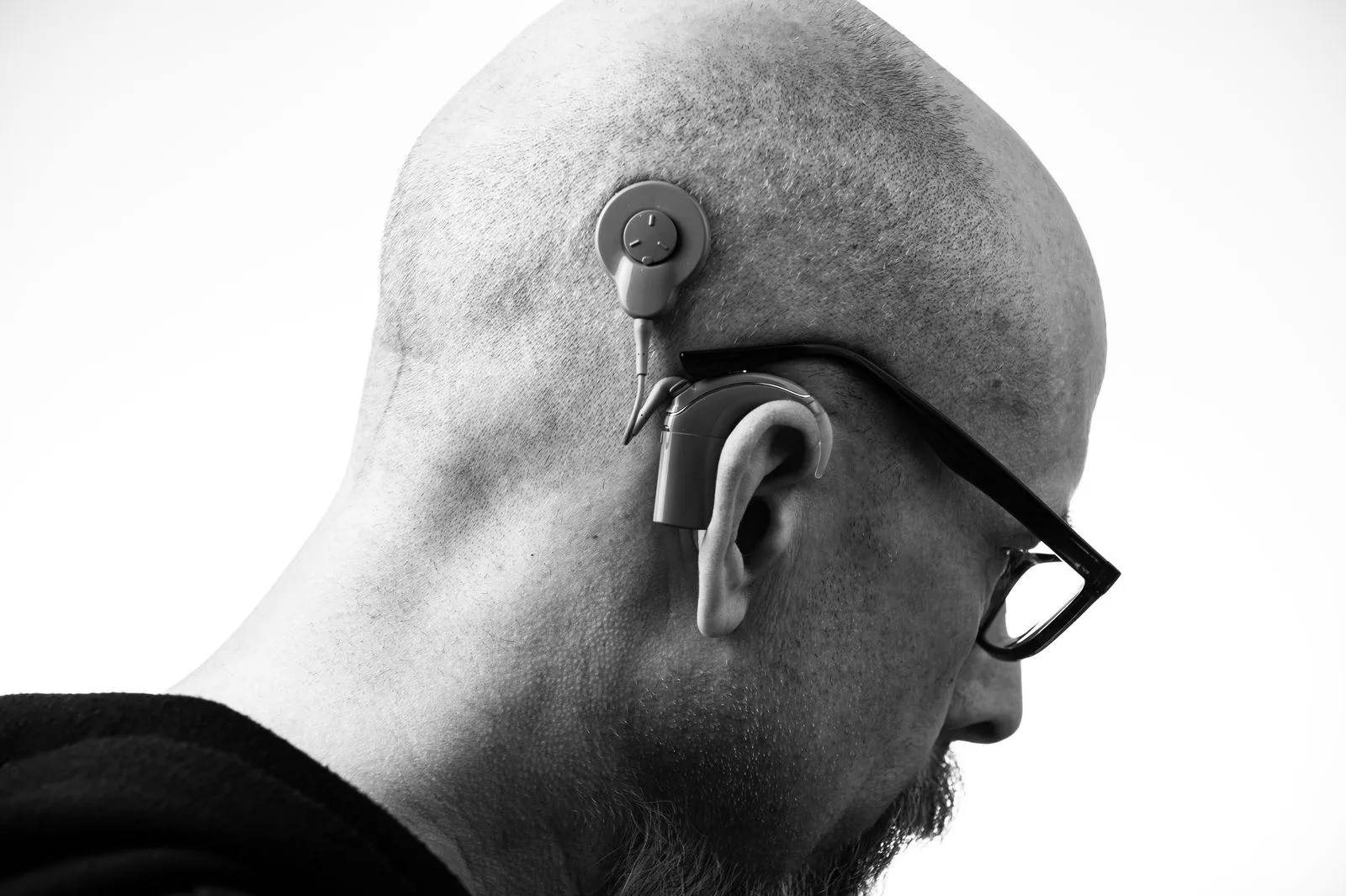
The most common question we get from CI customers — and from prospective customers who haven't been implanted yet — is whether the glasses interfere with the implant. They don't. The two devices operate in entirely different sensory channels, and the only physical consideration is fit around behind-the-ear processors, which is straightforward because AirCaps frames sit on the bridge of the nose and the temples, not behind the ears.
The more interesting question is when to use which. Here's how the AirCaps Pro customer base with cochlear implants tends to allocate the two tools across daily scenarios.
| Scenario | Cochlear Implant Alone | Captioning Glasses (Added) | Why the Glasses Help |
|---|---|---|---|
| Quiet one-on-one conversation | Works well for most CI users | Usually unnecessary | Implant alone is the right tool in clean acoustic settings |
| Family dinner with 4+ speakers | Partial; multiple voices fuse into noise | Strong fit; beamforming isolates the speaker | 4-microphone array reduces 78 dBA restaurant noise penalty |
| Multi-party work meeting | Effort-intensive; rapid turn-taking is hard | Speaker labels and transcript reduce cognitive load | Up to 15 speakers identified, full searchable record |
| International travel and unfamiliar accents | Recognition drops with unfamiliar phonetics | Strong fit; 60+ languages with auto-detection | Captions render regardless of which language is being spoken |
| End-of-day fatigue | Implant is working hard; user is depleted | Strong fit; offloads listening effort to vision | Reduces cumulative cognitive load in the evening hours |
| Doctor visits and medication instructions | Fast medical speech is error-prone | Strong fit; captures dosages and names verbatim | 97% caption accuracy preserves exact phrasing |
| Music or environmental awareness | Implant is the right tool | Captions don't apply | The implant carries timbre and prosody the glasses can't |
| Bilateral CI user in a quiet office | Often sufficient on its own | Selective use only | Glasses become useful as cognitive load increases |
| Unilateral CI user in a group setting | Localization gap creates effort spikes | Strong fit; speaker labels close the localization gap | Visual identification replaces lost spatial hearing |
The pattern across the table is consistent. The implant carries everything the glasses can't — tone, timbre, environmental sound, music, the prosodic markers that let a CI user pick up sarcasm or warmth in a familiar voice. The glasses carry everything the implant struggles to deliver in noise — verbatim transcription, speaker labels, a permanent searchable record, and a visual channel that doesn't have to compete with the room.
Latency is the spec that determines whether the combination feels natural or uncanny. Above roughly 350 milliseconds, captions drift visibly out of lip-sync (ACM CHI, 2024). AirCaps runs at 300 milliseconds end-to-end, which sits inside the perceptual tolerance for synchronization. For a CI user whose implant is already adding its own processing delay before the sound reaches the cortex, that latency budget is the difference between captions feeling like a real-time aid and captions feeling like a delayed translation.

Choosing Captioning Glasses as a CI User
Picking captioning glasses for a cochlear implant user looks slightly different from picking them for someone with no implant at all. The implant covers a meaningful portion of the auditory task, so the glasses don't need to carry the whole load. What they do need to do is fail gracefully in the exact rooms the implant struggles with — noise, multiple speakers, unfamiliar phonetics, fatigue. The feature priorities reorder accordingly.
The first thing to verify is microphone configuration. A single-microphone captioning system mixes every voice in the room into one transcript, which collapses in the multi-talker scenarios where CI users need help most. The 4-microphone beamforming array in AirCaps was engineered specifically to isolate the speaker facing the user. For a CI user at a noisy family dinner or a multi-party meeting, that directional capture is the feature that determines whether the device gets worn or sits in the case.
The second consideration is latency. CI processing already adds delay between sound capture and cortical perception, so the caption pipeline can't add another half-second on top without breaking the lip-sync illusion. AirCaps' 300 millisecond end-to-end latency sits at the lower edge of what the human visual system can fuse with speech. The third is display configuration. Binocular MicroLED — one display per eye — produces meaningfully less eye strain than monocular alternatives, which matters disproportionately for CI users who already spend more cognitive effort on a normal listening day.
| Feature | Why It Matters for CI Users Specifically | AirCaps Spec |
|---|---|---|
| Microphone array | Beamforming isolates the speaker the implant struggles to separate from noise | 4 microphones with directional beamforming |
| End-to-end latency | CI processing already adds delay; captions must arrive in lip-sync | 300 ms end-to-end |
| Caption accuracy | Verbatim transcript supplements imperfect speech recognition in noise | 97% accuracy (Pro tier) |
| Display type | Binocular displays reduce eye strain for an already cognitively loaded user | Binocular MicroLED, both lenses |
| Frame weight and fit | Compatible with behind-the-ear processors; light enough for all-day wear | 49 grams; nose-bridge and temple support |
| Speaker identification | Closes the localization gap for unilateral CI users in groups | Up to 15 distinct speakers labeled |
| Meeting summaries | Reduces post-meeting recall load for fatigued CI users | Structured notes with action items; searchable history |
| Language coverage | Auto-detection helps in international or multilingual households | 60+ languages with automatic detection |
| Light leakage | Captions stay private; implant is already visible behind the ear | Less than two percent front leakage from binocular MicroLED |
| Subscription structure | CI users are often already paying for processor upgrades and accessories | Free tier forever; optional Pro at $20/month |
Prescription compatibility is worth pulling out. Many CI users wear prescription eyewear already, which makes the integration trivial: AirCaps works with any prescription from -16 to +16 diopters through any optician, with no vendor lock-in. A behind-the-ear processor and a pair of prescription captioning glasses don't compete for the same real estate on the head — the processor sits behind the ear, the glasses rest on the bridge of the nose, and the temples slide above or around the processor without interference.
For meeting-intensive professionals with cochlear implants — sales leads, executives, clinicians, lawyers — the combination of speaker identification, searchable transcripts, and HIPAA-compliant recording does work the implant alone can't do. The implant lets you hear the meeting. The glasses let you not have to remember it.
Cost, HSA/FSA, and the 15-Day Trial
AirCaps captioning glasses cost $599, and the device qualifies as an assistive medical device — which means the purchase is eligible for pre-tax Health Savings Account and Flexible Spending Account dollars. For most buyers in the 22-32% federal tax bracket, that lowers the effective cost to roughly $400 to $470. For a cochlear implant user, the comparison set matters: a refurbished sound processor upgrade runs into the thousands, a Roger remote microphone is several hundred dollars per unit, and bilateral implantation itself often involves substantial out-of-pocket cost depending on insurance coverage. The captioning glasses sit at a price point that's serious enough to take seriously and accessible enough that families don't need to time it around the next surgical cycle.
| Option | Typical Price Range | Ongoing Cost | HSA/FSA Eligible |
|---|---|---|---|
| Cochlear implant processor upgrade | $8,000 - $12,000 (often partly insured) | Annual servicing, replacement accessories | Yes |
| Roger remote microphone system | $700 - $1,200 per unit | Battery replacement; transmitter sharing logistics | Often yes |
| AirCaps captioning glasses | $599 | Free tier forever; optional $20/mo Pro | Yes |
| Phone-based captioning apps | Free - $20/month | Ongoing subscription; phone in hand at all times | Usually no |
| Direct-streaming Bluetooth accessory | $200 - $400 | Battery and pairing maintenance | Often yes |
The 15-day no-questions-asked return policy is the part most CI families find unexpectedly useful. The implant evaluation timeline runs in months and years; the captioning glasses timeline runs in days. A bilateral CI user can try the glasses for a fortnight, run them through a family dinner, a doctor visit, and a multi-party meeting, and decide whether the visual channel is worth keeping — without committing to anything beyond a return shipping fee. Klarna and Affirm offer interest-free installments at checkout. AirCaps also provides a Letter of Medical Necessity template for families filing HSA/FSA reimbursement, which often matters more for CI households who are already documenting hearing-related medical expenses.

None of this replaces a relationship with a cochlear implant audiologist or a CI surgeon. For a CI user, the audiologist remains the right call for mapping adjustments, processor upgrades, and aural rehabilitation. Captioning glasses are an addition to that care plan, not a substitute for it. The 96% overall CI satisfaction figure cited above includes plenty of users for whom the implant is sufficient on its own (Hearing Review, 2024). The glasses are for the 4% who aren't fully satisfied — and for the much larger share who are satisfied overall but still struggle specifically in the noisy rooms.
Frequently Asked Questions
Will captioning glasses replace my cochlear implant?
No, and they aren't designed to. A cochlear implant restores audibility; captioning glasses render text. The implant carries everything the glasses can't — music, environmental sound, tone of voice, the prosody that lets you recognize the warmth in a familiar voice. The glasses carry what the implant struggles with most: speech in noise, multi-party meetings, and verbatim recall. Most CI users who wear AirCaps use them selectively in the rooms where the implant alone is effortful.
Do the glasses interfere with a behind-the-ear processor?
No. AirCaps frames rest on the bridge of the nose and the temples, not behind the ear, so they share no physical real estate with a CI sound processor. The temples slide above or around the processor without contact. There's also no electromagnetic interference because the captioning pipeline runs on Bluetooth 5.3 Low Energy to the user's phone — the same protocol many modern processors and remote microphones use without conflict.
How does latency compare to my implant's processing delay?
AirCaps captions render at 300 milliseconds end-to-end, which sits within the lip-sync tolerance the perception literature treats as synchronized to speech (ACM CHI, 2024). Cochlear implant processors typically add their own algorithmic delay between sound capture and cortical perception. The two delays are independent — the caption arrives on the lens roughly when the words arrive at the implant — which means CI users tend to perceive the captions as a true real-time aid rather than a lagging translation.
Should I use these instead of getting a cochlear implant?
That's a conversation for an otolaryngologist and a cochlear implant audiologist, not a captioning glasses company. For someone who's a strong CI candidate, the implant restores a richness of hearing that text cannot. For someone in the long evaluation window before implantation, or someone who has chosen not to pursue surgery, captioning glasses can keep daily conversation accessible while the medical decision matures. About one in five eligible adults actually receives a CI in high-income countries (PMC, 2024), so plenty of families are inside that gap.
Will the glasses work with a Roger transmitter or other accessories?
Yes, indirectly. AirCaps captures speech through its own 4-microphone beamforming array, which means the captions don't depend on the Roger or any CI accessory. If you wear both — implant streaming from Roger to your processor, captions running through the glasses microphones — you get two parallel channels of the same speech. Many bilateral CI customers describe this as the highest-confidence configuration for high-stakes meetings.
Are captioning glasses HSA/FSA eligible for CI users?
Yes. AirCaps qualifies as an assistive medical device, which makes the $599 purchase eligible for HSA and FSA reimbursement. The effective cost for most buyers in the 22-32% federal tax bracket lands around $400 to $470. We provide a Letter of Medical Necessity template that helps with reimbursement and partial insurance coverage. For CI households already documenting hearing-related medical expenses, the paperwork integration is usually straightforward.
What if I have a single implant and want to follow group conversations?
Unilateral CI users are the group that tends to get the most everyday benefit from captioning glasses. Single-sided implantation creates a localization gap — your brain can't fully separate speakers around a table because the spatial cues aren't symmetric. The speaker identification feature labels up to 15 distinct voices in the caption stream, which closes that gap visually. Several of our unilateral CI customers describe the labels as the feature that makes group meetings genuinely accessible for the first time since their implantation.
Do I need a prescription or a doctor's note to buy AirCaps?
No. The device is sold direct to consumers and doesn't require a prescription. That said, for cochlear implant users specifically, you should remain under the care of your CI audiologist for mapping, processor servicing, and aural rehabilitation. The glasses are an addition to that care plan, not a replacement for it. The Letter of Medical Necessity template is available if your clinician supports documenting the use case for insurance or HSA/FSA purposes.
Can I trial them before committing?
Yes. AirCaps ships in roughly two weeks, and the 15-day no-questions-asked return policy starts when the package arrives. That gives a CI user time to run the glasses through at least one family dinner, one medical appointment, and one work meeting before deciding. The return shipping fee is $12, and lens holders are non-refundable, but the device itself is fully refundable inside the window. Many of our CI customers describe the trial period as the moment they decided whether the visual channel was actually worth keeping in daily life.
Sources: NIDCD — Cochlear Implants, 2024. NIDCD — Quick Statistics About Hearing, Balance, and Dizziness, 2024. NIDCD Noisy Planet — Noise Levels in Restaurants, 2024. PMC — Trends in Adult Cochlear Implant Access and Uptake, 2024. PMC — Unilateral vs Bilateral Cochlear Implants in Adults, 2024. PMC — Evaluation of Speech Perception in Noise in Cochlear Implanted Adults, 2022. Frontiers in Audiology and Otology — ForwardFocus and Speech-in-Noise, 2024. PMC — Roger Multi-Talker Network Benefit, 2016. Frontiers in Neurology — Listening Effort and Fatigue in CI Users (Scoping Review), 2023. Hearing Review / York University — Global CI Satisfaction Survey, 2024. ACM CHI 2024 — How Users Experience Closed Captions on Live Television, 2024. WHO — Deafness and Hearing Loss Fact Sheet, 2024. Image credits: Pexels (royalty-free).
On this page
Table of Contents
▼
Written by
Madhav Lavakare
Co-founder & CEO, AirCaps
Co-founder of AirCaps. Building AI-powered smart glasses for conversation since 2013. Yale graduate, Y Combinator alum. Built his first Google Glass apps at age 13 and has spent 11+ years in speech AI and wearable computing.
Related Articles

Guides
Lipreading Plus Captions: Why Combining Both Beats Either Alone
Skilled lipreaders average just 50.7% of words from lips alone (PMC, 2023). Here's why pairing lipreading with in-view captions — one field of view, eyes on the face — beats either channel by itself.
Madhav Lavakare
·
Jul 23, 2026
·
18 min read
Guides
Hearing Loops and Telecoils vs. Captioning Glasses: What Public Venues Need to Know
Only about 34% of hearing aid wearers know they have a telecoil (Hearing Review, 2014). Here's what hearing loops, ALS receivers, and captioning glasses each reach.
Madhav Lavakare
·
Aug 1, 2026
·
22 min read

Guides
Sudden Sensorineural Hearing Loss: How Captioning Glasses Bridge the Recovery Gap
Sudden hearing loss strikes about 66,000 Americans a year, and roughly 90% is idiopathic (AAO-HNS, 2019). How captioning glasses bridge the uncertain recovery gap.
Madhav Lavakare
·
Jul 26, 2026
·
22 min read
© 2025 AirCaps. All rights reserved.