Sudden Sensorineural Hearing Loss: How Captioning Glasses Bridge the Recovery Gap
Sudden hearing loss strikes about 66,000 Americans a year, and roughly 90% is idiopathic (AAO-HNS, 2019). How captioning glasses bridge the uncertain recovery gap.
By Madhav Lavakare · Published 2026-07-26 · 22 min read
Why Sudden Hearing Loss Leaves a Communication Gap No One Warns You About
Table of Contents
What Sudden Sensorineural Hearing Loss Actually Is
Why the First Two Weeks Decide So Much
What the Recovery Gap Actually Feels Like
The Hidden Toll: Communication and Mental Health During Recovery
How Captioning Glasses Bridge the Recovery Gap
A Week-by-Week Look at Recovery With Captions
Captioning Glasses vs. Other Stopgaps During Recovery
Choosing Captioning Glasses During SSNHL Recovery
Frequently Asked Questions
Can captioning glasses help while I'm still recovering from sudden hearing loss?
Should I use captioning glasses instead of getting steroid treatment?
What if my hearing comes back fully — was buying glasses a waste?
How do captioning glasses handle noisy restaurants when one ear isn't working?
Are captioning glasses covered by insurance or HSA/FSA for hearing loss?
Does sudden hearing loss affect mental health, and can captions help?
How quickly can I start using captioning glasses after my diagnosis?

Guides
Sudden Sensorineural Hearing Loss: How Captioning Glasses Bridge the Recovery Gap

Madhav Lavakare
·
July 26, 2026
·
22 min read

On this page
Table of Contents
▼
Editorial disclosure: AirCaps builds captioning smart glasses, and a meaningful share of the people who buy them arrive after a sudden hearing loss event — often mid-recovery, still waiting to learn whether their hearing will return. This article is about that waiting period, the recovery gap, and where captioning glasses do and don't help during it. Sudden sensorineural hearing loss is a medical emergency; nothing here is a substitute for seeing an ENT immediately. Statistics are independently sourced and linked inline. AirCaps specifications are referenced where they bear on the recovery-period use case.
Why Sudden Hearing Loss Leaves a Communication Gap No One Warns You About
Sudden sensorineural hearing loss (SSNHL) affects an estimated 5 to 27 people per 100,000 each year, which works out to roughly 66,000 new cases annually in the United States, and about 90% of those cases have no identifiable cause (AAO-HNS Clinical Practice Guideline, 2019). It usually arrives without warning — you wake up, or step out of the shower, and one ear has gone quiet, muffled, or full. The medical emergency is real and time-sensitive. But the part nobody prepares you for is what comes after the steroid prescription: weeks, sometimes months, of not knowing whether the ear is coming back, while everyday conversation quietly falls apart.
That stretch is the recovery gap. Corticosteroids might restore your hearing. They might not. In the meantime, you still have to sit through dinner, take work calls, and understand your own doctor. Captioning glasses exist for exactly this window — a visual channel that works whether or not the ear does. This guide covers what SSNHL is, why the first two weeks decide so much, and how a caption stream fits into a recovery that has no guaranteed ending.
Key Takeaways
- Sudden sensorineural hearing loss strikes roughly 66,000 Americans a year at an incidence of 5 to 27 per 100,000, and about 90% of cases are idiopathic with no identifiable cause (AAO-HNS, 2019)
- Corticosteroids should begin within two weeks of onset for the best chance of recovery, which is why SSNHL is treated as a medical emergency (AAO-HNS, 2019; NIDCD, 2018)
- Roughly half of untreated cases recover some hearing within one to two weeks, and treated complete-recovery rates run higher, but a substantial minority are left with permanent, usually single-sided, loss (NIDCD, 2018; StatPearls, 2023)
- Sudden hearing loss is linked to a 1.66x higher risk of depression and 1.79x higher risk of anxiety, and the acute emotional toll shows up at diagnosis (JAMA Otolaryngology / PMC, 2018)
- AirCaps captioning glasses deliver 97% caption accuracy at 300ms latency using 4-microphone beamforming, weigh 49 grams, run on binocular MicroLED displays, and cost $599 (HSA/FSA eligible, no required subscription) — a visual channel that works regardless of whether the affected ear recovers
Table of Contents
- What Sudden Sensorineural Hearing Loss Actually Is
- Why the First Two Weeks Decide So Much
- What the Recovery Gap Actually Feels Like
- The Hidden Toll: Communication and Mental Health During Recovery
- How Captioning Glasses Bridge the Recovery Gap
- A Week-by-Week Look at Recovery With Captions
- Captioning Glasses vs. Other Stopgaps During Recovery
- Choosing Captioning Glasses During SSNHL Recovery
- Frequently Asked Questions
What Sudden Sensorineural Hearing Loss Actually Is
Sudden sensorineural hearing loss is a rapid drop of at least 30 decibels across three or more consecutive frequencies, developing within 72 hours (AAO-HNS, 2019). It's sensorineural, meaning the problem sits in the inner ear or the auditory nerve rather than in wax or fluid you can flush out. In roughly 90% of cases, no cause is ever found, which is why the medical term for most SSNHL is idiopathic (NIDCD, 2018).
The condition is overwhelmingly one-sided. An estimated 98 to 99% of cases are unilateral, sparing one ear entirely (Medscape, 2023). That single fact shapes the entire recovery experience. You aren't fully deaf — you have one good ear doing all the work while the other sits silent or distorted, and the brain loses its ability to separate speech from noise or tell where a sound is coming from. When the affected ear doesn't recover, the diagnosis becomes single-sided deafness, and SSNHL is one of the leading causes of it.
Citation capsule: Sudden sensorineural hearing loss is defined as a drop of at least 30 decibels across three or more consecutive frequencies within 72 hours, and roughly 90% of cases are idiopathic with no identifiable cause (AAO-HNS, 2019). It is unilateral in an estimated 98 to 99% of cases (Medscape, 2023), leaving the listener with one functional ear that can no longer separate speech from background noise.
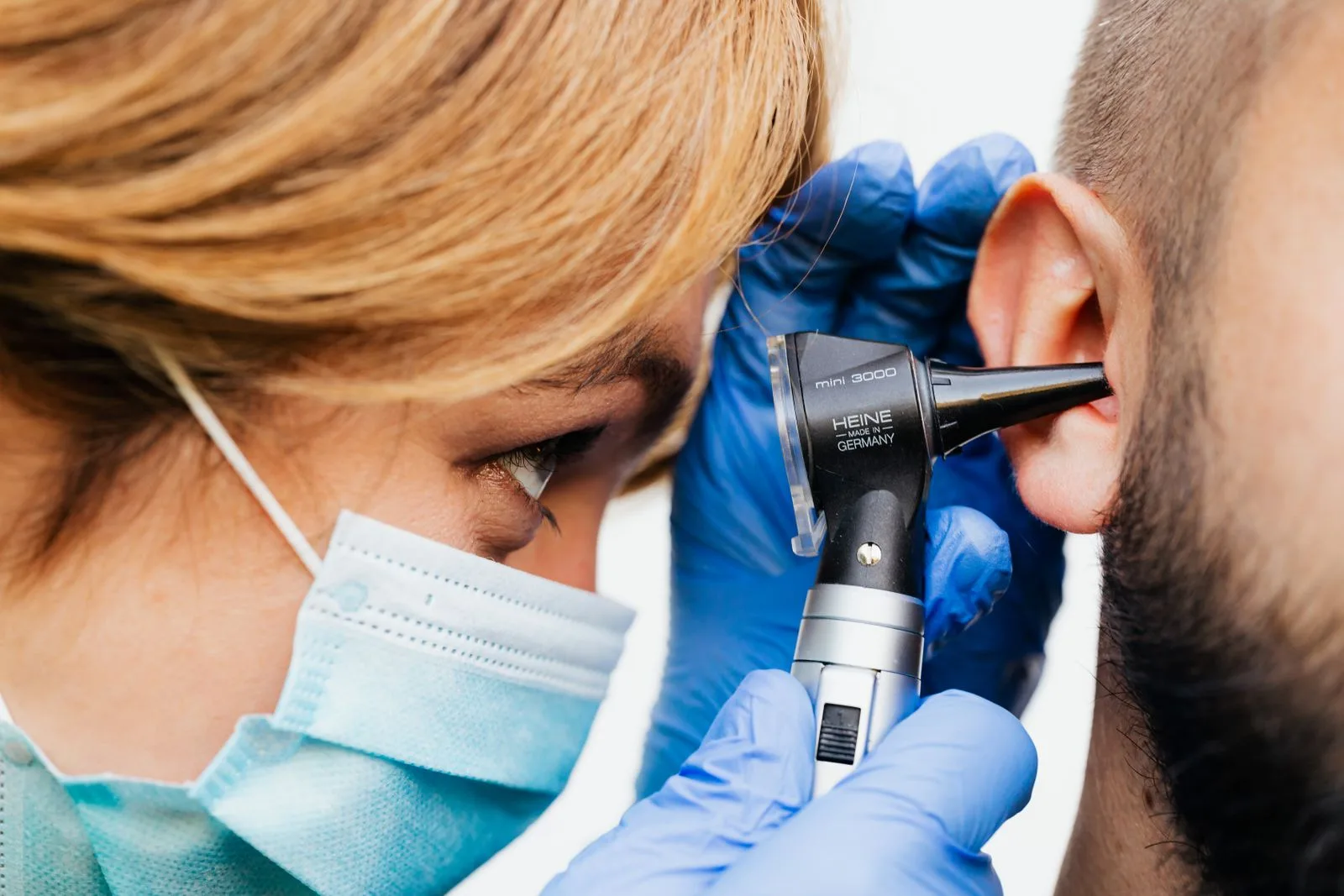
One of the cruel features of SSNHL is how easily it gets dismissed at first contact. The onset feels like a plugged ear, so people assume wax or a lingering cold and wait it out. The clinical guideline update was driven partly by exactly this problem — SSNHL is frequently mistaken for cerumen impaction or middle-ear fluid, which delays the steroids that work best early (AAO-HNS, 2019). There's also a small but serious reason to get imaged: in one series, 0.7% of patients initially labeled SSNHL turned out to have an acoustic neuroma (PMC, 2022). Sudden one-sided hearing loss is a "go to the doctor today" event, not a "see if it clears up" one.
Why the First Two Weeks Decide So Much
The treatment window is short, and it's the single most important thing to understand about SSNHL. Corticosteroids, the mainstay of treatment, should be offered within two weeks of symptom onset for the best chance of recovery, and salvage intratympanic injections are recommended in the two-to-six-week window if the first course falls short (AAO-HNS, 2019). Treatment delayed beyond a few weeks is far less likely to reverse the loss (NIDCD, 2018).
The outcomes make the case for speed. Roughly half of people with untreated SSNHL recover some or all of their hearing spontaneously, usually within the first one to two weeks, with peer-reviewed ranges landing between 32% and 65% (NIDCD, 2018; StatPearls, 2023). Prompt steroid treatment pushes complete-recovery rates higher, with retrospective analyses reporting complete recovery in roughly 49% to 79% of treated patients (PMC, 2022). Improvement inside the first two weeks is itself a strong predictor of an excellent long-term outcome (StatPearls, 2023).
Not everyone recovers, and honest prognosis matters here. Several factors predict a harder road: profound hearing loss at onset (odds ratio around 4.68), the presence of vertigo (odds ratio around 1.95), a descending or flat audiogram shape, older age, and a longer delay before treatment (PubMed meta-analysis, 2025; PMC nomogram cohort, 2023). When the first steroid course doesn't work and salvage injections are tried, the numbers get sobering — one 2025 cohort reported complete recovery in only 9.3% of the salvage population, partial in 29.1%, and no meaningful recovery in 61.6% (PLOS One, 2025). Those figures describe a harder-to-treat group, but they're the reality behind the phrase "we'll have to wait and see."
Citation capsule: Corticosteroids for sudden sensorineural hearing loss should begin within two weeks of onset, with salvage intratympanic injections recommended between two and six weeks if recovery is incomplete (AAO-HNS, 2019). Roughly half of untreated cases recover some hearing within one to two weeks, while prompt treatment raises complete-recovery rates to between 49% and 79% (StatPearls, 2023; PMC, 2022).
What the Recovery Gap Actually Feels Like
The recovery gap is the stretch between "we've started treatment" and "this is your final hearing level," and it can last anywhere from a couple of weeks to six months. Because full outcome is often assessed up to three to six months out, and salvage therapy extends the window, most patients live for weeks in a state of genuine uncertainty (AAO-HNS, 2019). You don't know if you're temporarily impaired or permanently single-sided, and every conversation happens under that cloud.
What makes the gap so disorienting is that a hearing aid usually isn't the answer yet. Audiologists typically wait to see where hearing settles before fitting anything, and if the loss is severe or profound in the affected ear, conventional amplification may not help that ear at all. So the patient is caught in between — too impaired to follow group conversation comfortably, not yet a candidate for a permanent device, and told to wait. That's precisely the interval where a tool that doesn't depend on the ear becomes useful.

The physical reality of one-sided loss is the part that surprises people most. With one ear out, the brain can no longer use the head-shadow effect to separate a voice from the noise around it, so a restaurant running at an average of 78 dBA becomes a wall of undifferentiated sound (University of Nebraska sound-level study, 2018; PMC occupational noise study, 2016). You can hear that people are talking. You just can't pull the words out. During the recovery gap, that experience is layered on top of the anxiety of not knowing whether it's permanent — which is a heavier cognitive load than either problem alone.
The Hidden Toll: Communication and Mental Health During Recovery
The emotional impact of sudden hearing loss is measurable and significant, not just anecdotal. A large cohort study following 8,550 patients found that sudden sensorineural hearing loss was associated with a 1.50x higher risk of any affective disorder, a 1.66x higher risk of depression, and a 1.79x higher risk of anxiety compared with matched controls (JAMA Otolaryngology / PMC, 2018). This is a recognized downstream consequence of the condition, and the recovery gap is where much of it takes root.
The distress shows up immediately, not just months later. In a study of 56 patients with new one-sided SSNHL, pretreatment Beck scores were elevated across the board — anxiety at 19.5, depression at 11.6, and hopelessness at 6.2 — captured at the moment of diagnosis (PubMed, 2018). The shock of a sudden sensory change, plus the uncertainty of whether it reverses, plus the daily friction of missing what people say, compounds fast. Recent causal-inference work using Mendelian randomization even links genetic susceptibility to sudden hearing loss with depression, suggesting the relationship runs deeper than situational stress (Nature Scientific Reports, 2024).

Here's the connection that gets missed: much of the mental-health toll is mediated by communication breakdown, and communication is the one part you can address immediately while the ear does whatever it's going to do. You can't speed up cochlear recovery. You can't make steroids work faster. But you can stop withdrawing from the dinner table, stop nodding along without understanding, and stop leaving the room during phone calls. Restoring participation doesn't cure SSNHL — it removes the daily reinforcement of loss that feeds the anxiety and isolation the research documents. That's the specific job a caption stream can do during the gap.
How Captioning Glasses Bridge the Recovery Gap
Captioning glasses solve the recovery-gap problem by sidestepping the ear entirely. Instead of amplifying sound into a cochlea that may or may not be working, they add a parallel visual channel: a 4-microphone beamforming array captures the speech of whoever you're facing, an on-device speech engine converts it to text, and the words render on the lenses at 300 millisecond latency with 97% accuracy. Whether the affected ear recovers fully, partially, or not at all, the caption stream reads the same.
That independence from the ear is what makes captions the right tool for an uncertain recovery. A hearing aid has to be fitted to a hearing level that hasn't stabilized yet. A cochlear implant is a permanent surgical decision you can't make until the audiogram settles. Captioning glasses require neither — they're a stopgap you can start using the week the loss happens and keep using indefinitely if the ear doesn't come back. During the gap, they carry you. After it, if recovery is incomplete, they simply keep working.
Citation capsule: Because roughly a third to half of sudden hearing loss patients are left with lasting, usually single-sided deficit (StatPearls, 2023; NIDCD, 2018), a recovery-period tool has to work whether or not the ear returns. Captioning glasses render speech as on-lens text using a 4-microphone beamforming array at 300 millisecond latency and 97% accuracy, a visual channel that is independent of the affected cochlea.
The beamforming array is the part that matters most in the rooms where one-sided listeners struggle. A single-microphone captioning app mixes every voice in a noisy restaurant into one transcript, which is the same failure mode the impaired ear already produces. A directional 4-microphone array steers a capture cone onto the person in front of you and filters the 78 dBA room before the speech engine ever sees it. And because the captions sit on the lens instead of on a phone screen, you keep your eyes on the person's face — which preserves lip-reading cues and the social contact that looking down at a phone destroys. For the fuller picture of how the caption pipeline works, see the AirCaps captions overview.
There's a second benefit that a hearing aid can't offer even after recovery: a verbatim record. During the gap, medical appointments come thick and fast — audiograms, follow-ups, steroid tapers, MRI results. When an ENT rattles off a medication schedule or an MRI finding, the caption sits on the lens long enough to actually read it, and Pro-tier meeting mode can preserve a searchable transcript. For a patient already spending extra cognitive effort just to follow the conversation, not having to also memorize it in real time is a genuine relief.
A Week-by-Week Look at Recovery With Captions
Recovery timelines vary widely, but the guideline windows give a realistic scaffold for where captioning glasses fit. The composite picture below traces a typical SSNHL course against the treatment milestones — onset within 72 hours, steroids within two weeks, salvage between two and six weeks, and final assessment up to six months (AAO-HNS, 2019). It isn't a promise of any individual outcome; it's a map of the interval a stopgap tool has to cover.
| Recovery Phase | What's Happening Medically | The Communication Reality | Where Captions Help |
|---|---|---|---|
| Days 0 to 3 (onset) | Sudden loss; urgent ENT visit; audiogram and steroid start | Shock; one ear silent or distorted; hard to follow your own doctor | Read the diagnosis and treatment plan verbatim on the lens |
| Weeks 1 to 2 (primary treatment) | Oral steroid course; most spontaneous recovery, if any, happens here | Uncertainty peaks; group settings feel impossible | Caption stream restores dinner-table and phone participation immediately |
| Weeks 2 to 6 (salvage window) | Intratympanic injections if recovery is incomplete | Fatigue sets in; anxiety about permanence grows | Verbatim transcripts reduce the memorization load of frequent appointments |
| Months 1 to 6 (settling) | Hearing stabilizes; audiologist assesses final level | Adapting to whatever hearing remains | If loss is permanent, the same glasses continue as a long-term SSD tool |
The point of laying it out this way is to show that the tool doesn't expire when the medical story ends. If the ear recovers fully, you stop wearing the glasses for hearing and they become ordinary prescription eyewear. If recovery is partial or absent, they carry straight through into permanent single-sided-deafness life without a second purchase decision.

Returning to work is the milestone where the value tends to become obvious. A conference room is quieter than a restaurant, but the turn-taking is faster and the cost of missing a word is higher — a dropped action item instead of dropped small talk. During the gap, when you can't yet trust the affected ear and don't want to announce a medical situation to every colleague, on-lens captions let you keep pace without disclosing anything. AirCaps speaker identification labels up to 15 distinct voices in the transcript, so you can follow who said what in a five-person meeting. The AirCaps meetings feature adds searchable summaries and action items on the Pro tier for exactly this scenario.
Captioning Glasses vs. Other Stopgaps During Recovery
During the recovery gap, most people reach for whatever's at hand — a phone captioning app, an amplifier, a request that everyone just speak up. Each has a place, and each has a specific limit that matters when one ear is out and the room is loud. The comparison below stacks the realistic stopgaps against captioning glasses on the dimensions that decide daily usefulness.
| Stopgap | How It Works | Where It Falls Short During Recovery | Typical Cost |
|---|---|---|---|
| Phone captioning apps | Single phone mic feeds a cloud transcript on the screen | Eyes drop to the phone; single mic mixes all voices in noise; no eye contact or lip cues | Free to $20/month |
| Personal sound amplifiers | Amplify all sound into the ear | Amplify noise along with speech; useless if the affected ear is severe or profound | $100 to $500 |
| Waiting for a hearing aid fitting | Amplification tuned to your audiogram | Audiologists wait for hearing to stabilize; may not help a severe or profound ear at all | $2,000 to $6,000 per pair |
| Asking people to repeat or speak up | Behavioral workaround | Exhausting for everyone; fails in groups and background noise; erodes participation | Free |
| Captioning glasses (AirCaps) | 4-mic beamforming, on-device speech recognition, text on lenses | Requires reading captions; not a substitute for restored hearing | $599, no required subscription |
Two things fall out of this table. First, the stopgaps that depend on the ear — amplifiers and hearing aids — are the least reliable during the gap precisely because the ear's status is unknown and possibly severe. Second, phone apps get the visual channel right but the ergonomics wrong: looking down at a screen breaks eye contact and lip-reading at the exact moment those cues matter most. Captioning glasses keep the visual transcript where a conversation actually happens — on the face of the person you're talking to.
None of this makes captioning glasses a treatment. They don't heal the cochlea, and they aren't a reason to skip or delay the steroids that might. They're a communication bridge for the weeks or months when the medical outcome is still unwritten, and a durable tool if that outcome turns out to be permanent.
Choosing Captioning Glasses During SSNHL Recovery
Picking captioning glasses in the middle of a recovery is a slightly different decision than picking them for settled, long-standing hearing loss. You're buying under uncertainty, possibly before you know your final hearing level, and you want a tool that works today and keeps working whichever way the ear goes. A few specifications matter more than others in that situation.
Microphone configuration comes first. A directional 4-microphone beamforming array is what separates a device that works in a real restaurant from one that only works in a quiet room, because it isolates the speaker before transcription instead of dumping every voice into one transcript. Latency comes second — captions above roughly 350 milliseconds drift visibly out of sync with lips, which adds cognitive load rather than removing it. AirCaps runs at 300 milliseconds, inside the perceptual sync window, which matters for a listener whose good ear is already working overtime.
| Feature | Why It Matters During SSNHL Recovery | AirCaps Spec |
|---|---|---|
| Microphone array | Isolates the speaker in noisy rooms where a single impaired ear fails | 4 microphones with directional beamforming |
| End-to-end latency | Good ear is already at capacity; captions must arrive in lip-sync | 300 ms end-to-end |
| Caption accuracy | Verbatim text compensates for words missed while the ear is impaired | 97% accuracy (Pro tier) |
| Independence from the ear | Works whether recovery is full, partial, or absent | Visual channel; no amplification required |
| Display configuration | Binocular displays reduce eye strain for a cognitively loaded user | Binocular MicroLED, both lenses |
| Frame weight | All-day tolerance through appointments, work, and meals | 49 grams; lighter than most prescription eyewear |
| Speaker identification | Labels who is talking in group settings a one-eared listener can't localize | Up to 15 distinct speakers labeled |
| Prescription integration | Any optician can fit lenses; no vendor lock-in | -16 to +16 diopters, any Rx |
| Meeting summaries | Reduces recall load across frequent medical and work appointments | Structured notes with action items; searchable history |
| Light leakage | Captions stay private; no need to disclose a medical situation | Less than two percent front leakage |
| Return window | Lets you trial before committing while the outcome is still uncertain | 15-day no-questions-asked return |
| Cost structure | No subscription trap during an already expensive medical period | $599; free tier forever, optional Pro at $20/month |
The financial picture is friendlier than most people expect during a medical event. AirCaps is HSA/FSA eligible as an assistive device, so the effective post-tax cost for buyers in the 22 to 32% federal bracket lands closer to $400 to $470, and there's no required subscription draining money month after month. The glasses ship in roughly two weeks and the 15-day return window starts on arrival — enough time to test them through a doctor's appointment, a family dinner, and a day back at work before deciding.
One last consideration worth naming: language. If your recovery is complicating an already multilingual life — a bilingual household, international work, a doctor with an accent you're now straining to parse — the AirCaps translation feature supports 60+ languages with automatic detection, transcribing and translating in the same on-lens stream. It's a category of help no amplifier or hearing aid provides, because those devices hand raw sound to an ear that then has to do all the language work itself.
Frequently Asked Questions
Can captioning glasses help while I'm still recovering from sudden hearing loss?
Yes, and the recovery period is one of the strongest use cases. Captioning glasses render speech as on-lens text using a 4-microphone beamforming array, independent of whether the affected ear works. Since about half of untreated cases recover within one to two weeks and outcomes aren't final for months (NIDCD, 2018), a visual channel lets you keep participating in conversations while you wait to learn your final hearing level.
Should I use captioning glasses instead of getting steroid treatment?
No. Captioning glasses are a communication tool, not a treatment. Sudden sensorineural hearing loss is a medical emergency, and corticosteroids should begin within two weeks of onset for the best chance of recovery (AAO-HNS, 2019). See an ENT immediately. Captioning glasses bridge the communication gap during and after treatment; they never replace the medical care that might restore your hearing.
What if my hearing comes back fully — was buying glasses a waste?
Not really. If your ear recovers completely, the glasses become ordinary prescription eyewear you can keep wearing. The AirCaps 15-day no-questions-asked return window also lets you trial them during the most uncertain weeks and return them if recovery arrives quickly. Because roughly a third to half of patients retain some permanent loss (StatPearls, 2023), many buyers find the glasses carry straight into long-term use.
How do captioning glasses handle noisy restaurants when one ear isn't working?
The 4-microphone beamforming array locks a directional cone onto whoever you're facing and filters ambient noise before the speech engine processes it. Restaurants average 78 dBA (University of Nebraska study, 2018), the exact environment where a single impaired ear fails because it can no longer separate speech from noise. Captions deliver the words visually at 97% accuracy while you keep eye contact with the speaker.
Are captioning glasses covered by insurance or HSA/FSA for hearing loss?
Direct insurance coverage varies by plan and is less established than hearing-aid coverage. However, AirCaps is HSA/FSA eligible as an assistive medical device, letting you pay with pre-tax health-savings dollars. For most buyers in the 22 to 32% federal bracket, that brings the effective cost of the $599 device to roughly $400 to $470. AirCaps also provides documentation that can support HSA/FSA reimbursement or workplace accommodation requests.
Does sudden hearing loss affect mental health, and can captions help?
Sudden sensorineural hearing loss is linked to a 1.66x higher risk of depression and a 1.79x higher risk of anxiety (JAMA Otolaryngology / PMC, 2018), and much of that toll is mediated by communication breakdown and isolation. Captioning glasses can't treat the condition, but restoring your ability to follow conversations removes the daily reinforcement of loss that feeds anxiety and withdrawal during an already stressful recovery.
How quickly can I start using captioning glasses after my diagnosis?
AirCaps ships in roughly two weeks, and there's no fitting appointment required — the glasses are self-fit and work with any prescription from -16 to +16 diopters through any optician. That timing lines up well with the recovery gap, since primary steroid treatment runs about two weeks and outcomes aren't assessed for months (AAO-HNS, 2019). Many people order in the first days after diagnosis and have the glasses before the salvage window even opens.
Sources: AAO-HNS Clinical Practice Guideline: Sudden Hearing Loss (Update) fact sheet, 2019. AAO-HNS Guideline full text (Chandrasekhar et al.), 2019. NIDCD (NIH) — Sudden Deafness, 2018. StatPearls — Sensorineural Hearing Loss (NCBI Bookshelf), 2023. Recurrent ISSNHL Prognostic Analysis (PMC), 2022. Intratympanic Steroid Predictors of Recovery (PLOS One), 2025. Poor-Prognosis Meta-Analysis (PubMed), 2025. Prognostic Nomogram Cohort (PMC), 2023. ISSNHL and Affective Disorders, JAMA Otolaryngology (PMC), 2018. Anxiety and Depression in Sudden One-Sided Hearing Loss (PubMed), 2018. ISSNHL and Depression Mendelian Randomization (Nature Scientific Reports), 2024. Acoustic Neuroma Presenting as SSNHL (PMC), 2022. Sudden Hearing Loss Overview, Medscape, 2023. Restaurant Sound-Level Analysis (University of Nebraska), 2018. Occupational Noise in Restaurants (PMC), 2016. Image credits: Pexels (royalty-free).
On this page
Table of Contents
▼
Written by
Madhav Lavakare
Co-founder & CEO, AirCaps
Co-founder of AirCaps. Building AI-powered smart glasses for conversation since 2013. Yale graduate, Y Combinator alum. Built his first Google Glass apps at age 13 and has spent 11+ years in speech AI and wearable computing.
Related Articles

Guides
Single-Sided Deafness (SSD): Why Captioning Glasses Beat CROS Hearing Aids for Many Users
Roughly 60,000 US adults develop single-sided deafness each year (Laryngoscope, 2022). Why captioning smart glasses often outperform CROS hearing aids in restaurants, meetings, and group settings.
Madhav Lavakare
·
Jul 1, 2026
·
26 min read

Guides
Lipreading Plus Captions: Why Combining Both Beats Either Alone
Skilled lipreaders average just 50.7% of words from lips alone (PMC, 2023). Here's why pairing lipreading with in-view captions — one field of view, eyes on the face — beats either channel by itself.
Madhav Lavakare
·
Jul 23, 2026
·
18 min read
Guides
Captioning Glasses for Tinnitus: Why Reducing Listening Effort Quiets the Ringing
14.4% of adults worldwide live with tinnitus (JAMA Neurology, 2022). Why captioning glasses that cut listening effort can lower tinnitus distress when straining to hear makes the ringing louder.

Nirbhay Narang
·
Jul 4, 2026
·
19 min read
© 2025 AirCaps. All rights reserved.