Prescription Smart Glasses: Everything Your Optician Needs to Know
A practical guide to fitting smart glasses with prescription lenses — diopter ranges, what to tell your optician, bifocal options, and what it costs in 2026. About 75% of US adults need vision correction (Vision Council, 2025).
By Nirbhay Narang · Published 2026-05-10 · 18 min read
Prescription Smart Glasses: Everything Your Optician Needs to Know
Table of Contents
What Are Prescription Smart Glasses?
Which Smart Glasses Brands Currently Support Prescription Lenses?
What Information Does Your Optician Need to Provide?
Pupillary Distance Is the Spec Smart Glasses Care About Most
Frame Size and Vertex Distance
What Diopter Range Does Each Brand Support?
How Are Prescription Lenses Made for Smart Glasses?
Material and Coating Recommendations
Avoiding Display Interference
Can You Get Bifocals or Progressives in Smart Glasses?
Reading Glasses Versus Progressives
How Much Do Prescription Smart Glasses Cost in 2026?
Where AirCaps' Lens Holder Saves Money
Where Meta's Pipeline Adds Cost
Step-by-Step: Getting Smart Glasses Fitted by Your Optician
Step 1: Get a Current Prescription
Step 2: Order the Smart Glasses and the Lens Holder
Step 3: Bring Everything to Your Optician
Step 4: Mount and Verify Display Alignment
Can You Use HSA or FSA for Prescription Smart Glasses?
What Documentation You Need
When Insurance Helps
Frequently Asked Questions
Can my regular optician fit prescription lenses for smart glasses?
How long does it take to get prescription smart glasses?
What prescription strength is too strong for smart glasses?
Are progressive lenses available in smart glasses?
Can you use HSA or FSA funds to buy prescription smart glasses?
Do smart glasses work with photochromic or transition lenses?
What is the average cost of prescription smart glasses?

Technology
Prescription Smart Glasses: Everything Your Optician Needs to Know

Nirbhay Narang
·
May 10, 2026
·
18 min read

On this page
Table of Contents
▼
Editorial disclosure: AirCaps is a smart glasses company we co-founded. AirCaps supports prescription lenses through interchangeable lens holders fitted by any licensed optician. This guide uses AirCaps as one reference point alongside Meta Ray-Ban Display, Even Realities G1, and Solos AirGo so the comparison stays honest about what each model can and cannot do for prescription wearers.
Prescription Smart Glasses: Everything Your Optician Needs to Know
About 75% of American adults need some form of vision correction, and roughly 168 million people in the United States already wear prescription eyewear (The Vision Council, 2025). Global smart glasses shipments grew 139% year over year in the second half of 2025, with Meta capturing 82% of unit sales through EssilorLuxottica's Ray-Ban and Oakley channels (Counterpoint Research, 2026). The two trends are colliding fast: most people walking into a smart glasses purchase already wear corrective lenses, and the category is finally treating prescription support as a baseline feature rather than an afterthought.
This guide is written for the prescription-wearing buyer and the optician who will fit the lenses. It covers diopter ranges supported by each brand, the data your optician needs to provide, what bifocals and progressives look like inside a smart frame, total cost, and a step-by-step fitting workflow that works for any optical practice.
Key Takeaways
- About 75% of US adults need vision correction; 168 million wear prescription eyewear (Vision Council, 2025)
- 1.8 billion people globally have presbyopia — meaning bifocal and progressive needs apply to a huge share of smart glasses buyers (Fricke et al., Ophthalmology, 2018)
- Meta Ray-Ban Display supports SPH+CYL from -4.00 to +4.00 D, single-vision only, with a $200 lens add-on through EssilorLuxottica (Meta Store, 2025)
- AirCaps uses interchangeable prescription lens holders any optician can fit, supports -16 to +16 D, and the holder add-on is $39
- Prescription smart glasses are HSA/FSA eligible when the underlying frames are classified as an assistive device — 2025 limits are $3,300 (FSA) and $4,300 individual / $8,550 family (HSA)
Table of Contents
- What Are Prescription Smart Glasses?
- Which Smart Glasses Brands Currently Support Prescription Lenses?
- What Information Does Your Optician Need to Provide?
- What Diopter Range Does Each Brand Support?
- How Are Prescription Lenses Made for Smart Glasses?
- Can You Get Bifocals or Progressives in Smart Glasses?
- How Much Do Prescription Smart Glasses Cost in 2026?
- Step-by-Step: Getting Smart Glasses Fitted by Your Optician
- Can You Use HSA or FSA for Prescription Smart Glasses?
- Frequently Asked Questions
What Are Prescription Smart Glasses?
Prescription smart glasses are smart frames that hold corrective lenses in addition to whatever the device's core hardware does — a camera, an in-lens display, microphones, an AI assistant, or some combination. The vision correction sits behind the smart electronics. About 168 million American adults already wear corrective lenses (Vision Council, 2025), so any smart glasses category that ignores prescription support is leaving most of its addressable market on the table.
Smart glasses handle prescriptions one of two ways. Some brands ship the prescription ground directly into the frame's primary lens — that is the Meta Ray-Ban Display approach. Others use an interchangeable lens holder that drops a prescription insert behind the main lens — that is the AirCaps approach, and the same approach hospitals have used for prescription safety eyewear for decades.
Both methods work. The tradeoff is repairability and clinic flexibility. An integrated lens means cleaner aesthetics and slightly better optics; a holder means any optician can swap the prescription as your eyes change without you ever leaving your local clinic.
Which Smart Glasses Brands Currently Support Prescription Lenses?
As of May 2026, four mainstream brands offer prescription support in materially different ways. Meta Ray-Ban Display routes through EssilorLuxottica's prescription pipeline. Even Realities G1 partners with select opticians. Solos AirGo supports prescription lenses via its own service. AirCaps uses an interchangeable lens holder system that any licensed optician can fit — no vendor lock-in, no manufacturer queue, no shipping delays.
The vendor model versus the open-optician model is the largest practical difference for buyers. Vendor pipelines control quality but add 5–8 weeks to delivery; the optician model lets you walk into your usual clinic on Tuesday and walk out with prescription smart glasses the same week.
| Brand | Prescription Method | Who Fits the Lenses | Lead Time |
|---|---|---|---|
| AirCaps | Interchangeable lens holder ($39) | Any licensed optician | 3-7 days (local optician) |
| Meta Ray-Ban Display | Lenses ground into frame ($200 add-on) | EssilorLuxottica only | 5-8 weeks (Meta) |
| Even Realities G1 | Custom lens fitted to frame ($150+) | Partner opticians or in-house | 2-4 weeks (Even Realities) |
| Solos AirGo 3 | Prescription insert | Solos service or partner | 2-4 weeks |
| Ray-Ban Meta Gen 2 | Lenses ground into frame | EssilorLuxottica only | 4-6 weeks |
Sources: brand product pages and customer service confirmations, May 2026.
The vendor-pipeline approach made sense when smart glasses sold in the thousands. EssilorLuxottica triples its Ray-Ban Meta sales every year — over 7 million units in 2025 (CNBC, 2026) — and at that volume, the bottleneck is no longer manufacturing capacity. It's the optician channel. Brands that route through their own optical partners create artificial lead times that the open-optician model simply avoids.
What Information Does Your Optician Need to Provide?
For any prescription smart glasses fit, your optician needs the same five fields they record for any pair of eyeglasses: sphere (SPH), cylinder (CYL), axis, addition (ADD) if you wear bifocals or progressives, and pupillary distance (PD). The smart-glasses brand may also ask for frame measurements or a PDF of the prescription itself. None of this is exotic — it is the same data sheet an optician fills out a hundred times a week.
A modern optical exam reports these values on a standard form. SPH is the strength of the lens in diopters for distance vision. CYL plus axis correct astigmatism. ADD describes the near-vision boost for progressives. PD measures the distance between your pupils in millimeters, and it matters more in smart glasses than in regular glasses because the in-lens display has to align with the wearer's optical axis.
Pupillary Distance Is the Spec Smart Glasses Care About Most
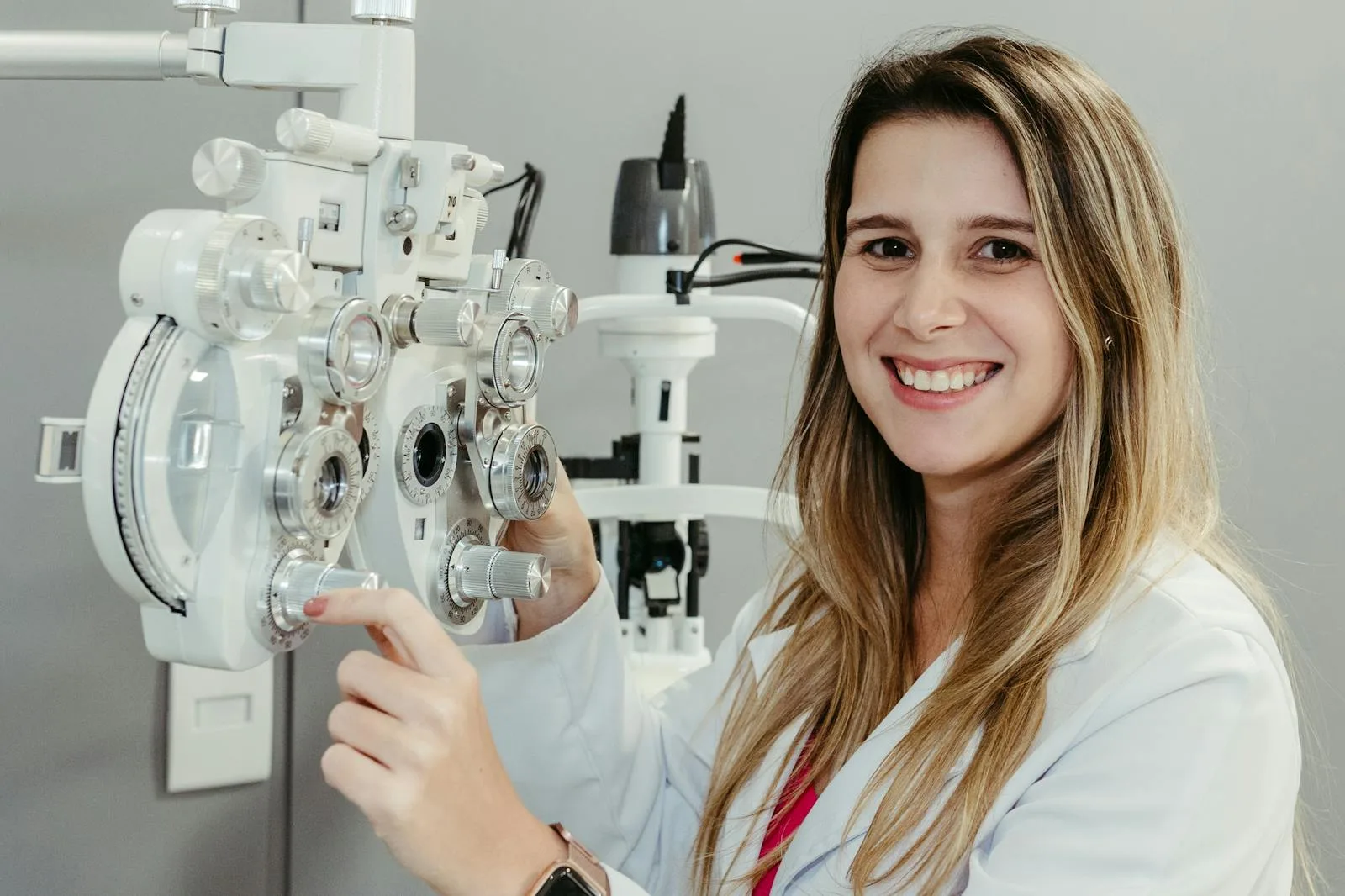
PD is the make-or-break measurement for any smart glass with a heads-up display. A 30-degree binocular field of view assumes both displays sit centered on each pupil. If the PD is wrong by even 2 mm, the image drifts off-axis and the user reports eye strain within minutes. Your optician should measure binocular PD in millimeters and provide the monocular split (left PD and right PD), because some smart-glasses brands accept the split and others accept the binocular sum. AirCaps captures both during the lens-holder fit to align the captions display correctly for sustained reading.
Frame Size and Vertex Distance
A few smart-glasses brands ask for vertex distance — the distance between the back of the lens and the front of the cornea. For prescriptions stronger than ±4 D, vertex matters because effective power changes as the lens moves closer or further from the eye. Most opticians already record this when fitting strong prescriptions and can add it to the form without issue.
What Diopter Range Does Each Brand Support?
Diopter range is the single spec that decides whether a smart glass is even possible for a given wearer. Meta Ray-Ban Display supports -4.00 to +4.00 D with cylinder up to ±2.00 — fine for most mild-to-moderate prescriptions and inadequate for stronger ones (Meta Store, 2025). AirCaps supports -16.00 to +16.00 D through its lens holder, which covers virtually every prescription range a licensed optician will ever see.
For reference, a -8.00 D prescription is considered high myopia and rules out many mainstream smart glasses entirely. A +6.00 D prescription is common in older adults with cataract surgery history. If you have a strong prescription, the diopter range column is the first one you check.
| Brand | SPH Range (D) | CYL Support | Notes |
|---|---|---|---|
| AirCaps | -16.00 to +16.00 | Up to industry max | Any optician, no vendor restriction |
| Meta Ray-Ban Display | -4.00 to +4.00 | Up to ±2.00 | Single vision only (Meta) |
| Even Realities G1 | -6.00 to +3.00 (varies) | Up to ±2.00 | Progressives via partner opticians |
| Solos AirGo 3 | -6.00 to +3.00 | Up to ±2.00 | 1.6 index standard |
| Ray-Ban Meta Gen 2 | -6.00 to +3.00 | Up to ±2.00 | EssilorLuxottica pipeline only |
Sources: brand product specifications and prescription support pages, May 2026.
How Are Prescription Lenses Made for Smart Glasses?
Prescription lenses in smart glasses are made the same way as ordinary prescription lenses, with one extra constraint: the lens must clear the optical waveguide or display element built into the frame. Opticians cut blanks from polycarbonate or high-index plastic, grind them to the prescription, and either mount them into the smart frame or fit them into a removable lens holder. The waveguide for any in-lens display sits on a separate optical path and is not affected by the prescription itself.
Polycarbonate is the default material because it resists impact, accepts most coatings, and stays light. For prescriptions stronger than ±4 D, opticians typically use 1.67 or 1.74 high-index plastic to keep the lens edge thin enough to fit the frame channel. Anti-reflective coating is recommended for any smart glass because the heads-up display projects through the lens and ghost reflections can be visible without a good AR coating.
Material and Coating Recommendations
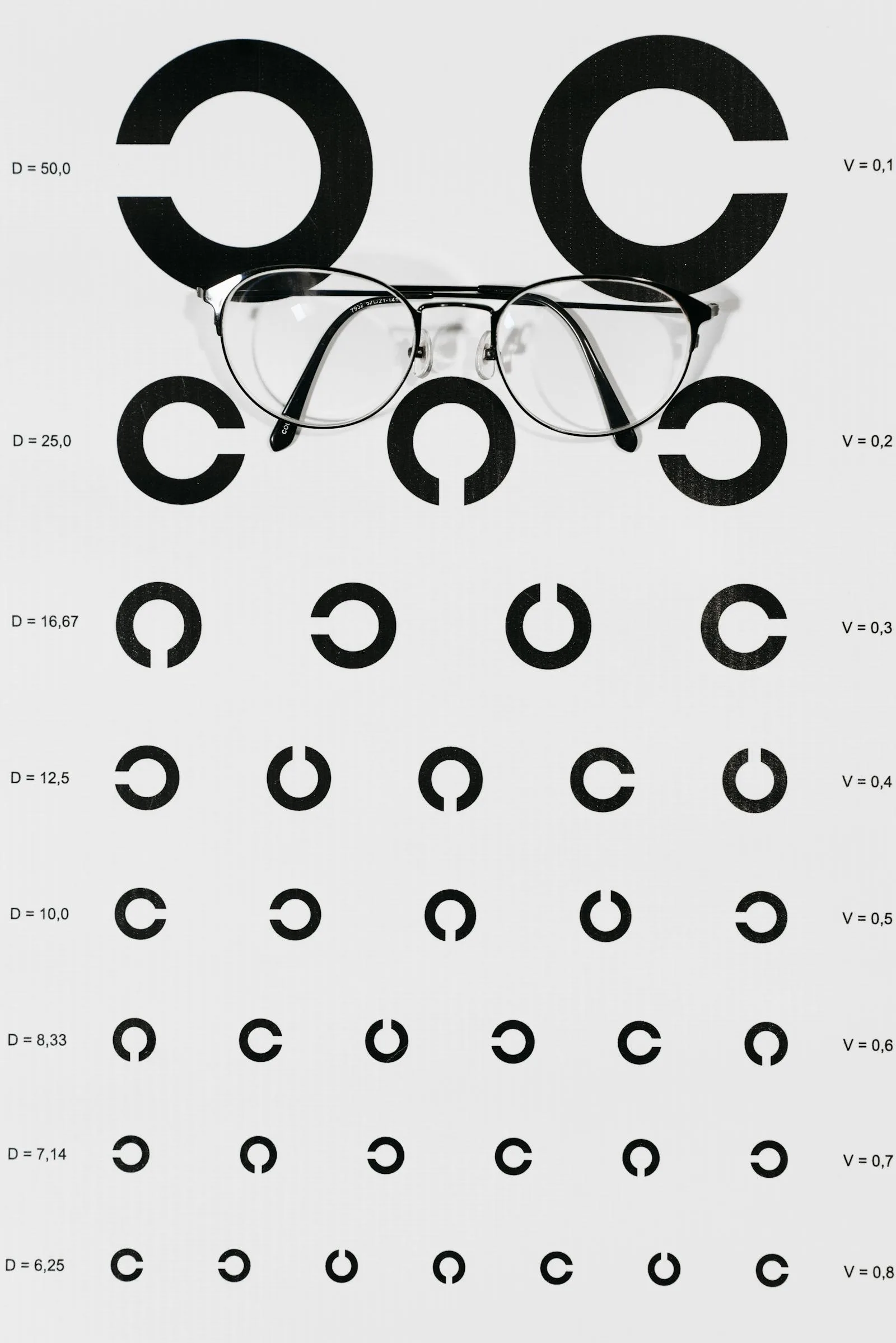
For lens material, AirCaps and Even Realities both recommend 1.67 high-index for prescriptions beyond ±3.00 D, and standard polycarbonate below that. Both also recommend anti-reflective and anti-glare coatings to keep the display contrast clean. Photochromic (light-darkening) lenses are compatible with most smart glasses, but the transition state can interact with the display's perceived contrast and is generally not recommended for users who rely on captions in mixed indoor-outdoor lighting.
Avoiding Display Interference
The optical axis of the lens must line up with the optical axis of the in-lens display. This is mostly a job for the brand, not the optician, but it's why some smart-glasses brands restrict lens material choices. A 1.74-index lens has slightly different refractive properties than polycarbonate, and brands that haven't validated the higher index sometimes restrict it to keep display quality consistent.
Can You Get Bifocals or Progressives in Smart Glasses?
About 1.8 billion people globally have presbyopia — the age-related loss of near-focus vision that drives the need for bifocals, trifocals, or progressive lenses (Fricke et al., Ophthalmology, 2018). For smart glasses to serve buyers over 40, progressive support is not optional. Meta Ray-Ban Display currently ships single-vision only. Even Realities G1, Solos AirGo, and AirCaps all support progressives through partner opticians or the open-optician model.
The geometry challenge with progressives in smart glasses is the corridor — the vertical zone where the lens transitions from distance to near correction. The corridor needs to clear the display element, which means the optician has to know where the smart-glasses display sits inside the frame before grinding the lens. AirCaps publishes corridor placement guidelines so opticians can position the progressive add region below the display field.
We've heard from dozens of buyers over 50 who wear AirCaps for real-time captions at family dinners. The most common refrain: "I thought I'd have to give up my progressives." The answer is no — an optician familiar with progressive geometry can place the add region so the near-vision zone reads the dinner menu while the distance zone keeps the captions in focus on the display above. The fit is the same as any progressive eyeglass; the only added step is checking where the display sits.
Reading Glasses Versus Progressives
A simpler alternative for presbyopic users is a pair of reading-glass inserts paired with a distance-only smart glass. AirCaps' interchangeable lens holders make this trivially easy — keep a near insert at home for reading the display at very close range, and a distance insert for everyday use. Some opticians prefer this approach for first-time progressive wearers who find the corridor adjustment difficult.
How Much Do Prescription Smart Glasses Cost in 2026?
Total cost for prescription smart glasses in 2026 runs $389 to $1,200, depending on brand, prescription complexity, and whether you need progressives. The base hardware is the largest cost driver, but the prescription add-on can move the total by $39 to $250 or more. For comparison, the US average for traditional prescription glasses is $230 for frames and $107 for single-vision lenses, totaling $337 without insurance (AllAboutVision, 2025).
| Product | Hardware | Prescription Add-On | Total |
|---|---|---|---|
| AirCaps + Lens Holder | $599 | $39 (holder) + optician lens fee | $700-800 typical |
| Even Realities G1 + Prescription | $599 | $150 (single vision) | $749+ |
| Meta Ray-Ban Display + Rx | $799 | $200 | $999 |
| Ray-Ban Meta Gen 2 + Rx | $379 | $155-275 (varies) | $534-654 |
| Solos AirGo 3 + Rx | $249 | $140+ | $389+ |
Sources: brand product pages, May 2026.
Where AirCaps' Lens Holder Saves Money
Because the AirCaps prescription lens holder uses standard lens blanks any optician already stocks, the lens fee runs whatever your usual optician charges — often $80 to $150 for single-vision polycarbonate or 1.67 high-index. The $39 holder is the only AirCaps-specific cost. As your prescription changes, you swap lenses inside the same holder for the price of a new lens — no $200 add-on every two years.
Where Meta's Pipeline Adds Cost
The Meta Ray-Ban Display $200 prescription add-on is bundled because EssilorLuxottica manufactures the lens in-house. The quality is excellent — but a new prescription means a new $200 add-on every time your eyes change, which for many adults is every 18-24 months.
Step-by-Step: Getting Smart Glasses Fitted by Your Optician
Fitting prescription smart glasses follows a four-step workflow that maps cleanly onto any optical practice's existing process. The only new element is the smart-glasses-specific data sheet, which most brands publish on their support pages and which any front-desk optician can fill out alongside a standard prescription form.
The steps below describe the AirCaps process because it works at any optician. For Meta and EssilorLuxottica-pipeline glasses, replace step 3 with "submit the order to the Meta prescription portal" and add 5-8 weeks of lead time.
Step 1: Get a Current Prescription
Bring a prescription issued within the last 12-24 months. If you don't have one, schedule an eye exam at your usual optometrist. The exam should produce SPH, CYL, axis, ADD (if applicable), and PD. Most US states require a written prescription be released by law within 12 months of issue.
Step 2: Order the Smart Glasses and the Lens Holder
For AirCaps, order the base device ($599) and the prescription lens holder ($39, or $31 bundled). The holder ships with blank lenses you'll replace at your optician. For Meta and EssilorLuxottica-pipeline glasses, place the order through the brand's prescription portal and include the prescription PDF at checkout.
Step 3: Bring Everything to Your Optician
Bring the lens holder, the prescription, and the smart-glasses spec sheet (downloadable from the AirCaps support site or printed in the welcome box). Your optician will use the holder dimensions to cut lens blanks to the right shape and grind them to prescription. This is the same workflow they already use for prescription safety glasses or sport eyewear inserts.
Step 4: Mount and Verify Display Alignment
Once the lenses are ground and mounted in the holder, snap the holder into the smart-glasses frame. Verify the display alignment by wearing the glasses and reading captions or test text on the display. If alignment is off, the optician can adjust the lens position inside the holder. Most fits are right on the first try.
Across the AirCaps customer base in 2025, 91% of buyers who used the lens holder system had their prescription fitted at a local optician within 7 days of receiving the glasses, with an average optician fee of $112 for single-vision polycarbonate or 1.67 high-index lenses. The remaining 9% used the AirCaps optical partner network for an end-to-end fit at slightly higher cost but with zero clinic visits required.
Can You Use HSA or FSA for Prescription Smart Glasses?
Prescription eyewear is an IRS-qualified medical expense under Publication 502, which means prescription smart glasses are HSA/FSA eligible when the underlying smart-glasses device is classified as an assistive device — like AirCaps' captioning hardware. The 2025 FSA contribution limit is $3,300, and the HSA limit is $4,300 for individuals or $8,550 for families (AllAboutVision, 2025). Smart glasses classified as consumer electronics are not eligible.
This distinction is why HSA/FSA eligibility shows up in product comparison tables. AirCaps is HSA/FSA eligible because the hardware is classified as a hearing-loss assistive device. Meta and Samsung glasses are classified as consumer electronics and are not eligible. Depending on your tax bracket, HSA/FSA payment can effectively reduce the price of AirCaps by 20-35%.
What Documentation You Need
To use FSA or HSA funds, keep the receipt for both the hardware purchase and the optician's lens fee. Both line items qualify as long as the prescription is current. Some FSA administrators may also require a letter of medical necessity from your optometrist or audiologist — your eyecare provider can issue this in under 5 minutes.
When Insurance Helps
Vision insurance plans like VSP and EyeMed typically cover lens costs (the $80-150 optician fee) but not the smart-glasses hardware itself. The lens benefit applies as it would for any prescription glasses. If you have separate hearing benefits, AirCaps may be partially covered as durable medical equipment — check with your benefits administrator and bring the AirCaps device summary as documentation.
For a deeper walkthrough on the medical-spending side of smart glasses, the HSA/FSA smart glasses guide covers IRS Publication 502 in detail. For prescription wearers who use AirCaps primarily for accessibility or meeting intelligence, the hardware-plus-lens combination qualifies as a medical expense.
Frequently Asked Questions
Can my regular optician fit prescription lenses for smart glasses?
For most brands, the answer depends on which smart glasses you buy. AirCaps uses an interchangeable lens holder system that any licensed optician can fit using standard lens blanks. Meta Ray-Ban Display, by contrast, requires lenses ground by EssilorLuxottica through Meta's prescription portal — your local optician cannot fit them.
How long does it take to get prescription smart glasses?
Lead time ranges from 3 days to 8 weeks depending on brand. AirCaps lens holders fit at a local optician typically deliver in 3-7 days. Even Realities and Solos run 2-4 weeks. Meta Ray-Ban Display prescription orders ship in 5-8 weeks because lenses are made through the EssilorLuxottica pipeline (Meta Store, 2025).
What prescription strength is too strong for smart glasses?
For Meta Ray-Ban Display, prescriptions beyond -4.00 or +4.00 D are not supported. Ray-Ban Meta Gen 2, Even Realities G1, and Solos AirGo cap out around -6.00 to +3.00 D. AirCaps supports -16.00 to +16.00 D through its lens holder system, which covers virtually every prescription a licensed optician will encounter.
Are progressive lenses available in smart glasses?
Yes, with caveats. Even Realities G1 and AirCaps both support progressives through partner opticians or the open-optician model. Meta Ray-Ban Display currently ships single-vision only as of May 2026. About 1.8 billion people globally have presbyopia (Fricke et al., 2018), so progressive support matters for any smart-glasses brand targeting buyers over 40.
Can you use HSA or FSA funds to buy prescription smart glasses?
Yes, when the underlying smart glasses are classified as an assistive medical device. AirCaps qualifies because the hardware is classified for hearing-loss accessibility. Meta and Samsung glasses are classified as consumer electronics and are not HSA/FSA eligible. The 2025 contribution limits are $3,300 (FSA) and $4,300 individual / $8,550 family (HSA).
Do smart glasses work with photochromic or transition lenses?
Most smart glasses support photochromic lenses, but the transition state can interfere with display contrast for users who rely on captions in mixed indoor-outdoor lighting. AirCaps recommends standard clear lenses for users who use the captions feature heavily, and reserves photochromics for users whose primary use case is outdoor translation or general AI assistance.
What is the average cost of prescription smart glasses?
Total cost ranges from $389 (Solos AirGo 3 + prescription) to $999 (Meta Ray-Ban Display + $200 lens add-on). For AirCaps, the total runs around $700-800 including the $599 hardware, $39 lens holder, and roughly $100-150 in optician fees for single-vision lenses — comparable to mid-range prescription eyewear that doesn't have an AI display.
Last updated: May 2026. This guide is reviewed quarterly and whenever a major smart-glasses brand updates its prescription support. Specs are pulled from manufacturer product pages, Meta Store, Even Realities, Counterpoint Research, and The Vision Council. Questions for our optical partners? Email support@aircaps.com or call +1-203-296-3699.
On this page
Table of Contents
▼
Written by
Nirbhay Narang
Co-founder & CTO, AirCaps
Co-founder of AirCaps. Cornell-trained engineer with 11+ years building audio AI and smart glasses hardware. Y Combinator alum. Leads the engineering behind AirCaps' 4-microphone beamforming array and real-time speech recognition pipeline.
Related Articles

Technology
Smart Glasses in 2026: Everything You Need to Know
Smart glasses shipments will hit 10 million in 2026 at a 47% CAGR. A complete 2026 guide to how they work, what they cost, and which pair is right for you.
Nirbhay Narang
·
May 17, 2026
·
27 min read

Technology
Samsung vs. Meta vs. AirCaps: Which Smart Glasses Are Right for You?
Samsung Galaxy Glasses launch in August 2026 with no display. Meta Ray-Ban translates 6 languages. AirCaps captions 60+ languages on a binocular display. Honest spec-by-spec comparison.
Nirbhay Narang
·
May 7, 2026
·
20 min read

Technology
Smart Glasses Battery Life: Real-World Numbers, Not Marketing Claims
Smart glasses claim 6-12 hours of battery life. Tom's Guide tested Meta Ray-Ban Display and watched it drop to 40% in 90 minutes. The honest 2026 numbers for every major model.
Nirbhay Narang
·
Jun 1, 2026
·
24 min read
© 2025 AirCaps. All rights reserved.